Fish & Seafood Doneness
Scallop: Sear Doneness (Translucent Core)
Also: seared scallop doneness, dry-packed scallop sear, scallop internal doneness, just-set scallop, scallop crust doneness
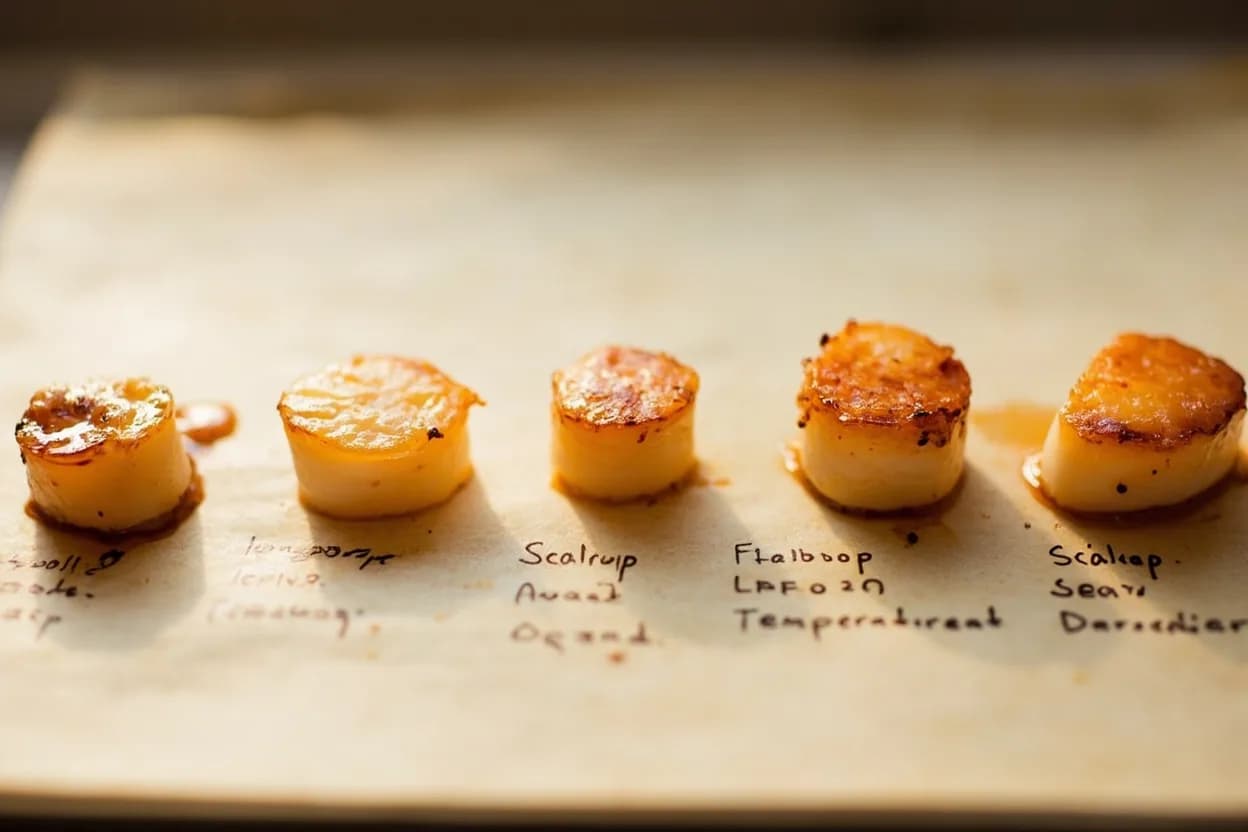
A perfectly seared scallop has a deep mahogany crust with an interior between 49–54°C (120–130°F) — warm, barely set, and slightly translucent at the very center, never rubbery.
Sea scallops are among the most demanding proteins to cook properly because the margin between ideal (warm, barely set, silky) and ruined (tough, chewy, bouncy) is a matter of 10–15°C and less than a minute. The ideal seared scallop achieves a deep Maillard-browned crust on both flat faces while the center remains soft and slightly translucent, hovering between 49–54°C (120–130°F). At this internal temperature the proteins have partially denatured (yielding firmness with silk), but the actin proteins have not yet fully contracted, so the cell structure still holds moisture. Above 60°C the scallop firms, moisture expels, and the texture becomes tough and resilient — the hallmark of overcooked scallop.
In photos


What happens
Scallop adductor muscle is composed primarily of actin and myosin proteins plus a high-moisture content (around 75–80% water). As heat is applied, myosin denatures first (~40–50°C), initiating firmness and opacity from the outside inward. The surface reaches Maillard-active temperatures (above 140°C) very rapidly in a hot pan, forming the crust. The target is to pull the scallop while the center is still in the 49–54°C window — still slightly translucent, with actin largely intact. Above 65°C, actin denatures fully and the scallop firms dramatically. The very high moisture content means overcooked scallops also steam in their own liquid, compounding the rubbery texture.
What to look for
- Exterior crust is deep golden-brown to mahogany, contrasting sharply with the pale sides of the scallop — a crust, not a tan
- The scallop releases cleanly from the pan with no sticking; forced early removal tears the crust
- When gently pressed with a fingertip, the center gives easily and feels slightly squishy, not springy or firm
- Cross-section shows a 3–5 mm opaque cooked band on each side with a translucent, barely-set white interior
- Interior is warm (not cold) when touched with a knife tip pressed against the lip
- No white liquid pooling in the pan — excess moisture indicates either wet-packed scallops or overcooking
How to check
- Press the side of the scallop gently while in the pan — it should feel soft and yielding at the center; when it firms even slightly, remove immediately
- Insert a thin cake tester or skewer through the equator of the scallop horizontally and press the tip to your lower lip: warm but not hot indicates ideal internal temperature
- Use an instant-read thermometer inserted horizontally into the thickest part of the equator, targeting 50–52°C (122–126°F)
- Watch the sides: when opacity has crept up each side to meet in the middle, the scallop is at the border — remove just before they meet
Food safety
Carryover & resting
Scallops carry over 3–5°C after leaving the heat, especially when pulled from a very hot pan. Remove them from the pan at 47–50°C and let them rest on a warm plate for 30–45 seconds to reach the ideal 50–54°C. Do not rest on a cold plate or the carryover will be insufficient.
The science behind it
The browning chemistry above ~140°C that creates the caramelized crust critical to the contrast with the soft interior
- Dry-packed vs. wet-packed scallops
Wet-packed scallops are treated with sodium tripolyphosphate (STP), absorbing water that steams off in the pan and prevents browning — dry-packed are essential for a proper sear
- Actin denaturation
Occurs above ~65°C in scallops and is the primary cause of rubbery overcooked texture
- Adductor muscle anatomy
The edible part of a sea scallop is the adductor muscle — a single cylindrical column of fast-twitch muscle fiber with high moisture content
- Pat dry before searing
Surface moisture must be eliminated completely before the scallop contacts the pan, or steaming will prevent crust formation
Appears in
References
- 1.The Food Lab — J. Kenji López-Alt
- 2.On Food and Cooking — Harold McGee
- 3.Modernist Cuisine: The Art and Science of Cooking — Nathan Myhrvold et al.
- 4.The French Laundry Cookbook — Thomas Keller
- 5.FDA Retail Food Protection: Fish and Seafood Safety
Confidence: high
Notes
Dry-packed scallops are non-negotiable for a sear
Wet-packed scallops are treated with sodium tripolyphosphate (STP), a preservative that causes the scallop to absorb water — often adding 20–30% to its weight. This excess moisture steams off in the pan, dramatically lowering the surface temperature and preventing Maillard browning. The result is a grey, steamed scallop with no crust. Dry-packed scallops are sold without additives, often labeled 'chemical-free' or 'dry.' They are more expensive but the only option for a proper crust.
Pan choice and temperature
A heavy cast iron or stainless steel pan heated to very high temperature (add oil just as it begins to smoke) is essential. Non-stick pans do not reach the surface temperatures needed for true Maillard browning. Place scallops in the pan flat-face down and do not touch them for 90 seconds to 2 minutes — premature movement tears the forming crust. Season just before pan contact to avoid drawing out moisture.
The side muscle
Fresh scallops often have a small, opaque, tough side muscle (the 'foot' or 'strap') attached to the equator — a different muscle than the adductor. It cooks unevenly and has a chewier texture. Pull it off before cooking: grip it between two fingers and tear sideways along the adductor. It takes 2 seconds and meaningfully improves the final texture.