Bread & Dough Doneness
Sourdough Bulk Fermentation Cues
Also: bulk proof cues, bulk fermentation doneness, first rise sourdough, bulk rise indicators
Sourdough bulk fermentation is complete when the dough has risen 50–75%, the surface is domed with visible bubbles, the texture is airy and jiggly, and the windowpane test shows strong, extensible gluten — timing is temperature-dependent.
Bulk fermentation (or 'first rise') is the extended fermentation phase after mixing and before shaping, during which wild yeast produces CO₂ (inflating the dough) and lactic acid bacteria generate organic acids (developing flavor and gluten extensibility). Unlike commercial yeast doughs where rise volume is the primary indicator, sourdough bulk fermentation is assessed by a combination of volume increase, surface texture, dough behavior, and the windowpane test — because starter strength, temperature, and hydration all affect the timeline dramatically. A correctly fermented dough is the foundation of good oven spring, open crumb, and complex flavor; under-fermented dough won't hold its shape or open well; over-fermented dough collapses, turns sticky, and produces a dense, acidic loaf.
In photos

What happens
Wild yeast (primarily Saccharomyces cerevisiae and Kazachstania humilis/Candida humilis) ferments maltose and glucose derived from enzymatic starch breakdown, producing CO₂ gas that inflates the gluten network. Simultaneously, Lactobacillus bacteria produce lactic acid (at warmer temperatures, producing a milder, yogurt-like flavor) and acetic acid (at cooler, longer fermentation, producing a sharper, vinegary tang). As fermentation progresses, gluten extensibility increases as organic acids relax cross-links (acidic pH weakens hydrogen bonds in the gluten network). The dough transitions from dense and tight to light, jiggly, and extensible. At 50–75% rise, the gluten has been conditioned without being over-relaxed to the point of structural failure. Above 100% rise, over-fermentation risks: the gluten network becomes over-acidified and loses its ability to hold gas, the dough becomes slack and sticky, and oven spring is severely compromised.
What to look for
- 50–75% volume increase from the original dough mass — a straight-sided container with a rubber band marker is the most precise way to track this
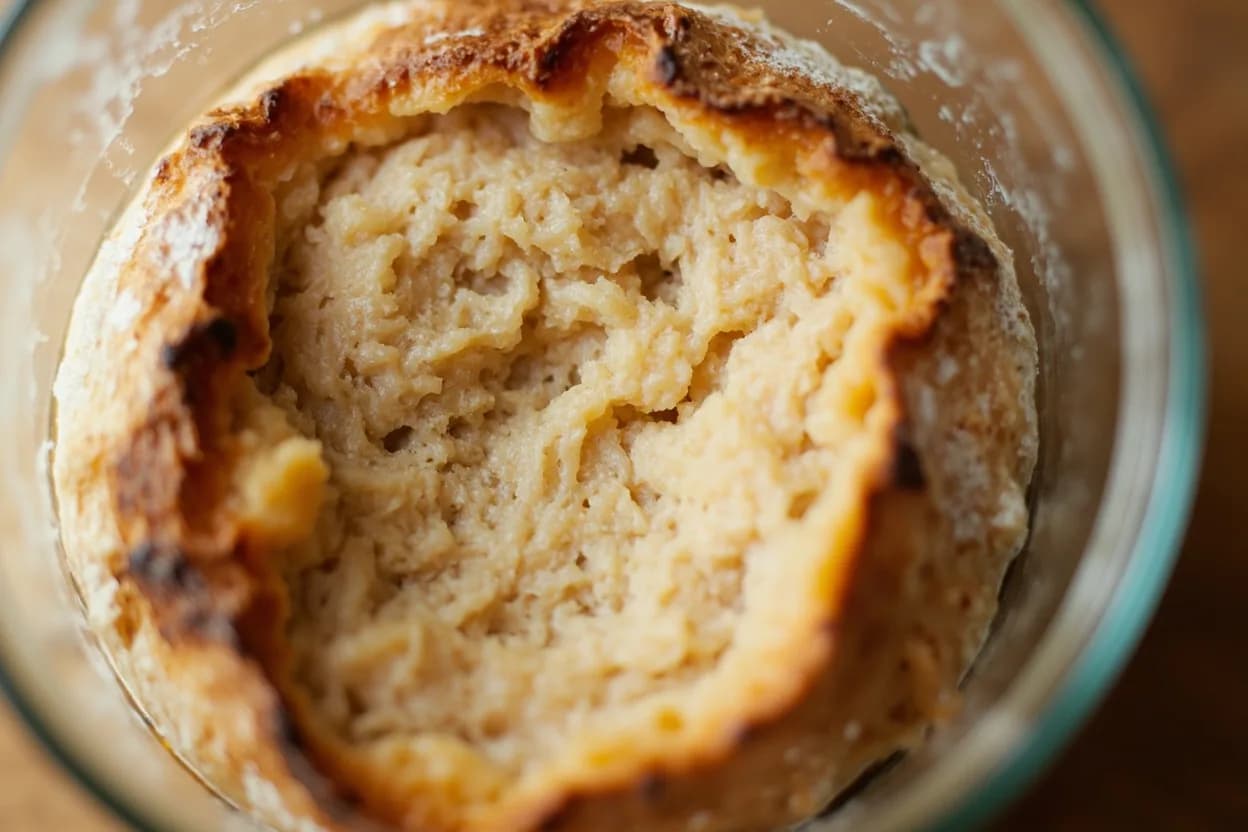
- Surface is domed, with a slight convex crown rather than flat or concave — a concave surface signals over-fermentation
- Visible bubbles on the surface (1–4mm) and on the sides of the container through the glass
- Dough jiggles like a set panna cotta when the container is gently shaken — airy internal structure
- Dough pulls away cleanly from the container sides and feels light, not dense or tacky
- Mild lactic aroma (yogurt-like) developing — sharp acetic smell suggests over-fermentation
How to check
- Mark the starting level with a rubber band or tape on a straight-sided container (dough-rise bucket or tall container) — volume tracking is far more reliable than time alone
- Windowpane test: take a small piece of dough, gently stretch it between your fingers — fully fermented dough stretches thin enough to be translucent without tearing, showing a strong, developed gluten network
- Poke test at the end of bulk: gently poke the surface with a floured finger — a properly fermented dough rebounds slowly and partially, not immediately (under) or not at all (over)
- Track dough temperature with a probe thermometer throughout bulk — a 2°C warmer environment halves the timeline; adjust bulk duration accordingly
- Fold frequency observation: after stretch-and-fold sets (typically 4 sets in the first 2 hours), the dough should increasingly resist folding and hold its shape, indicating gluten development
The science behind it
The definitive gluten development check; dough that passes (stretches thin without tearing) has developed sufficient gluten network for shaping
- Starter percentage (inoculation)
Higher starter % (20–30%) speeds bulk fermentation; lower % (5–10%) extends it to 10–16+ hours at room temperature — both are valid approaches with flavor trade-offs
- Dough temperature and Desired Dough Temperature (DDT)
Bakers calculate DDT to hit a target bulk duration; 24–26°C (75–79°F) is a standard target for a 4–6 hour bulk
- Stretch and fold
Series of gentle folds during bulk fermentation that build gluten network tension incrementally, replacing mechanical kneading in high-hydration sourdough
- Retarded proofing
Cold proofing after bulk fermentation; extends acid development and allows scheduling flexibility
Pre-fermentation rest that pre-develops gluten before bulk starts, compressing the early stages of bulk fermentation
Appears in
References
- 1.Tartine Bread — Chad Robertson
- 2.The Perfect Loaf — Maurizio Leo
- 3.Modernist Bread — Myhrvold & Migoya
- 4.The Sourdough School — Vanessa Kimbell
- 5.Bread Science — Emily Buehler
Confidence: high
Notes
Time is a guide, not a target
No sourdough recipe should specify 'bulk ferment for 4 hours' without also specifying a target dough temperature. A 4-hour bulk at 24°C produces a completely different fermentation outcome than a 4-hour bulk at 21°C. Professional bakers specify Desired Dough Temperature (DDT) and use it to calibrate water temperature at mixing, then track dough temperature throughout bulk. Home bakers using room temperature as a variable (seasonal kitchen temperatures, different starters) must learn to read the dough visually and tactilely rather than relying on a clock.
The 50–75% rule and why 100% is dangerous
Many bakers learn a '100% rise rule' (double in size) from commercial yeast bread recipes, where this reliably works. In sourdough, 100% rise is frequently over-fermentation — particularly at warmer temperatures or with strong starters — because the gluten network has been exposed to organic acids long enough to become over-relaxed. The 50–75% target was popularized by Tartine and has become the community standard for open-crumb sourdough. Dense, tight-crumb styles (like some German sourdoughs) may use lower inoculation and longer bulk with different volume targets.
Over-fermentation rescue
Over-fermented dough — sticky, slack, concave surface — can sometimes be rescued by shaping cold (refrigerate 15–30 minutes to firm slightly), using a stronger shaping technique, and baking immediately without a second proof. The loaf will be denser and more acidic but salvageable. Severely over-fermented dough (very strong alcohol smell, dough tears during folding) is best repurposed as a discard addition to pancakes or crackers.