Technique-Specific Doneness
Sous Vide Precision Temperature Reference
Also: sous vide doneness guide, water bath precision cooking, immersion circulator targets, time-temperature sous vide
Water bath precision of ±0.5°C means the set temperature is the exact final internal temperature — enabling doneness outcomes impossible with dry heat.
Sous vide cooking exploits the precision of a thermostatically controlled water bath (±0.1–0.5°C) to hold food at an exact target temperature indefinitely. Because food cannot exceed the bath temperature, the set point becomes the ceiling and the equilibrium internal temperature simultaneously. This fundamentally changes the doneness logic: a 54°C bath will produce a 54°C steak whether it cooks for 1 hour or 4 hours. Extended time beyond the minimum needed for pasteurization does not increase temperature — it affects texture through enzyme activity and collagen conversion. Different proteins (myosin, actin) and tissue types (muscle, collagen) have their own transformation thresholds, all exploitable at one-degree resolution.
In photos
What happens
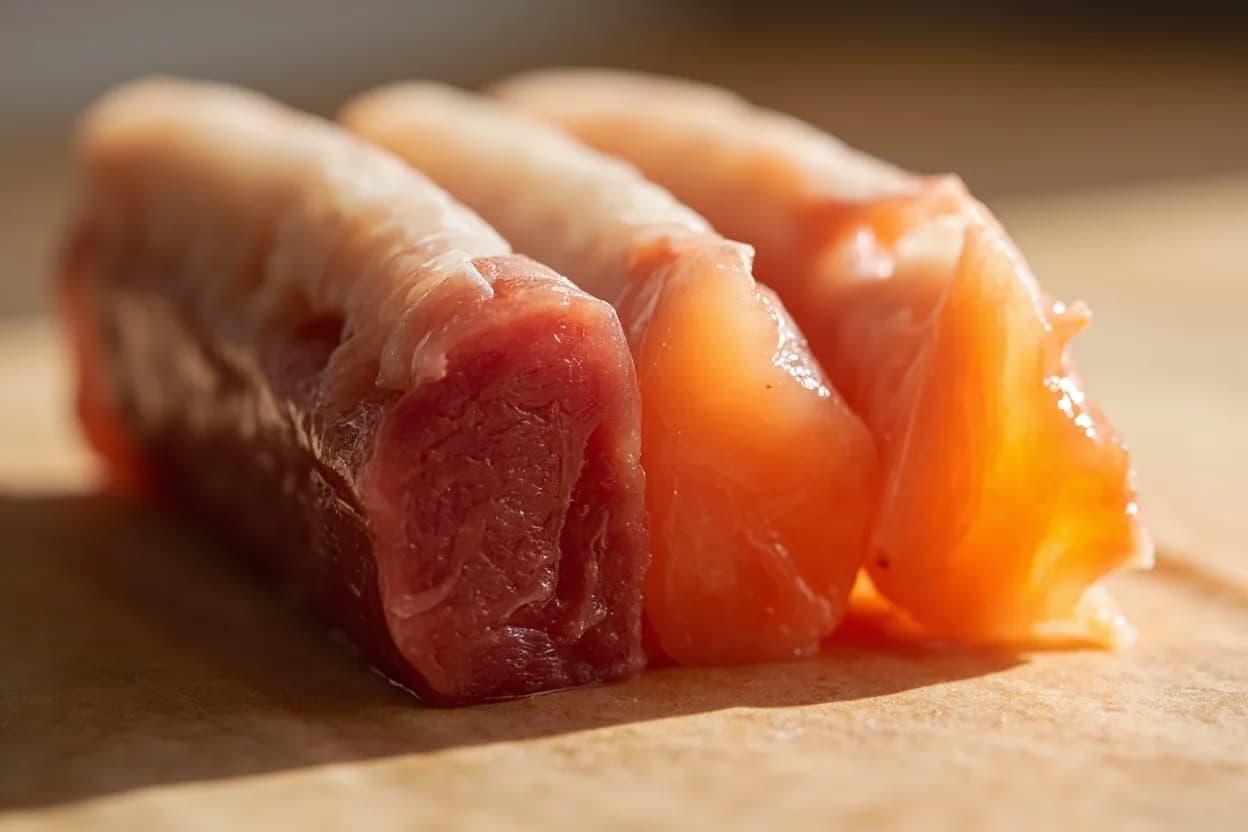
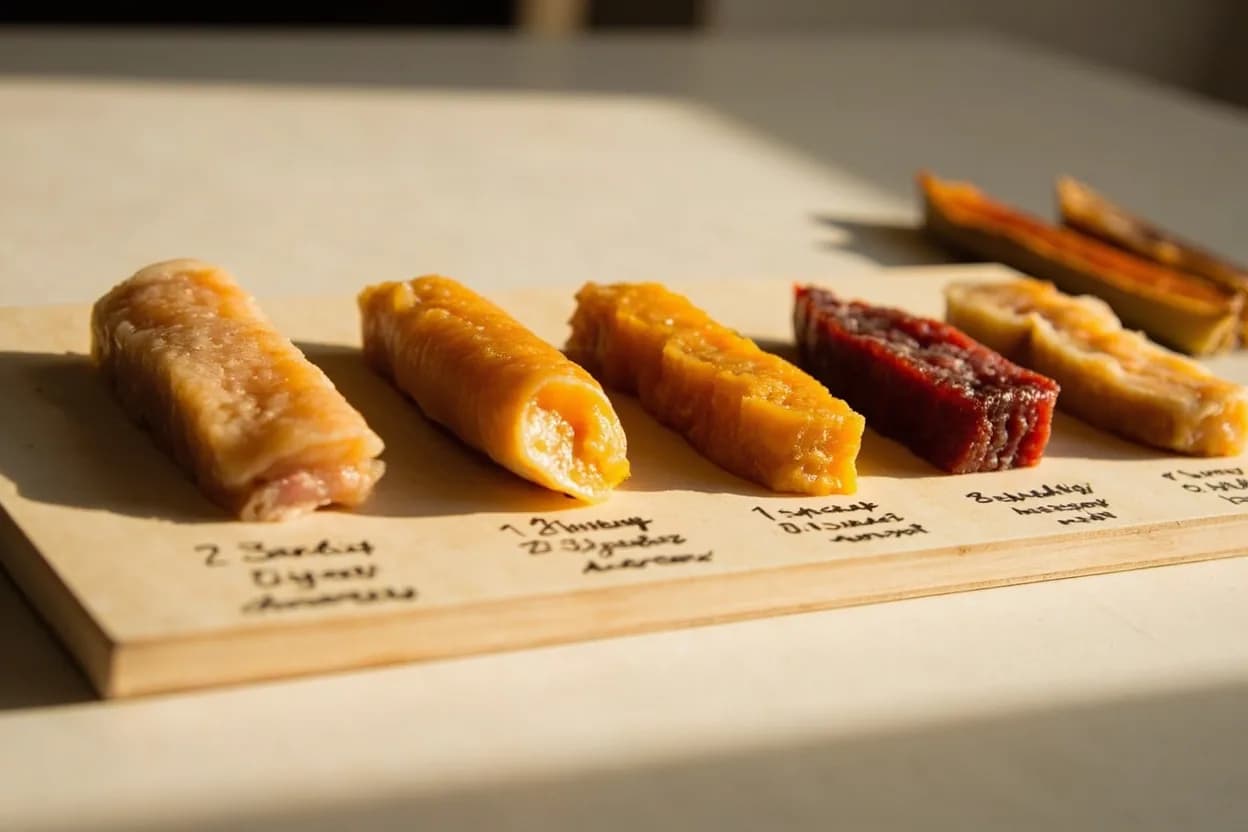
Muscle proteins denature in stages: myosin begins to firm around 50°C (122°F), actin around 65–67°C (149–153°F). Cooking between these two thresholds — the sous vide sweet spot for most red meat — produces firm but still very juicy results because actin, which holds the most water, has not contracted. Fish proteins are more delicate; salmon myosin begins denaturing near 38°C (100°F), with translucent, butter-textured flesh at 40–45°C (104–113°F) and fully opaque, flaky results at 55°C (131°F). Eggs present the most nuanced case: yolk and white proteins denature at different rates and temperatures (white ovalbumin sets at 80°C / 176°F, yolk lipoproteins at ~65°C / 149°F), enabling the 63°C egg with flowing yolk and just-set white. Vegetables benefit from the 83–85°C range (181–185°F) where pectin enzymes denature before softening, producing a firm-tender texture impossible to achieve with boiling.
What to look for
- Red meat at 54–57°C: deep pink throughout, velvety-soft with a slight resistance — uniformly medium-rare edge to edge
- Chicken breast at 60–63°C: white throughout with very slight translucency at center, extremely juicy — unlike the chalky result from traditional cooking
- Salmon at 45–50°C: translucent coral with a custard-like texture that flakes only gently under pressure
- Eggs at 63–65°C: white barely set and jiggly, yolk viscous and flowing like heavy cream
- Vegetables at 83–85°C: tender but with noticeable structural resistance — bends before breaking
How to check
- The bath temperature IS the final internal temperature; no thermometer needed for time-equilibrated food
- Confirm equilibration: thin items (2cm) equilibrate in 30–45 minutes; 4cm items need 1.5–2 hours
- For pasteurization, consult FDA time-temperature tables — holding time varies inversely with temperature (e.g. chicken safe at 60°C for 4 minutes, 63°C for 1 minute, 74°C instantly)
- Sear immediately after the bath and before serving; do not re-chill and re-sear as this affects moisture
- Ice-bath chill (0–1°C) immediately if not serving within 10 minutes — bag stays sealed until service
Food safety
Carryover & resting
Sous vide food exits the bath at its target temperature already. A brief high-heat sear (30–60 seconds per side in a cast-iron pan or with a torch) adds Maillard crust with minimal internal temperature rise (+1–2°C). Account for this: set the bath 1–2°C below the desired final eating temperature if a hard sear follows.
The science behind it
- Myosin and actin denaturation temperatures
The two principal contractile proteins in muscle, denaturing at different temperatures; sous vide exploits the gap between them
- Pasteurization by time-temperature
The basis for sous vide food safety; lower temperatures require proportionally longer holding times to achieve the same log reduction
- Maillard reaction at sear stage
High-heat surface browning applied post-bath; adds flavor crust without altering internal temperature significantly
Requires sustained temperatures above 70°C (158°F) for hours; sous vide can achieve this at 72–80°C for tough cuts over 24–48 hours
Minimal in sous vide compared to oven or grill; sear adds only 1–2°C at the surface
Appears in
References
- 1.Modernist Cuisine — Nathan Myhrvold, Chris Young & Maxime Bilet (The Cooking Lab, 2011)
- 2.Under Pressure: Cooking Sous Vide — Thomas Keller (Artisan, 2008)
- 3.Douglas Baldwin's Practical Guide to Sous Vide Cooking (online reference, 2010–2020)
- 4.USDA Time-Temperature Tables for Cooking Meat and Poultry Products (FSIS, 2017)
Confidence: high
Notes
Temperature Precision vs. Time Flexibility
The key insight of sous vide is that precision and flexibility trade places compared to traditional cooking. Temperature is fixed and exact; time is a range rather than a point. A steak at 54°C can hold for 30 minutes to 4 hours with little change in doneness — overcooking via temperature is impossible, while overcooking via excessive time produces texture degradation (muscle fibers weaken and become mushy). Most proteins have a safe window of 1–4× the minimum cook time before quality declines.
Protein-Specific Temperature Reference
Quick reference: beef/lamb/pork (medium-rare) 54–57°C; pork (medium) 60–63°C; chicken breast 60–65°C; duck breast 57–60°C; salmon 45–52°C; halibut 50–55°C; lobster 55–60°C; eggs (silky whole) 63°C; eggs (onsen) 65°C; vegetables 83–85°C; fruit (poached) 65–70°C. These are starting benchmarks; personal preference and specific cuts shift the target.