Fish & Seafood Doneness
Steamed Fish Eye-White Doneness
Also: fish eye indicator, whole fish doneness, Cantonese steamed fish doneness, 清蒸鱼火候
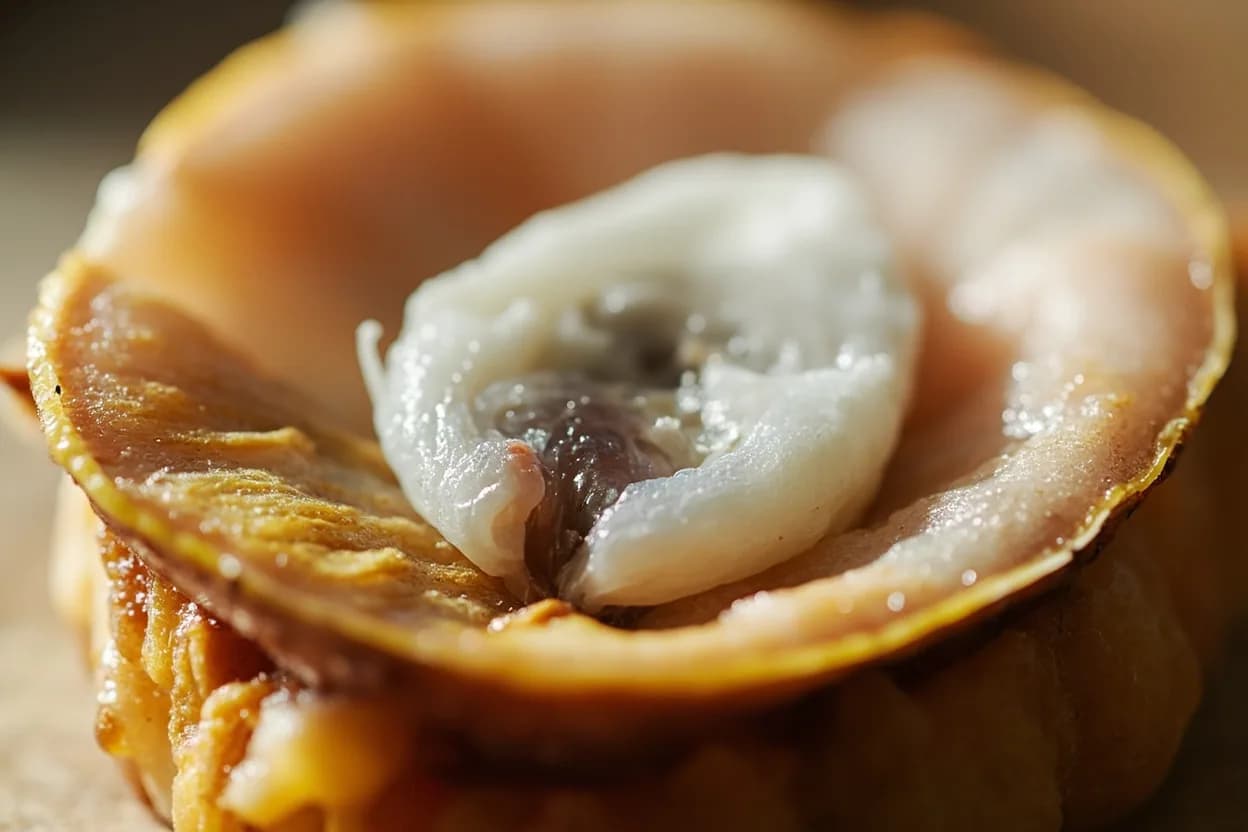
When the eye of a whole steamed fish turns opaque white and begins to bulge outward, the flesh throughout the body has reached doneness — a centuries-old Cantonese visual cue requiring no thermometer.
In Cantonese whole-fish steaming, the eye is the most reliable visual doneness indicator because the proteins of the eye's vitreous body and lens denature at nearly the same temperature as the thickest part of the fish's flesh. A live or freshly killed fish has a clear, dome-shaped eye. As internal temperature climbs through 60–65°C, the ocular proteins coagulate and the eye turns white (opaque) and protrudes slightly from the socket. Because heat penetrates the relatively thin skull and eye socket faster than through thick dorsal muscle, the eye-white transition happens a brief moment before the thickest flesh just above the spine reaches doneness — making it a practical leading indicator that the fish is done or within moments of being done.
In photos


What happens
The fish eye contains a crystalline lens surrounded by the vitreous humor, both rich in transparent structural proteins (crystallins in the lens; collagen-based proteins in the vitreous). These proteins denature and aggregate between 60°C and 65°C, transforming optically clear tissue into opaque white coagulated protein — the same mechanism as egg white turning white during cooking. Simultaneously, the aqueous humor inside the eye expands with heat, and the loss of structural integrity in surrounding orbital tissue allows the eye to push outward. The fish's dorsal musculature, being of similar protein composition (myosin and actin), undergoes the same thermal denaturation at essentially the same temperature. The thin bone and small air spaces around the eye accelerate heat transfer there, making the eye a real-time proxy for internal flesh temperature.
What to look for
- Eye turns from clear or cloudy-grey to fully opaque bright white, with no translucent center remaining
- Eye visibly bulges outward from the orbit — a protruding, rounded dome rather than a flat or sunken profile
- Dorsal fin feathers at the base detach cleanly when tugged with chopsticks or fingers
- Flesh separates from the lateral line bone when probed with a chopstick or bamboo skewer along the back
- Skin has tightened and may show slight splitting at the thickest point behind the gills
How to check
- Eye observation: look for full opacity (white throughout, no grey translucent patch at center) plus outward bulge — both must be present
- Chopstick probe: insert a bamboo chopstick or skewer perpendicular to the spine at the thickest dorsal point; it should pass through flesh with little resistance and emerge without clear liquid
- Fin-pull test: grasp the dorsal fin and pull firmly; if the fin bones pull free cleanly, the flesh is cooked through
- Thermometer (secondary confirmation): insert an instant-read probe through the gill slit to the thickest point above the spine; target 63°C (145°F) per USDA guidance, though many Cantonese cooks prefer 60–62°C for a more supple texture
- Steam timing guide: a 600g (1.3 lb) fish steams in 8–10 minutes; a 1 kg (2.2 lb) fish in 12–14 minutes over vigorously boiling water — use eye-white as the final check
Food safety
The science behind it
- Myosin denaturation in fish
Fish myosin denatures between 40–50°C; actin at 65–70°C. The desirable Cantonese texture catches the fish between these points — myosin set, actin still intact
- Velveting technique
Cantonese cooking often marinates fish in egg white and cornstarch before steaming to protect delicate surface proteins from rapid heat
- Ginger-scallion oil finish
Hot oil (180–200°C) is poured over scallion and ginger on the cooked fish at service — a Cantonese technique that finishes aromatics, not the fish
- Whole fish presentation (游水鱼)
Live fish (游水, 'swimming fish') steamed within minutes of dispatch has the clearest eyes initially, making the eye-white transition the most dramatic and reliable
- Rigor mortis and fish freshness
Pre-rigor fish flesh is more translucent and cooks more evenly; a fish killed days earlier may have already-dulled eyes, making the white-eye cue less stark but still valid
Appears in
References
- 1.The Complete Asian Cookbook — Charmaine Solomon (Tuttle, 2011)
- 2.Every Grain of Rice — Fuchsia Dunlop (Bloomsbury, 2012)
- 3.Land of Fish and Rice: Recipes from the Culinary Heart of China — Fuchsia Dunlop (Norton, 2016)
- 4.On Food and Cooking — Harold McGee (Scribner, 2004)
- 5.The Food of China — E.N. Anderson (Yale University Press, 1988)
Confidence: high
Notes
Why this cue works across species
The eye-white indicator holds for virtually all bony fish (teleosts) because ocular crystallin proteins and fish muscle proteins share similar denaturation temperatures. It is less reliable for cartilaginous fish (sharks, rays) or for very thin flat fish such as sole or flounder, where the flesh cooks through before the eye develops a visible reaction.
The steamer setup matters
Cantonese steaming requires vigorously boiling water and a tightly sealed steamer — insufficient steam pressure extends cooking time and risks uneven heat penetration. The fish is elevated on a heatproof plate with space for steam circulation beneath. Wok lids should be slightly ajar for large fish to prevent condensation dripping onto the flesh and diluting the cooking juices.
Cultural significance
In Cantonese cuisine, whole fish is one of the most demanding tests of a cook's timing. Restaurant chefs at traditional seafood restaurants (海鲜酒家) take pride in delivering fish at the exact moment the eye whites — not a second over. The dish is a hospitality marker at banquets; overcooked whole fish at a formal table is considered a significant failure of craft.