Sugar & Candy Stages
Sugar: Firm Ball Stage
Also: firm ball, caramel stage, nougat stage
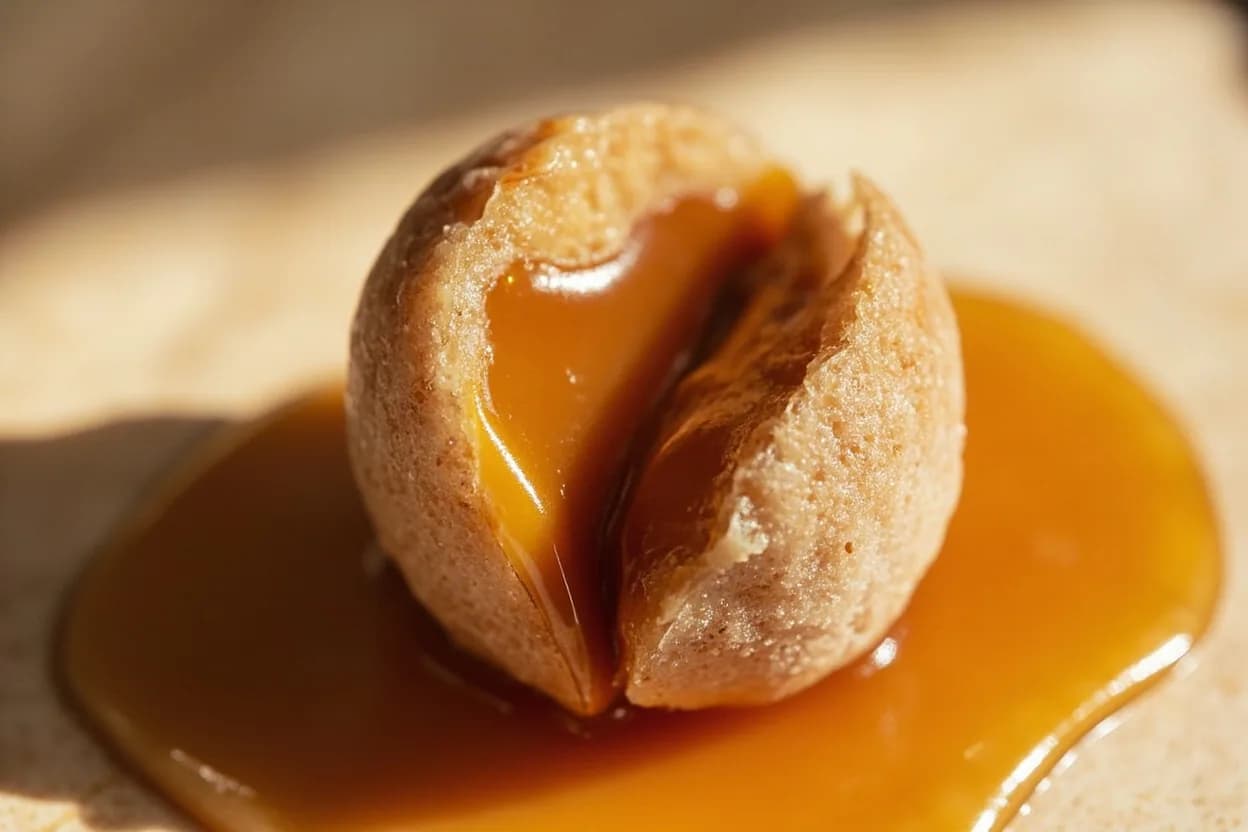
Cooked sugar at 119–121°C (246–250°F) that forms a firm but pliable ball in cold water — the stage for chewy caramels and nougat.
The firm ball stage is reached when a sugar syrup has been concentrated to the point that a small amount dropped into ice-cold water can be shaped into a ball that holds its form firmly but can still be deformed with persistent finger pressure. The lower water content compared with the soft ball stage produces confections with a distinctly chewier, denser texture. Caramels and many nougats target this range precisely because the candy sets firm enough to cut cleanly yet remains tender to bite.
In photos

What happens
At 119–121°C the syrup has lost enough water (roughly 12–14% moisture remains) that the dissolved sugar network becomes considerably stiffer on cooling. In caramel production, additional Maillard and caramelization reactions at these temperatures deepen colour and develop complex butterscotch, nutty, and dairy-lactone flavours when milk solids or cream are present. The tighter sugar network gives the finished candy a pronounced chew that resists deformation but ultimately yields.
What to look for
- A ball formed in ice water holds its shape in the hand but can be dented with firm thumb pressure and does not spring back
- The syrup forms a thick, slow ribbon falling from a spoon that does not break into drops
- Bubbles on the pan surface are small and dense, and the syrup has noticeably deepened in colour if making caramel
- The mass feels plastically deformable — like cold, stiff clay — not springy and not brittle
How to check
- Clip a calibrated candy or digital probe thermometer to the saucepan with the bulb submerged below the syrup surface but not touching the base
- Cold-water test: drop 1/2 tsp of syrup into ice water, gather after 10 seconds — the ball should be firm enough to hold its shape without flattening on its own, yet deform when squeezed hard
- For accuracy, confirm with an instant-read digital thermometer plunged directly into the syrup
- Adjust target temperature for altitude: subtract approximately 0.5°C per 150 m above sea level
The science behind it
- Soft Ball Stage
The preceding stage (113–116°C), used for fudge and fondant; produces a squashable, instantly flattening ball
- Hard Ball Stage
The next stage (121–130°C), yielding rigid, hold-shape balls; used for Italian meringue syrup and divinity
Protein–sugar browning reactions intensify in caramel batches at this temperature range when dairy is present
Thermal degradation of sucrose begins in earnest just above this range, adding colour and bittersweet complexity
- Invert Sugar
Corn syrup or glucose syrup added to caramel formulas prevents graining and controls texture
Appears in
References
- 1.On Food and Cooking — Harold McGee (2nd ed., 2004)
- 2.Chocolates and Confections — Peter Greweling (2nd ed., 2012)
- 3.The Art of the Chocolatier — Ewald Notter (2011)
- 4.How Baking Works — Paula Figoni (3rd ed., 2010)
Confidence: high
Notes
Caramel Formulation
Most commercial and artisan soft caramels are pulled at 118–121°C, then combined with cream, butter, and often corn syrup. The dairy proteins and fats physically interrupt the sugar network, softening the final bite. Pulling the pan a degree or two early and allowing carryover rise from residual heat is common practice. Caramels cooked to the lower end of the firm ball stage (118–119°C) slice cleanly at room temperature; those at the top edge (121°C) may need brief warming.
Italian Meringue Overlap
Italian meringue recipes vary: many specify 118–121°C (overlapping the top of the soft ball and bottom of the firm ball range). The exact temperature determines stiffness and stability of the meringue; 121°C produces a very stable, glossy foam that pipes with sharp definition and holds for hours.