Charcuterie & Terrines
Stock Gelatin Set Test
Also: spoon gel test, stock wobble test, gelatin richness test, napping test
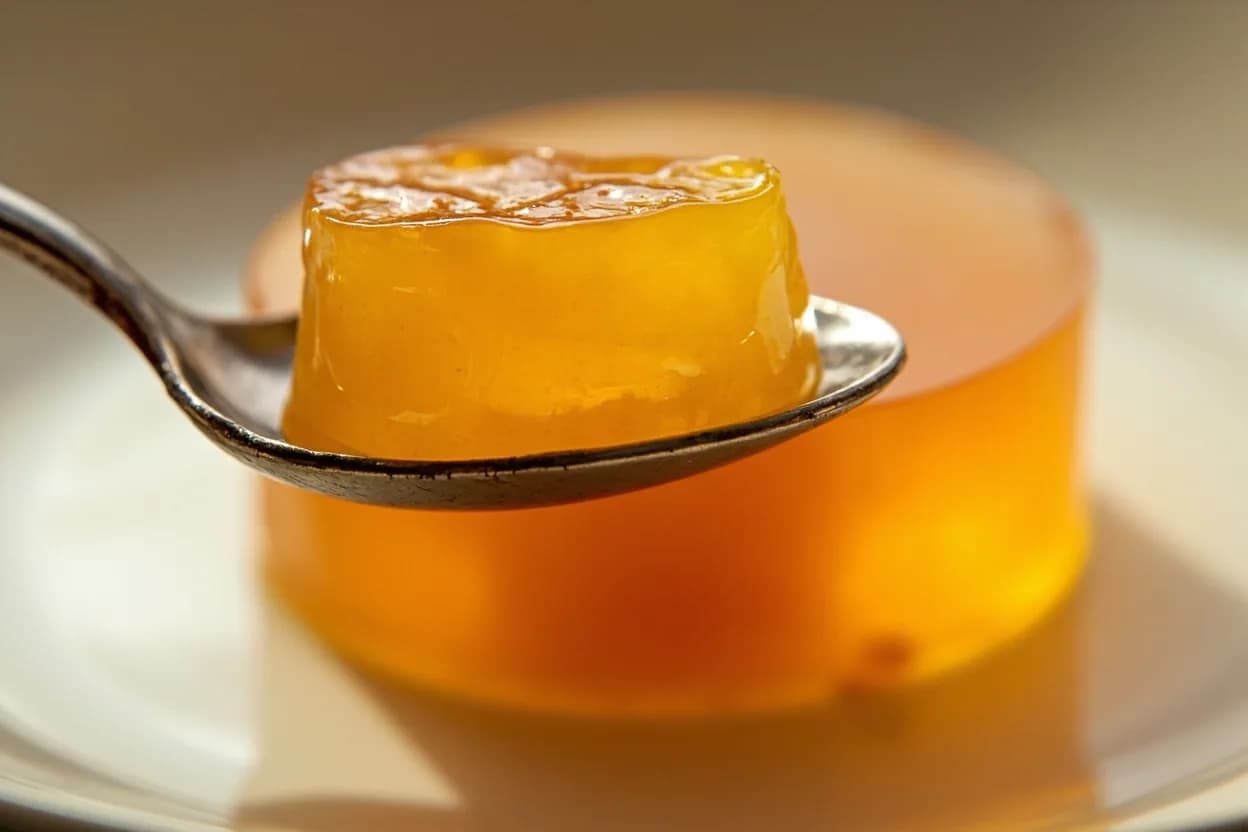
Chill a spoonful of reduced stock on a cold plate — if it sets to a trembling, lightly adhesive gel, collagen extraction is sufficient for sauces, terrines, and aspic.
The stock gelatin set test is a practical doneness check used to verify that long-cooked bones, joints, trotters, or fish frames have released enough collagen — converted to gelatin — to give a finished stock its characteristic body, mouth-coat, and gelling power. It is not a thermometer check but a chilling test: a small amount of stock is chilled rapidly and observed for gel formation, firmness, and adhesion. A properly gelatinous stock is the foundation of classical French sauces (glace de viande, demi-glace), terrines, aspics, and braises whose reduced braising liquid coats the meat and garnish.
In photos

What happens
During stock-making, prolonged simmering (4–8 hours for chicken and veal, 8–12 hours for beef) extracts collagen from connective tissue — cartilage, tendons, skin, and marrow bones. At simmering temperature (around 85–95°C), collagen hydrolyses into gelatin. Upon chilling below ~25°C, the gelatin strands begin to hydrogen-bond and recoil into helical structures. Below 15°C a continuous gel network forms. The firmness of the set gel reflects gelatin concentration: a light stock may barely coat a spoon; a concentrated fonds de veau lié or glace de viande will set to a stiff, bouncy gel at room temperature. Reduction concentrates the gelatin, intensifying flavour and increasing gel strength.
What to look for
- Chilled spoonful on a cold plate sets to a clear, quivering gel that peels away from the plate — good gel
- Lifted between fingers, the gel feels tacky and slightly elastic — a sign of sufficient gelatin
- A light finger-press leaves an indent that slowly springs back — medium gel, suitable for sauces
- Gel does not melt immediately when touched — indicates good concentration
- Stock that stays completely liquid after chilling test has insufficient gelatin; reduce further or add trotters/feet
How to check
- Spoon test: place a metal spoon dipped in hot stock into the freezer for 3–4 minutes; inspect for gel formation and assess firmness
- Plate test: pour 1–2 tablespoons onto a cold plate, refrigerate 5 minutes; tilt plate — set gel does not flow
- Finger-press: press a chilled gel sample between thumb and forefinger; it should feel sticky and elastic, not watery
- Wobble test: pour a small amount into a ramekin and refrigerate; a properly gelatinous stock sets to a firm wobble like pannacotta
- Visual check when cold: a good veal or chicken stock looks like firm jello in the pot after overnight refrigeration — a spoon stands in it
The science behind it
Thermal hydrolysis of collagen at simmering temperature is the underlying chemistry the set test evaluates
Stock reduced by 80–90% until syrupy; a tablespoon gels firmly at room temperature
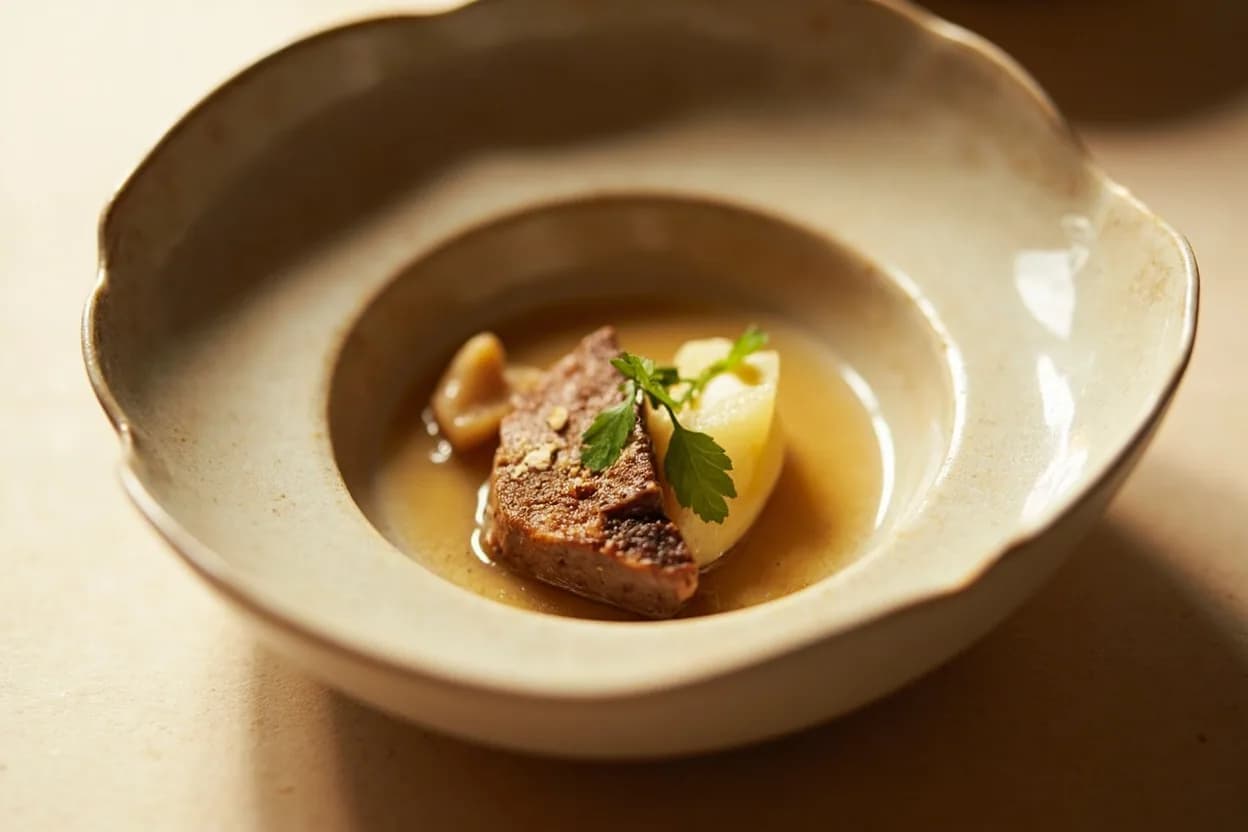
Half-glaze sauce built on espagnole + veal stock; its quality depends entirely on gelatin content of the stock
Clarified gelatinous stock chilled to a firm gel — the set test determines if the stock is strong enough without added gelatin
- Bloom strength
Intrinsic gelatin concentration in stock behaves like gelatin Bloom — higher concentration = firmer set
- Stock reduction
Reducing stock by half roughly doubles gelatin concentration and gel firmness
Appears in
References
- 1.Escoffier, Auguste — Le Guide Culinaire (1903; trans. Cracknell & Kaufmann, 2011)
- 2.McGee, Harold — On Food and Cooking: The Science and Lore of the Kitchen (revised ed., 2004)
- 3.Peterson, James — Sauces: Classical and Contemporary Sauce Making (3rd ed., 2008)
- 4.Keller, Thomas — The French Laundry Cookbook (1999)
Confidence: high
Notes
Reading gel firmness
There are three practical grades of stock gel: a soft set (barely holds shape, suitable for light consommé or a light chicken sauce), a medium set (firm enough to coat a spoon and quiver when unmoulded, ideal for braising sauces and pan sauces), and a hard set (stands firmly at room temperature — this is glace territory, used for fortifying sauces or glazing meats). The cook's art is in knowing which grade a given application requires and reducing or supplementing accordingly.
When to add bought gelatin
If a stock does not pass the set test after reasonable reduction, adding sheet gelatin (2–4 sheets per litre, bloomed in cold water) is acceptable for home cooks making aspic or headcheese. However, for classical French sauces and braises the preference is always natural gelatin from better-quality or more collagen-rich raw material — calf's feet, chicken backs and wings, veal knuckles — because the natural gelatin also contributes flavour compounds that sheet gelatin lacks.
Fish stock caveat
Fish fumet must not be simmered more than 20–25 minutes or it turns bitter (ichthyocolla — fish gelatin — is abundant in fish bones and skin and extracts quickly). The set test for fish stock should show a loose, lightly adhesive gel — not the bouncy firmness of a good veal stock. Fish aspic often requires a small supplement of sheet gelatin to achieve a sliceable set without over-simmering.