Sugar & Candy Stages
Sugar: Hard Ball Stage
Also: hard ball, divinity stage, rock candy stage
Cooked sugar at 121–130°C (250–265°F) that forms a rigid, hold-shape ball in cold water — used for divinity, marshmallow syrup, and Italian meringue.
The hard ball stage spans 121–130°C (250–265°F) and is defined by a cold-water test in which the syrup solidifies into a ball firm enough to hold its shape unaided, yet still capable of being dented or deformed with strong finger pressure. The moisture content has dropped to approximately 8–12%. Confections made at this stage are noticeably stiffer and more resilient than caramels, with a texture that resists chewing before ultimately yielding.
In photos
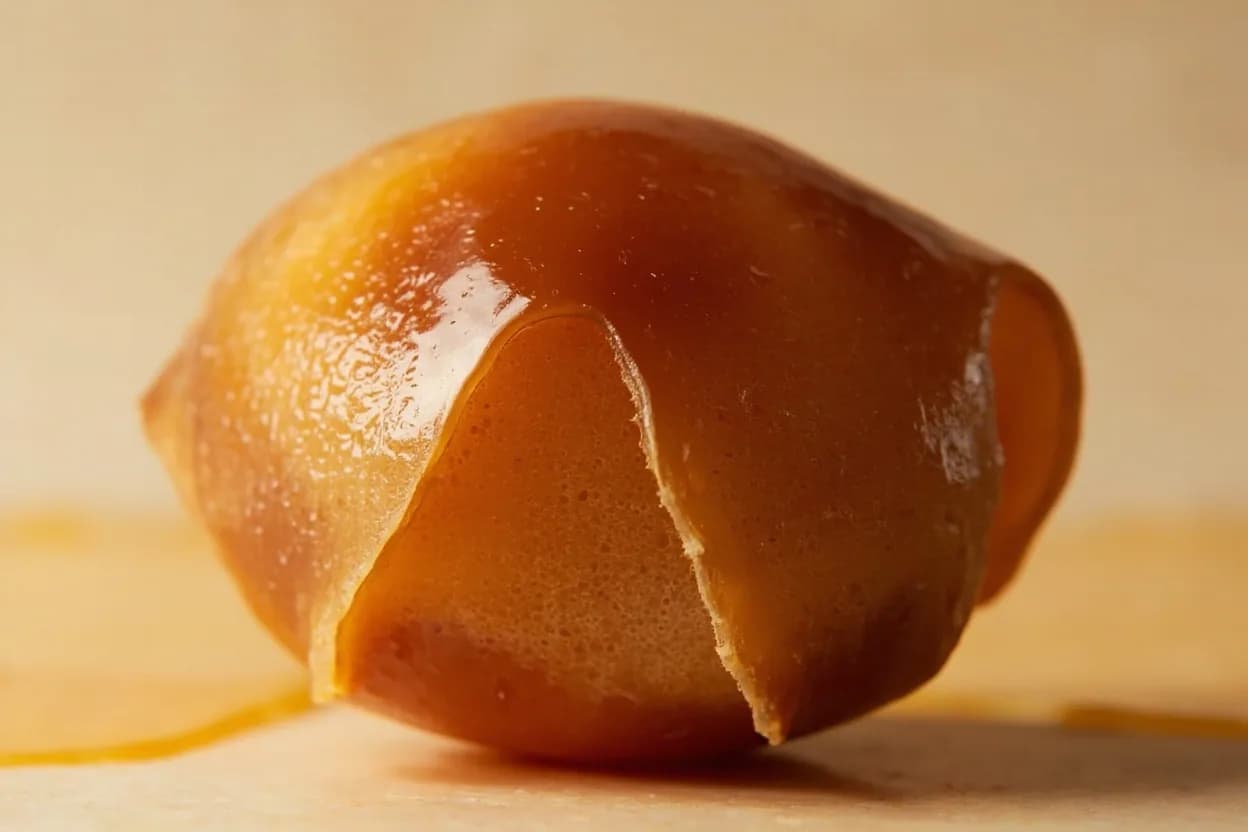


What happens
Further water evaporation at this stage tightens the sugar network substantially. The viscosity of the hot syrup is high enough that it requires strong agitation to incorporate air (as in divinity and marshmallow). At the lower end (121°C) the syrup is used for Italian meringue where it is poured in a thin stream onto whipping egg whites, partially cooking them while creating an ultra-stable foam. At the upper end (130°C) the resulting candy is stiff and chewy bordering on hard. Caramelization and Maillard reactions begin to contribute perceptible colour and flavour above ~125°C.
What to look for
- Ball formed in ice water holds its shape completely when removed and does not slump or flatten under its own weight
- The ball can be dented with determined thumb pressure but does not deform easily — springier and more resistant than a firm-ball caramel
- Hot syrup pulls in long, thick threads from a spoon and is clearly more viscous than at lower stages
- Colour begins to shift to a very pale gold at the top of this range
How to check
- Use a digital instant-read or probe thermometer clipped to the pan; read at the centre of the syrup mass, away from the sides
- Cold-water test: drop 1/2 tsp syrup into ice water, let solidify 10–15 seconds — ball should hold shape on the countertop unaided yet not shatter when struck
- The distinction between firm ball and hard ball is subtle in the cold-water test; rely primarily on the thermometer
- Stir the thermometer gently before reading to avoid hot-spot error from the pan base
The science behind it
- Firm Ball Stage
The preceding stage (119–121°C); produces chewy caramels and nougats
- Soft Crack Stage
The next stage (132–143°C); threads bend and stick rather than forming a ball
- Italian Meringue
Classic recipe targets 121°C (the bottom of the hard ball range) for maximum foam stability
- Marshmallow
Gelatin-set confection made with syrup at 127–130°C poured onto bloomed gelatin and whipped
- Supersaturation
The syrup is highly supersaturated at this point, making it critical to avoid crystallisation triggers such as stirring or seeding
Appears in
References
- 1.On Food and Cooking — Harold McGee (2nd ed., 2004)
- 2.Chocolates and Confections — Peter Greweling (2nd ed., 2012)
- 3.The Professional Pastry Chef — Bo Friberg (4th ed., 2002)
- 4.Modernist Cuisine at Home — Myhrvold & Bilet (2012)
Confidence: high
Notes
Italian Meringue Precision
Most professional recipes specify 121°C for Italian meringue syrup — precisely at the boundary between firm and hard ball. The egg-white foam is still whipping when the syrup stream begins; pouring too early (soft ball range) yields an unstable meringue prone to weeping, while syrup above 130°C can seize around the whisk or scorch if the bowl contacts the stream. The 3–4 degree window is why a reliable thermometer is non-negotiable for this preparation.
Divinity and Humidity
Divinity — a Southern U.S. cloud-like confection of corn syrup, egg whites, and sugar — is particularly sensitive to ambient humidity. The sugar syrup must reach the firm-to-hard ball range (127–130°C) and be beaten into stiff egg whites in dry conditions; on humid days above about 60% RH the candy may never set properly regardless of temperature.