Sugar & Candy Stages
Sugar: Soft Crack Stage
Also: soft crack, toffee stage, butterscotch stage
Cooked sugar at 132–143°C (270–290°F) that forms threads in cold water that bend and stick rather than snap — the zone for toffee and butterscotch.
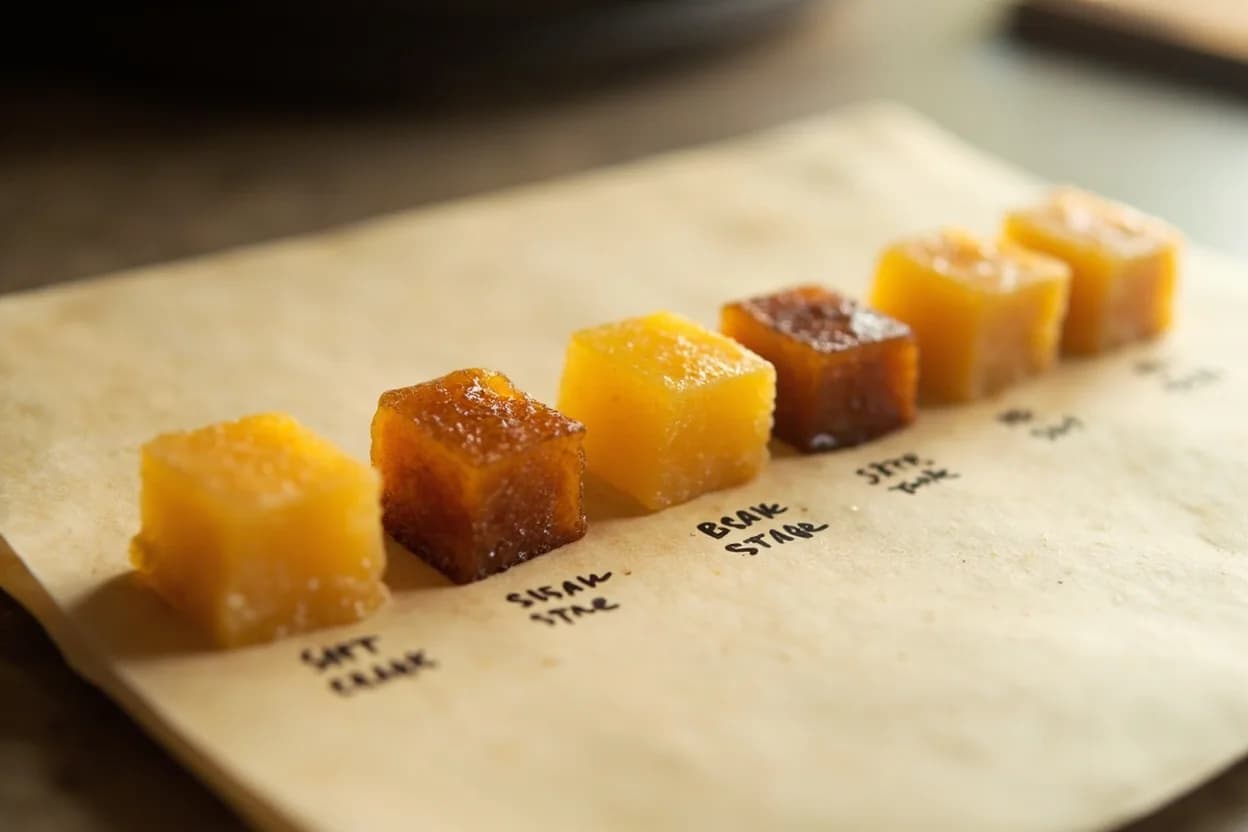
The soft crack stage spans 132–143°C (270–290°F), where the sugar syrup has become so concentrated (roughly 5–8% residual water) that threads pulled from cold water are pliable and bend without fracturing, yet remain firm and slightly sticky. The cold-water test no longer yields a ball; instead, the syrup solidifies into distinct, bendable threads or sheets. Confections made here are chewy-to-brittle at the lower end and firm-brittle approaching the hard crack threshold, with a characteristic toffee-like resilience.
In photos

What happens
At these temperatures caramelization of sucrose accelerates markedly, generating dozens of aromatic degradation products — diacetyl, furanones, lactones, and maltol — that deliver the characteristic butterscotch and toffee aromas. Maillard browning with any milk proteins also deepens at this range. The minimal residual water content means the sugar network will form a glassy, amorphous solid on cooling that is rigid but not yet fully crystalline-brittle. Pulling or working the sugar at this stage can introduce air and opacity (as in old-fashioned pulled toffee).
What to look for
- Threads pulled in ice water are firm, hold their shape, bend without snapping, and feel slightly sticky between the fingers
- The syrup has a pronounced golden-amber colour and releases rich butterscotch and caramel aromas
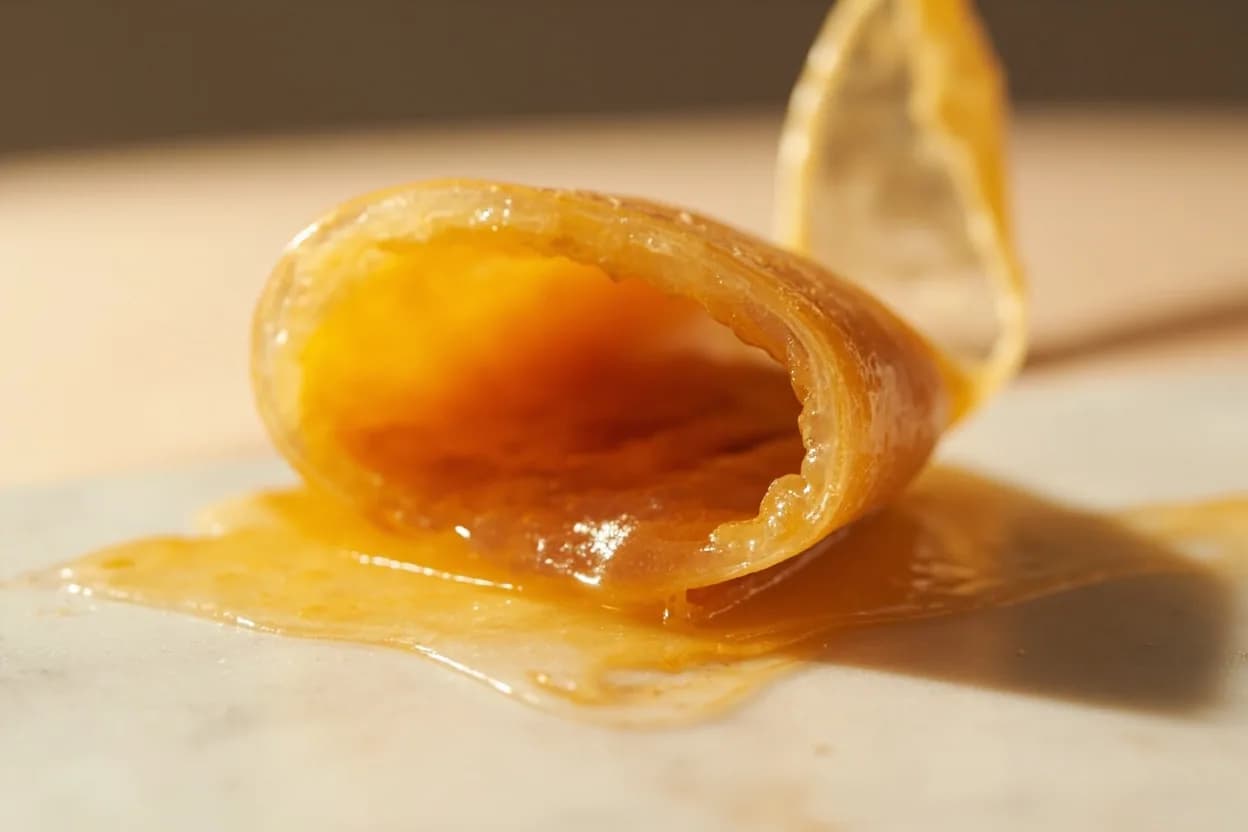
- A drop on a cold marble slab spreads minimally and sets to a firm, bendable sheet within seconds
- The hot syrup flows slowly and pulls into long, thin threads that hold their form rather than balling
How to check
- Use a calibrated candy or digital probe thermometer — the soft crack range is wide (11°C) so pinpoint temperature within the range based on desired firmness
- Cold-water test: drop 1/2 tsp syrup into ice water; threads should be pliable, bending without breaking and remaining tacky when pressed
- Distinguish from hard crack by the bend-not-snap characteristic — threads pulled at hard crack will fracture cleanly with a click
- Watch the colour: the upper end of soft crack approaches deep amber; pull before the syrup over-caramelizes into bitterness
The science behind it
- Hard Ball Stage
The preceding stage (121–130°C); yields firm but deformable balls, used for divinity and marshmallow
- Hard Crack Stage
The next stage (149–154°C); threads snap cleanly; used for lollipops and brittles
Accelerates through the soft crack range, delivering toffee and butterscotch flavour compounds
- Pulled Sugar
Working the hot mass at soft crack temperatures introduces air, creating the opaque sheen of traditional pulled toffee
- Glucose Syrup
Added to toffee and butterscotch formulas to retard crystallization and control texture through this range
Appears in
References
- 1.On Food and Cooking — Harold McGee (2nd ed., 2004)
- 2.Chocolates and Confections — Peter Greweling (2nd ed., 2012)
- 3.The Professional Pastry Chef — Bo Friberg (4th ed., 2002)
- 4.How Baking Works — Paula Figoni (3rd ed., 2010)
Confidence: high
Notes
Toffee vs. Butterscotch
Toffee and butterscotch both live in the soft crack zone but differ in butter content and cooking method. Butterscotch (originally a Scottish confection of brown sugar, butter, and sometimes cream) is typically pulled at the lower end of soft crack (132–138°C) and eaten as a chewy candy. English toffee is cooked higher (138–143°C), sometimes with almonds, and is firmer and more brittle — edging toward hard crack. The temperature difference of even 5°C produces a noticeably different bite.
Pulling and Texture
Traditional pulled toffee and taffy exploit the plasticity of sugar in the soft crack zone. As the mass is repeatedly stretched and folded over hooks, millions of tiny air bubbles are incorporated, turning the glassy amber mass opaque and ivory-coloured. This dramatically changes the mouthfeel — the aerated structure melts and softens on the tongue instead of fracturing like a hard candy. Temperature management during pulling (keeping the mass warm enough to work but cool enough not to flow) is the critical skill.