Sugar & Candy Stages
Sugar: Thread Stage
Also: thread stage, filo stage, soft thread, sugar syrup thread
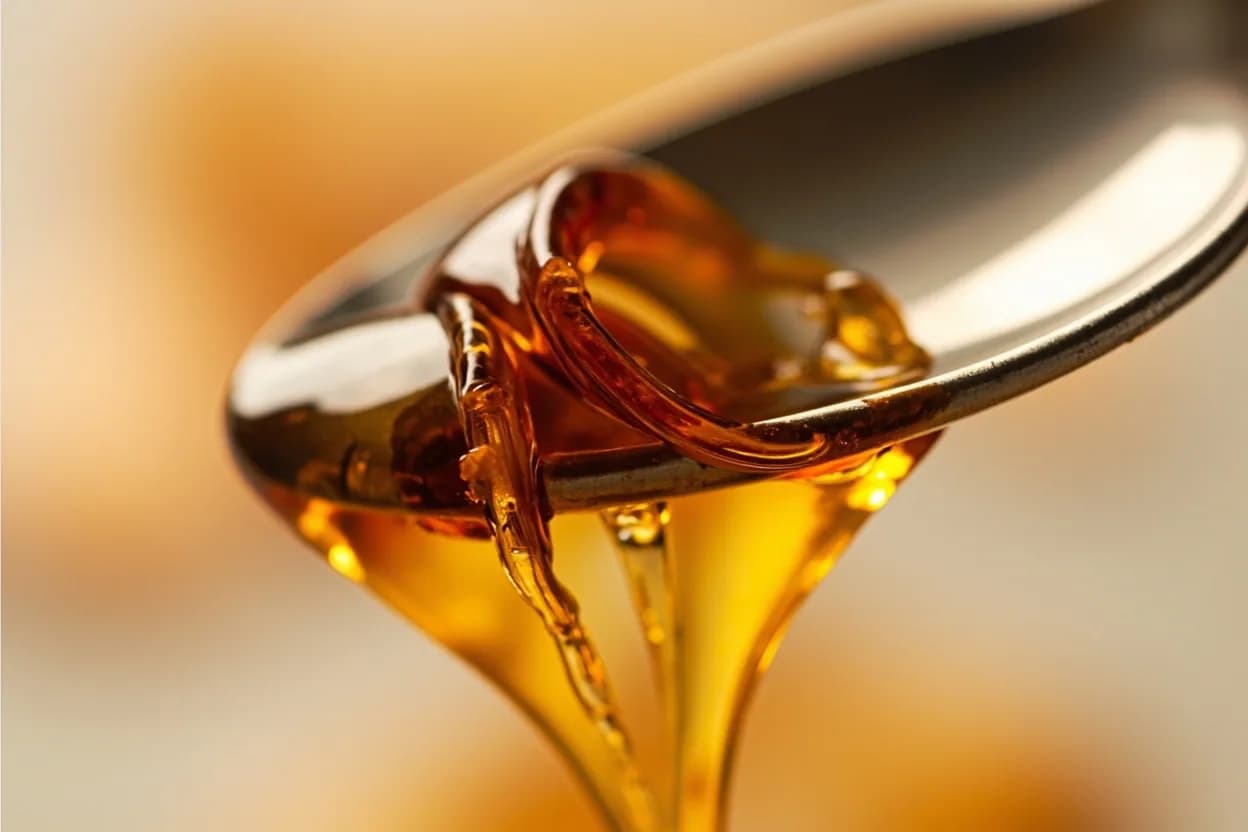
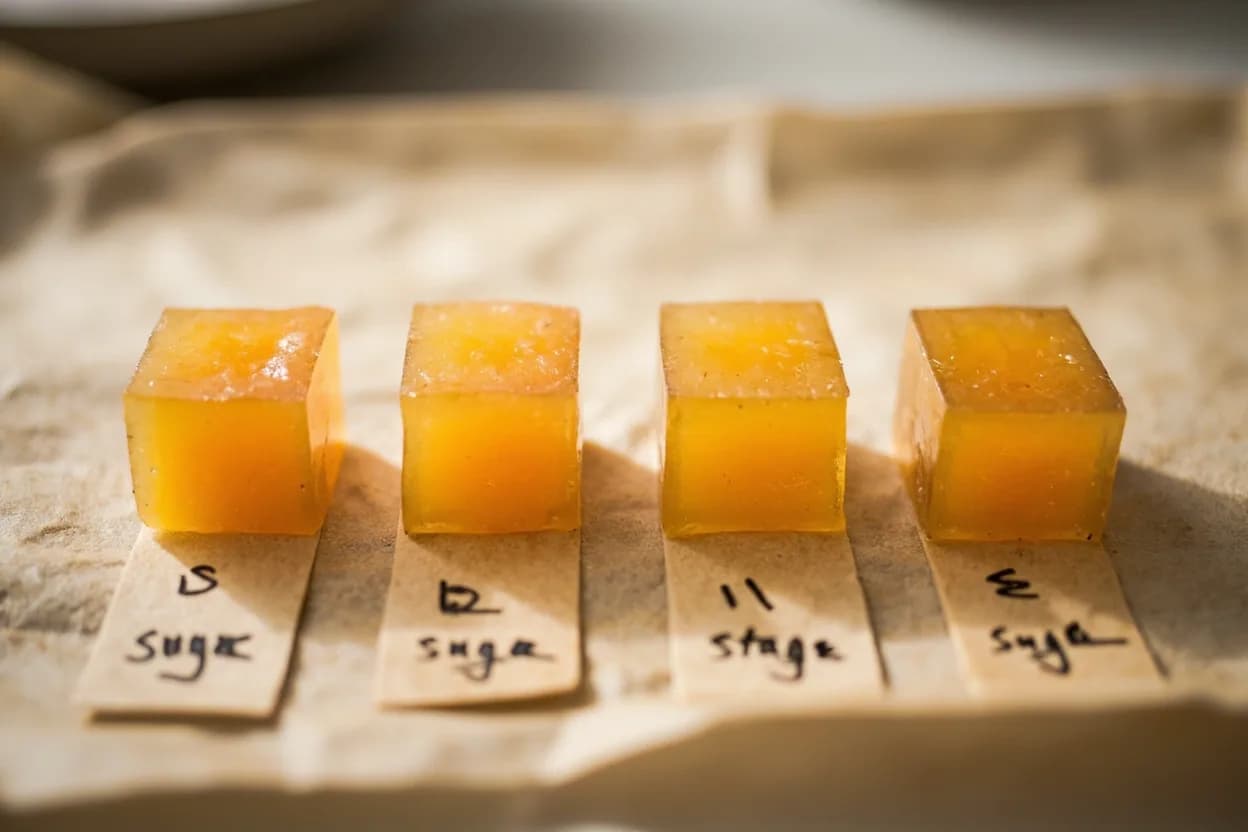
The earliest candy stage at 110°C (230°F), where concentrated sugar syrup spins a fragile thread between the fingers — thin enough to break with light pressure.
The thread stage is the first identifiable candy benchmark on the sugar thermometer, reached when a boiling syrup of water and sucrose hits approximately 107–113°C (225–235°F), with the classic thread point defined at 110°C (230°F). At this temperature, the syrup has lost enough water to be approximately 80% sucrose by weight. When a small amount is dropped into cold water or pulled between thumb and forefinger, it forms a thin, flexible thread 5–8 cm long that breaks cleanly when pressure is applied. The thread stage is used for light sugar syrups, spun sugar work, and certain glazing applications — it is too dilute for firm candies but concentrated enough to coat.
In photos

What happens
Plain water boils at 100°C, but as sucrose dissolves and concentrates in the syrup, the boiling point rises proportionally to the sugar concentration (boiling point elevation). At the thread stage, enough water has evaporated to raise the boiling point by approximately 10°C, yielding a syrup of roughly 80% soluble solids. The sucrose concentration is high enough that rapid cooling produces a supersaturated solution — the syrup wants to crystallize but can't do so quickly at room temperature, remaining viscous and flexible. This is why thread-stage syrup can be pulled into strands. The threads are amorphous glass rather than true crystals; they are fragile and hygroscopic, quickly turning sticky and collapsing in humid conditions.
What to look for
- A small amount of syrup dropped from a spoon into cold water disperses partially but leaves a few thin, fragile threads that break when touched
- Pulling the back of two clean spoons apart through the syrup forms a thin filament that snaps at 5–8 cm
- The syrup flows from a spoon in a thin, continuous ribbon that begins to thread before hitting the surface below
- No color change from the base sugar — the syrup remains water-clear to very faintly golden
- The surface of the boiling syrup shows medium-sized bubbles that are becoming slightly slower
How to check
- Thermometer: clip a calibrated candy thermometer to the pan; target 110°C (230°F) at the center of the syrup mass, not touching the pan bottom
- Cold water test: drop 1/4 teaspoon of syrup from a small spoon into a bowl of ice water, then pull the cooled syrup between thumb and forefinger — it should form a fragile thread 5–8 cm long that breaks cleanly
- Spoon pull test: dip two clean spoons into the syrup, press them back-to-back, then pull apart slowly — a thread of 5–8 cm that snaps confirms the stage
Food safety
The science behind it
- Soft ball stage
The next stage at 112–116°C; syrup forms a soft, pliable ball in cold water — used for fudge and fondant
- Boiling point elevation
The colligative property by which dissolved sucrose raises the boiling point of water proportionally to concentration
- Spun sugar
A primary application of thread-stage syrup; the thin threads are whipped or drizzled to create airy sugar decorations
- Invert sugar
Adding cream of tartar or glucose to the syrup during cooking hydrolyzes sucrose into glucose and fructose, reducing crystallization risk and extending the thread-spinning window
- Sugar glass
Thread-stage and higher sugar syrups cool into amorphous glass rather than crystalline candy; the fragile thread is a thin glass filament
Appears in
References
- 1.On Food and Cooking — Harold McGee
- 2.The Professional Pastry Chef — Bo Friberg (4th ed.)
- 3.Candy and Confections — Robert Greweling
- 4.Professional Baking — Wayne Gisslen (7th ed.)
- 5.Modernist Cuisine — Myhrvold, Young, Bilet (Vol. 4, Sugar)
Confidence: high
Notes
Humidity is the enemy of thread work
Thread-stage sugar is the most hygroscopic of the candy stages — it absorbs atmospheric moisture rapidly because the sucrose concentration is relatively lower than at higher stages. Spun sugar and thread-stage decorations must be made in low-humidity environments (below 50% relative humidity) and served within hours of creation. In humid kitchen conditions, threads begin to soften and collapse within 30–60 minutes.
Glucose prevents crystallization
Professional confectioners add glucose syrup (typically 10–15% of the sugar weight) when working with thread-stage syrup for spun sugar. Glucose molecules disrupt the regular crystal lattice that sucrose would otherwise form as the syrup cools, keeping the glass amorphous and pliable for longer. Without it, the syrup grains at thread stage are common, especially if any foreign particles (a grain of undissolved sugar, a wooden spoon fiber) are present.
Thread vs. soft ball: a practical distinction
The thread stage (107–113°C) and soft ball stage (112–116°C) overlap at their edges; the distinction is tactile, not purely thermometric. Thread-stage syrup forms a thread that breaks; soft ball-stage syrup forms a cohesive mass that can be shaped. A syrup at 112°C might exhibit either behavior depending on how quickly the thread is pulled. The thermometer is the reliable arbiter — the cold water test is confirmation, not primary measurement.