Starch & Specialty Doneness
Tapioca Pearls: Translucent Set
Also: boba done, tapioca translucent, pearl tea pearls ready, sago translucent set
Tapioca pearls are fully cooked when the entire pearl turns translucent with no white opaque core — confirmed by resting off-heat in a covered pot.
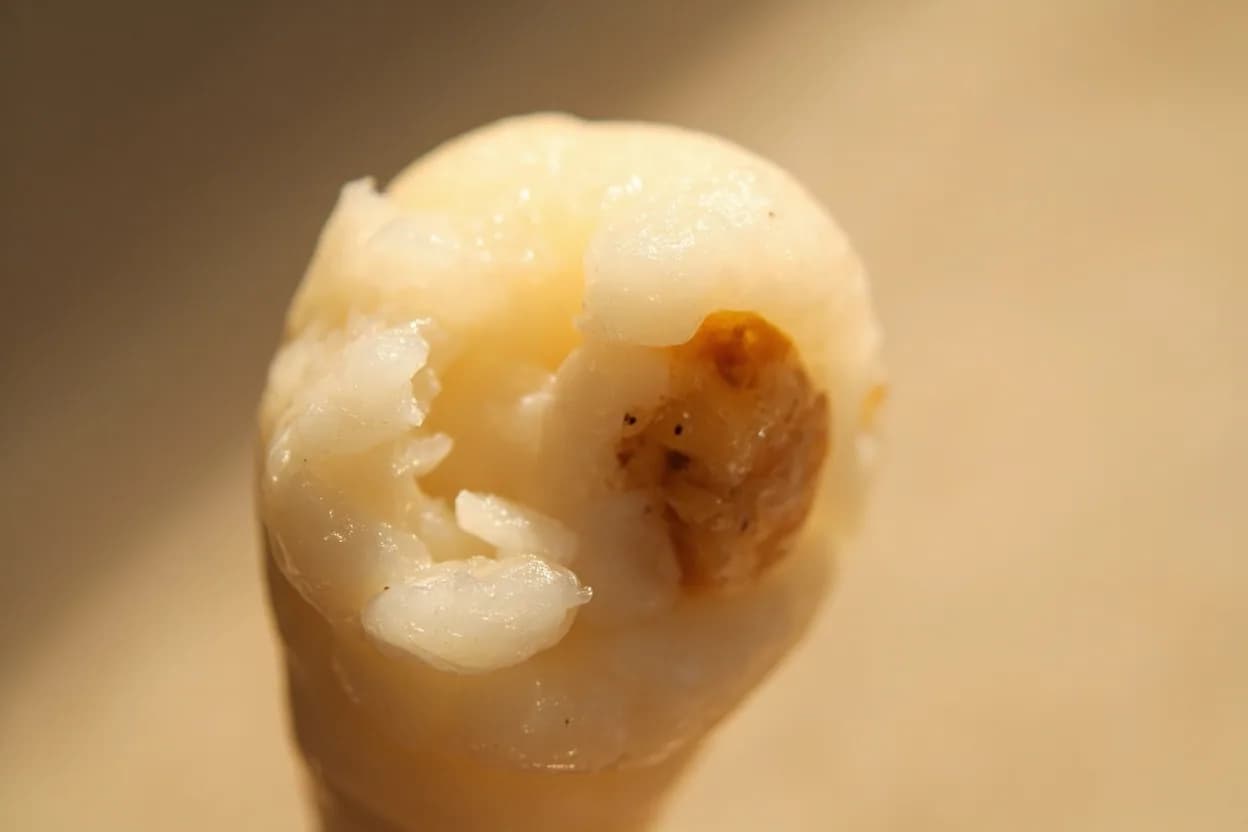
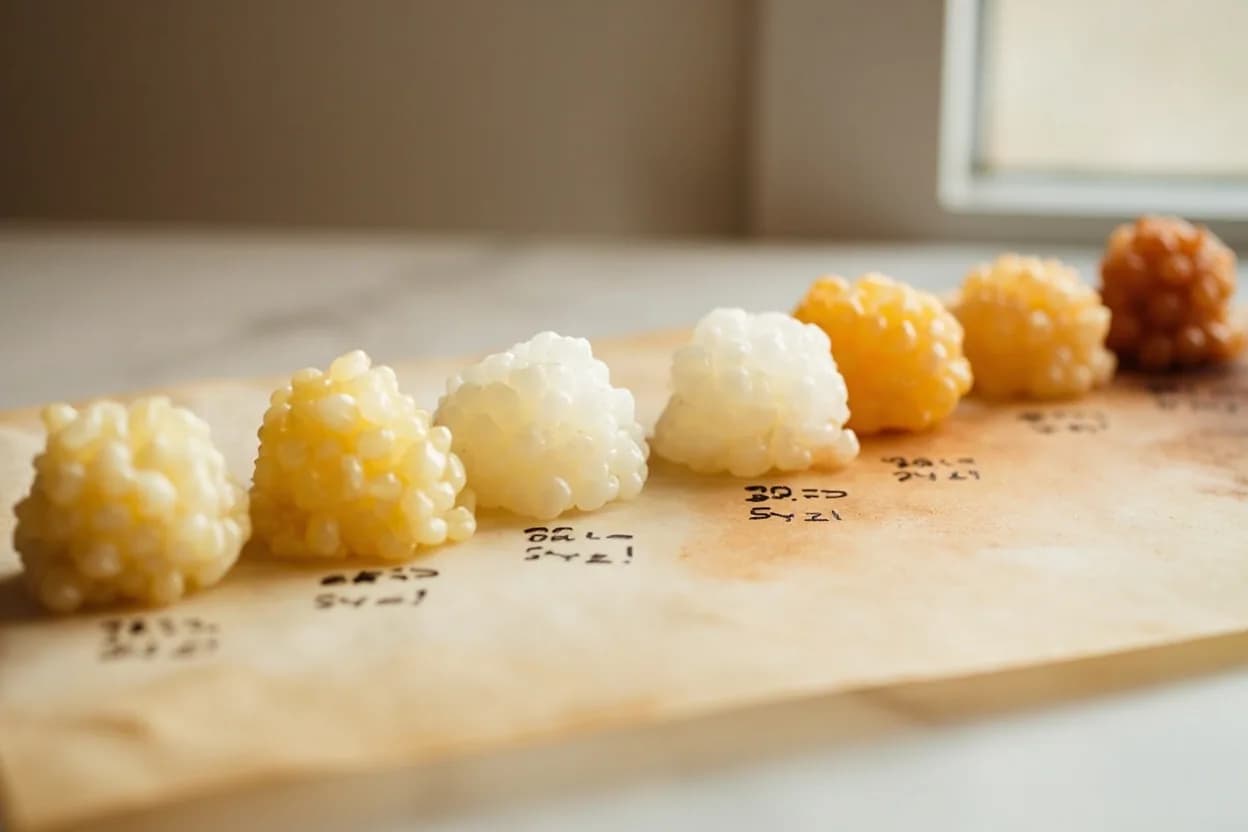
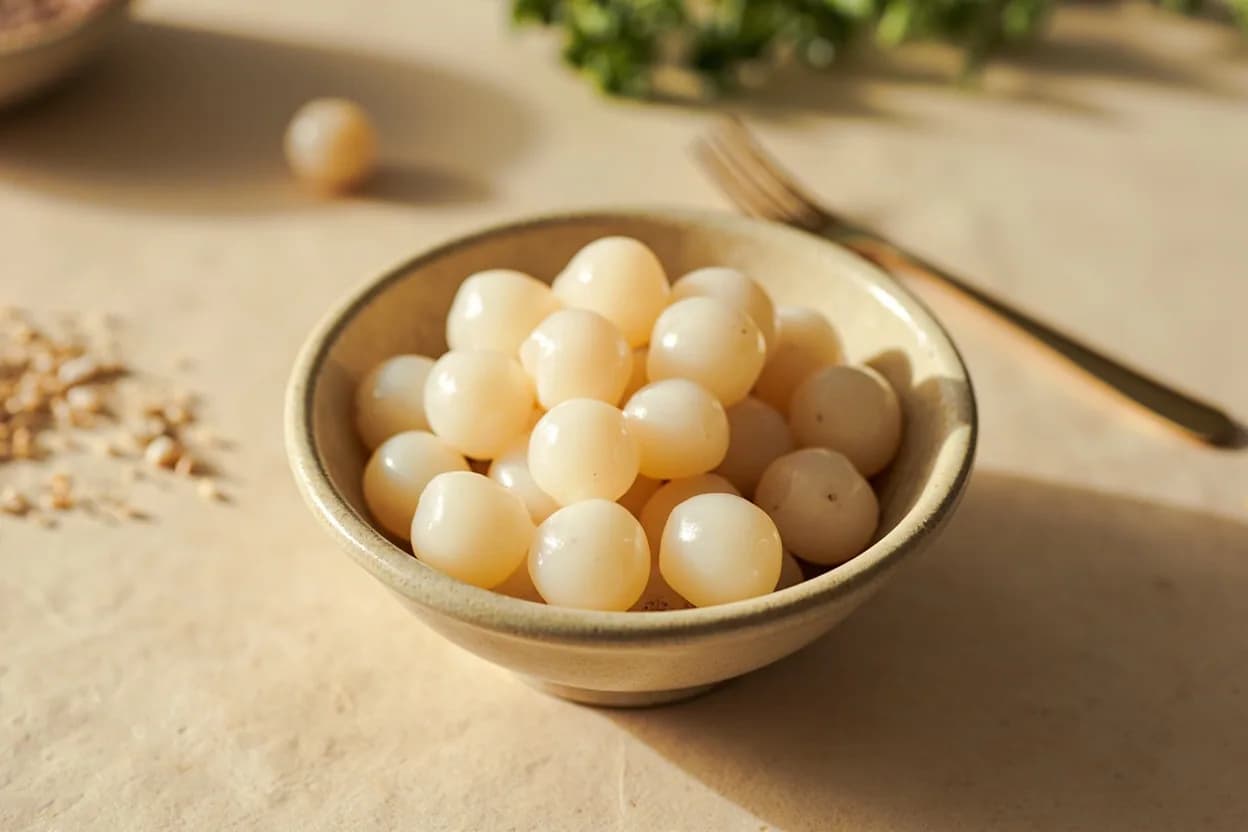
Tapioca pearl translucency is the visual doneness standard for cooked tapioca pearls (whether small white pearls used in puddings and Southeast Asian desserts, or large black boba pearls used in bubble tea). A fully cooked pearl has undergone complete starch gelatinization throughout its cross-section, making it uniformly translucent or semi-transparent. An opaque white center indicates incompletely gelatinized starch — the pearl is under-cooked. The transition from opaque to translucent happens primarily during active simmering but is completed during a covered off-heat rest, which is essential to the technique.
In photos
What happens
Tapioca pearls are formed from cassava starch (tapioca) compressed and dried into spheres. When submerged in boiling water, starch granules at the surface hydrate and gelatinize first, forming a translucent gel layer. Heat then conducts inward, progressively gelatinizing deeper layers. The white opaque center is granular, ungelatinized starch that has not yet absorbed sufficient water or heat. During the off-heat covered rest (typically 15–30 minutes), residual heat and steam penetrate the now-softened outer layer and complete gelatinization at the core. Black boba pearls contain brown sugar or caramel coloring mixed into the starch, which gives them a darker hue but the same translucency principle applies — the center changes from an opaque dark-grey to a uniformly dark and slightly translucent state.
What to look for
- Pearls are uniformly translucent or semi-transparent from edge to center when held up to light — no white or grey opaque core visible
- Texture is chewy and resilient ('QQ' in Taiwanese culinary parlance) but not gummy, gluey, or hard at the center
- Color is uniform throughout the pearl — no lighter or whiter interior visible when biting through
- Pearls float freely in the water and do not clump together (proper cooking water volume and stirring prevents this)
- The cooking liquid turns slightly starchy and thickened
How to check
- Cut or bite a pearl in half and examine the cross-section — it should be uniformly translucent with no opaque white dot at the center
- Hold a pearl up to a light source; a done pearl allows some light diffusion through; an underdone pearl has a distinct opaque white center
- Press a pearl between two fingers — it should compress uniformly with even resistance throughout, no hard core
- Taste: the center should taste the same as the exterior — sweet/starchy and smooth, not chalky or resistant
The science behind it
The molecular transformation driving the opaque-to-translucent visual change
- Covered Rest / Carry-Over Cooking
The off-heat covered rest is not optional — it completes the core gelatinization that active boiling begins
- Sago Pearls Doneness
True sago (from sago palm starch) follows the same translucency rule; often confused with tapioca in Southeast Asian recipes
- Cassava Starch Properties
Cassava starch gelatinizes at a relatively low temperature (~60°C) but requires sustained hydration to complete throughout a dense sphere
Appears in
References
- 1.The Food Lab — J. Kenji López-Alt, W. W. Norton & Company
- 2.Asian Tofu — Andrea Nguyen, Ten Speed Press
- 3.On Food and Cooking — Harold McGee, Scribner
- 4.The Wok: Recipes and Techniques — J. Kenji López-Alt, W. W. Norton & Company
Confidence: high
Notes
The Boil-and-Rest Method
The standard technique for large black boba pearls is: bring a large pot of water to a full rolling boil (at least 10:1 water-to-pearl ratio), add pearls, return to boil, cook uncovered for 25–30 minutes, then turn off heat, cover tightly, and rest 15–25 minutes. The covered rest is what drives complete translucency. Brands vary — some instant pearls (5-minute boba) use pre-gelatinized starch and require only a brief boil, but still benefit from a 5-minute covered rest.
Serving Window
Fully cooked tapioca pearls have a short optimal window — approximately 2–4 hours at room temperature. Over time, gelatinized starch retrogrades (crystallizes), causing pearls to harden and lose their characteristic chew. Commercial bubble tea shops soak freshly cooked pearls in brown sugar syrup, which delays retrogradation and adds flavor. Do not refrigerate before serving — chilling accelerates retrogradation dramatically.
Small vs. Large Pearls
Small white tapioca pearls (2–3 mm, used in puddings) cook much faster — typically 15 minutes boiling then a 10-minute rest. They are also more prone to over-cooking and dissolving into the liquid. The translucency test applies equally: any white center means more cook time or rest time is needed.