Technique-Specific Doneness
Tofu Skin Formation Temperature
Also: yuba temperature, tofu skin, bean curd skin, beancurd sheet, fu zhu formation
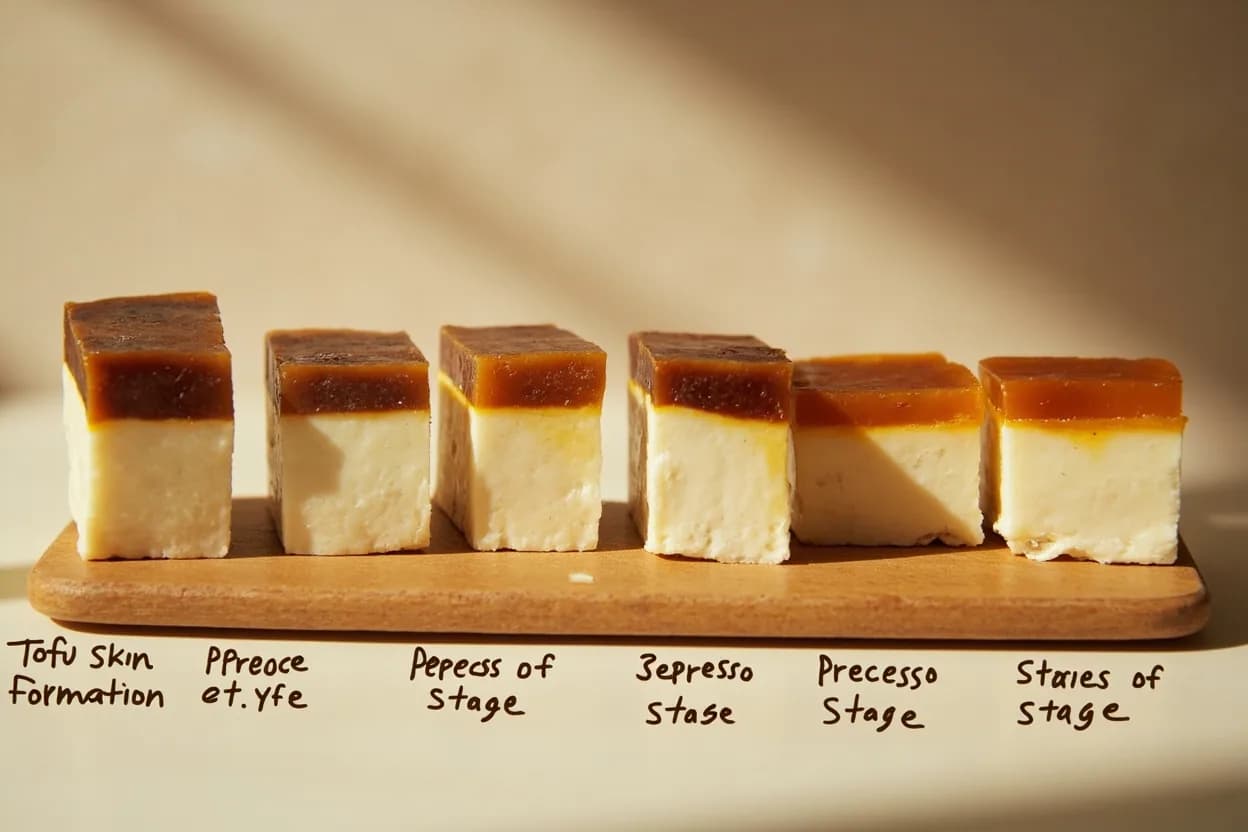
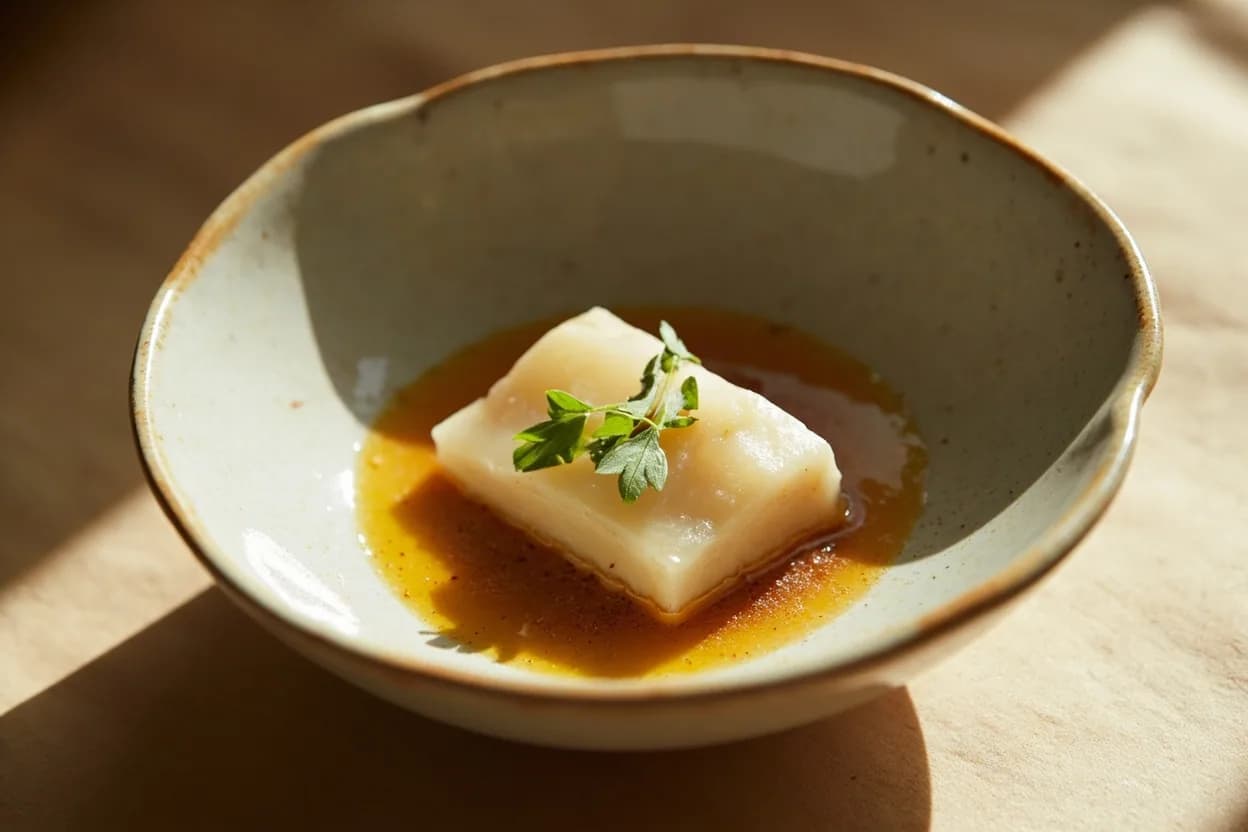
Fresh soy milk held at 80–85°C (176–185°F) — below a boil — forms a delicate protein-and-fat skin (yuba) on its surface within 10–15 minutes, which is lifted off intact with a bamboo skewer to yield successive sheets.
Yuba (湯葉, Japanese; 腐竹 fǔzhú in dried form, Chinese) is the skin that forms on the surface of heated soy milk when kept at a steady 80–85°C. As soy proteins denature and concentrate at the air-liquid interface, and as the surface loses moisture to evaporation, a thin cohesive film of protein and soy lipids forms. This skin is lifted off whole — typically with a single bamboo skewer or two chopsticks slipped under from opposing sides — and either used fresh (tender, creamy, rich) or dried (firm, chewy, deeply savoury). The technique is exquisitely temperature-sensitive: below 75°C no skin forms at all; above 90°C a full boil disrupts skin formation and creates foam instead. The sweet spot is a gentle, steam-releasing surface with no visible movement in the liquid.
In photos

What happens
Fresh soy milk is a colloidal suspension of proteins (primarily glycinin and beta-conglycinin, together ~40% of soy protein), lipids, carbohydrates, and water. When held at 80–85°C, several things happen simultaneously at the surface: water evaporates, concentrating proteins and fat; the air-liquid interface acts as a hydrophobic-hydrophilic boundary that attracts soy lipids and some globulins; globulins begin to partially denature and unfold, exposing hydrophobic regions that aggregate and bond; the lipid-protein complex forms a continuous, cohesive membrane. The rate of skin formation depends on soy milk concentration (higher concentration = thicker, faster skins), temperature stability, air humidity (lower humidity = faster evaporation = faster skin), and whether a lid is used (lid prevents evaporation and suppresses skin formation). A single pot of soy milk at 80–85°C will yield 8–15 sheets before the milk is exhausted.
What to look for
- A faint, wrinkled film becomes visible on the surface 8–12 minutes after the soy milk reaches temperature
- The skin appears pale ivory to cream-coloured and slightly translucent
- Edges of the skin separate slightly from the pot walls, indicating it is ready to lift
- The liquid below has stopped steaming visibly — a sign temperature is holding below a boil
- After lifting, the surface looks bare and liquid for a few minutes before the next skin begins forming
How to check
- Thermometer check: verify soy milk is at 80–85°C and stable before beginning; use an instant-read thermometer clipped to the side of the pot
- Visual surface check: a skin should appear within 10–15 minutes; if no skin forms after 20 minutes, raise temperature slightly
- Lift test: slide a bamboo skewer or chopstick under one edge — if the skin lifts as a single cohesive sheet, it is ready; if it breaks apart, allow another 2–3 minutes
- Thickness test: a properly formed skin will drape from the skewer in a single piece at least 15–20 cm across before it starts to tear
The science behind it
- Protein denaturation at air-liquid interface
The surface of heated soy milk is where thermal denaturation and interfacial adsorption concentrate to form the cohesive yuba film
- Soy milk concentration
Yuba quality depends on soy milk being at least 10–12 Brix; dilute milk produces thin, fragile, low-yield skins
- Tofu coagulation
Related process: soy milk proteins coagulate when a coagulant (nigari, gypsum) is added to hot soy milk — yuba formation requires no coagulant, only heat and evaporation
- Fu zhu (dried tofu skin sticks)
Sheets of yuba are folded into sticks and dried to make fu zhu, a shelf-stable form used extensively in Chinese braised dishes
- Maillard browning in dried yuba
When yuba is fried or baked, its protein-sugar surface undergoes rapid Maillard browning, creating a golden, crisp exterior
Appears in
References
- 1.On Food and Cooking — Harold McGee (Scribner, 2004)
- 2.Japanese Farm Food — Nancy Singleton Hachisu (Andrews McMeel, 2012)
- 3.The Art of Japanese Cooking — Shizuo Tsuji (Kodansha, 1980)
- 4.Land of Plenty — Fuchsia Dunlop (W. W. Norton, 2001)
- 5.Soy: A Cultural History and Scientific Analysis — William Shurtleff & Akiko Aoyagi (Soyinfo Center, multiple editions)
Confidence: high
Notes
Kyoto and the yuba tradition
Yuba has been central to Kyoto cuisine for over a millennium, arriving via Buddhist monastery food culture from Tang-dynasty China. The temple cuisine tradition of shōjin ryōri (精進料理) — strictly vegetarian — relies on yuba and tofu as primary protein sources. In Kyoto, fresh yuba is so prized that dedicated yuba restaurants serve it in multiple textures: raw (fresh-lifted, barely set), simmered, deep-fried, and aged. The city's soft water (low mineral content) is believed to produce especially delicate, sweet yuba and tofu — an environmental terroir analogous to wine.
Maximising yield: concentration and humidity
Professional yuba producers concentrate their soy milk to 12–14 Brix (roughly double the Brix of standard soy milk) to maximise skin thickness and yield. Working in a low-humidity environment (or using a gentle fan) accelerates surface evaporation without raising liquid temperature, increasing skin formation rate. Covering the pot between lifts is counterproductive: the lid traps moisture and suppresses evaporation, slowing or preventing skin formation entirely.