Starch & Specialty Doneness
Turnip Cake (Lo Bak Go) & Moin Moin Set Point
Also: lo bak go done, turnip cake set, moin moin cooked, radish cake set, steamed cake doneness
Steamed starch-based savory cakes are fully set when a skewer inserted at the center withdraws cleanly with no wet batter — indicating the starch matrix has gelatinized throughout.
The set point for Lo Bak Go (Chinese turnip/radish cake, 蘿蔔糕) and Moin Moin (Nigerian steamed bean cake) describes the doneness state at which the slurry or batter — a mixture of starch or ground legumes with aromatics and liquid — has fully cooked and solidified into a firm, sliceable cake. The internal starch or protein network has set sufficiently to hold its shape under a knife, yet the interior remains moist and tender. The skewer test is the universal check across both dishes and their cousins: a thin skewer or chopstick withdrawn from the center should emerge dry or with only minimal moist crumbs, never with raw wet batter on it.
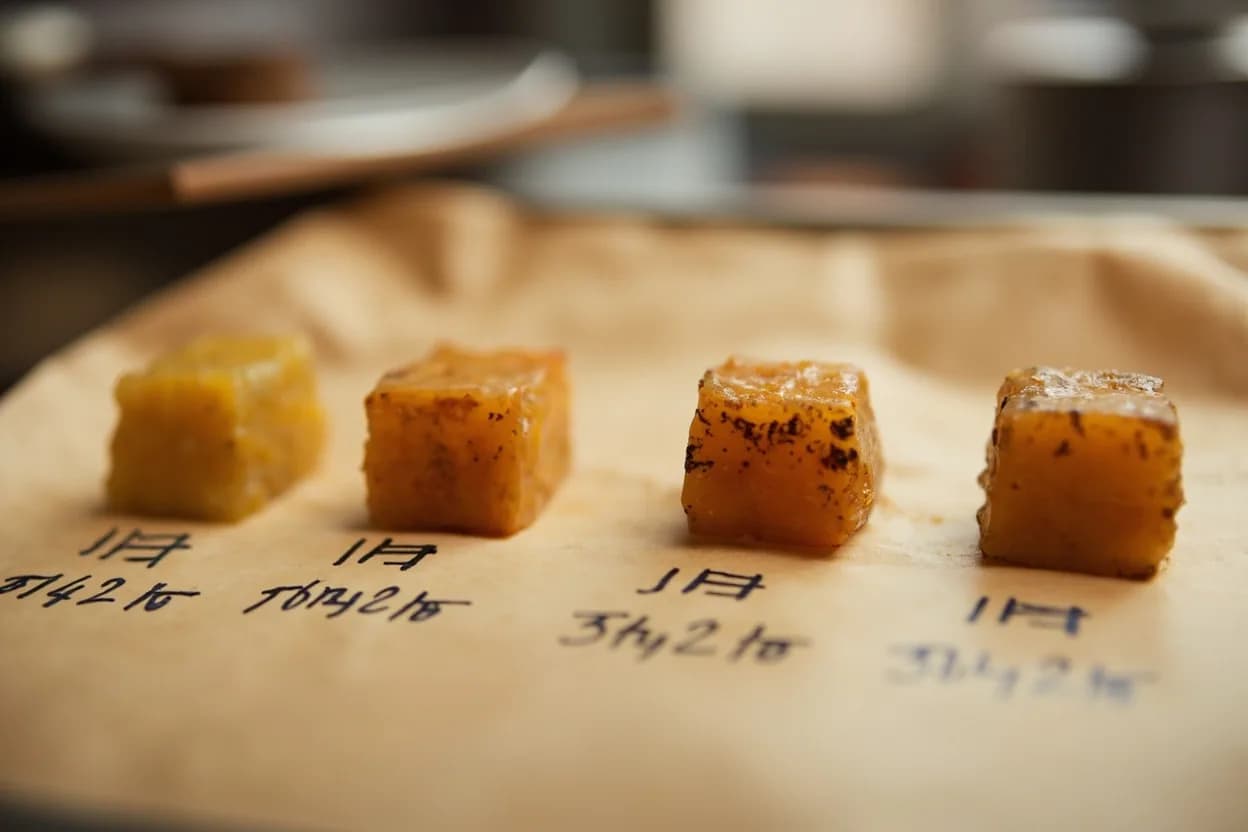
In photos


What happens
In Lo Bak Go, rice flour and sometimes wheat starch are mixed with grated daikon radish and seasoning into a thick slurry. During steaming, the starch granules gelatinize (beginning around 60–65°C) and form a continuous gel network that encases the shredded radish. As temperature climbs toward 80–85°C throughout the cake, this network sets firmly enough that slicing is possible once cooled. The radish releases moisture during cooking, which is absorbed by the starch; this moisture balance is what keeps the cake supple rather than gummy or dry. In Moin Moin, ground black-eyed peas (peeled and blended to a smooth paste with water, onion, and chiles) coagulate via protein denaturation as the egg-like bean proteins set, analogous to a savory custard or steamed egg. Both doneness events produce the same skewer result — the internal batter transitions from liquid to solid.
What to look for
- A skewer or thin chopstick inserted to the center and withdrawn comes out clean or with only dry crumbs — no wet batter clings to it
- The cake pulls slightly away from the sides of the pan or mold as it sets and contracts
- The surface of the cake is firm and matte, not shiny or wet-looking — no liquid pools on top
- Gentle pressure on the surface produces a slight spring-back rather than a dent that stays
- A slicing knife cut through the edge reveals a uniform, set interior without liquid running out
How to check
- Insert a thin bamboo skewer, chopstick, or cake tester into the deepest center point and withdraw steadily — look for no wet batter
- Check the edges of the pan: when set, the cake will have contracted 1–3 mm from the sides of the mold
- Press the center surface lightly with a finger — it should feel firm and spring back
- For Lo Bak Go: tilt the pan slightly; no liquid should pool or shift under the cake
- For Moin Moin: pierce the wrapping (banana leaf or foil) and check the skewer through the wrapper opening at the top
Carryover & resting
Both Lo Bak Go and Moin Moin firm up considerably as they cool after steaming. A cake that tests slightly soft-set but not wet at 82°C will reach full slicing firmness after 20–30 minutes of cooling at room temperature or refrigeration. Lo Bak Go is traditionally chilled before being sliced and pan-fried; this chilling step is as important as the initial steam cook.
The science behind it
The primary setting mechanism in Lo Bak Go — rice starch forms the continuous gel matrix
- Protein Coagulation (Bean)
The primary setting mechanism in Moin Moin — legume proteins denature and set like a savory custard
- Skewer Test
The canonical doneness check shared across steamed cakes, steamed puddings, and quick breads globally
- Custard Set Point
Moin Moin's setting mechanism is closer to a baked custard than a starch gel — both use the clean-skewer test
Appears in
References
- 1.The Complete Asian Cookbook — Charmaine Solomon, Tuttle Publishing
- 2.All Under Heaven: Recipes from the 35 Cuisines of China — Carolyn Phillips, Ten Speed Press
- 3.My Grandmother's Chinese Kitchen — Eileen Yin-Fei Lo, Stewart, Tabori & Chang
- 4.The Nigerian Cookbook — Mytle Beach, self-published / widely cited culinary reference
Confidence: high
Notes
Lo Bak Go: The Steam → Chill → Fry Sequence
Authentic Lo Bak Go is a two-stage cook: first steamed to set the starch cake (the set point described here), then cooled completely (often overnight in the refrigerator) until firm enough to slice into 1–2 cm slabs without crumbling. The slabs are then pan-fried in oil until a golden, crisp crust forms on each side while the interior stays soft. Attempting to slice and fry a Lo Bak Go that has not fully chilled results in crumbling. The skewer test confirms the steam phase; the firmness of the cold cake is a separate check before frying.
Moin Moin Wrapping Variations
Traditional Moin Moin is wrapped in ewe eran leaves (banana or similar) sealed with toothpicks, but modern recipes use foil pouches, tin cans (efi), or ramekins. The cooking vessel affects both cooking time and the character of the set: banana leaf wrappings produce a slightly firmer, more even-cooked result from all-around steam contact; tin cans can produce a slightly wetter bottom if steam condensation pools. The skewer test remains valid regardless of wrapping.
Pan Size and Depth Affect Time
For Lo Bak Go, a deeper pan (more than 5 cm) can add 20–30 minutes to the steam time. The skewer test is especially important for deep pans where the center may still be liquid long after the edges have set. Steam the cake in the pan size specified in the recipe to avoid having to extend timing significantly.