Poultry Doneness
Yakitori: Doneness by Protein Part
Also: yakitori doneness, chicken skewer doneness, binchōtan grill doneness
Each yakitori cut demands its own pull-point — breast pulls just shy of opaque, thigh blushed and juicy, liver still rosy at center, skin blistered and crackling.
Yakitori — grilled chicken skewers cooked over binchōtan charcoal — encompasses multiple anatomical cuts, each with a distinct ideal doneness driven by the muscle fiber type, fat content, and collagen density of that part. A single internal temperature target does not apply uniformly: breast (mune) is pulled at 65–68°C for juiciness; thigh (momo) at 70–74°C for deeper flavor without dryness; liver (rebā) is left rosy at 63–65°C by traditional izakaya standards; and chicken skin (kawa) is judged by visual crispness rather than temperature.
In photos

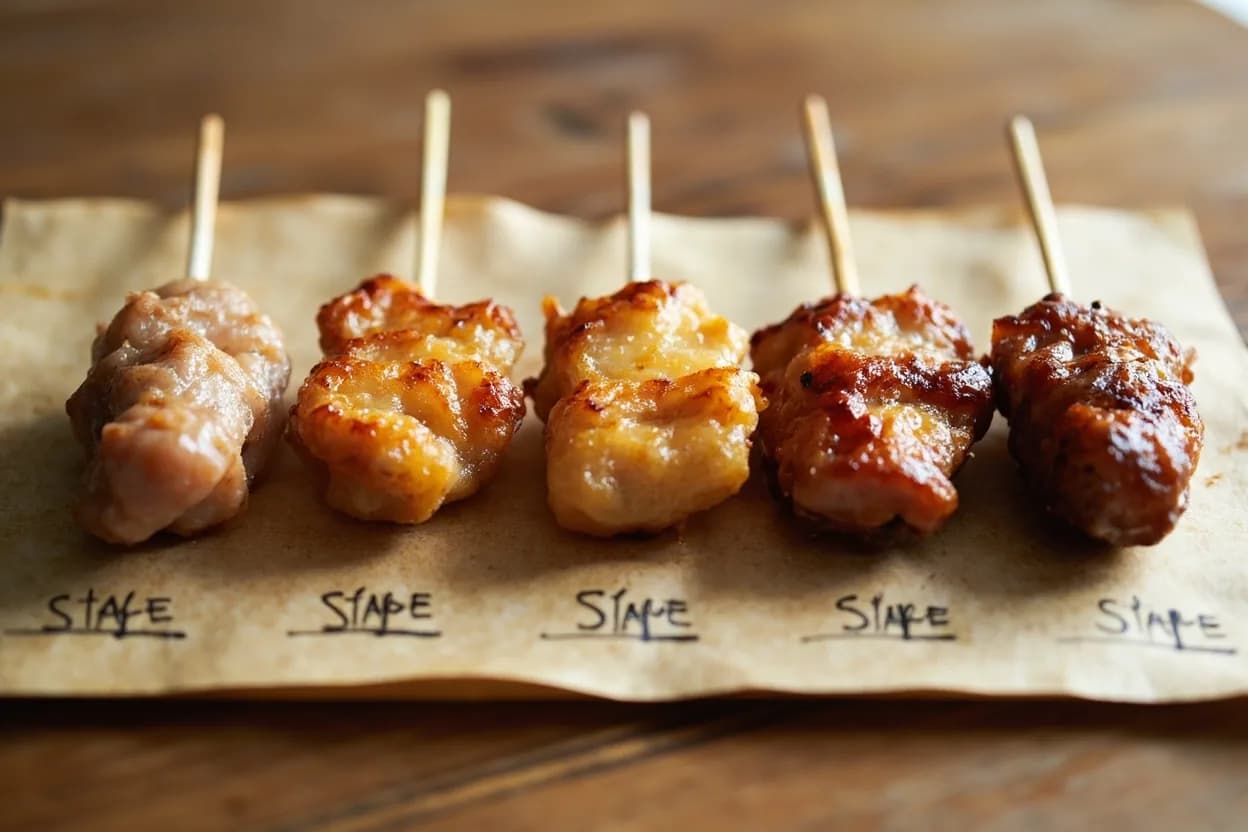

What happens
Breast meat (mune) is lean fast-twitch muscle with minimal collagen; beyond 68°C myosin contraction accelerates moisture loss sharply, producing the chalky texture that defines overcooked breast. Thigh meat (momo) contains more slow-twitch fiber and intramuscular fat, giving it buffering capacity to stay moist at 70–74°C. Liver is dense with myoglobin and glycogen; at 63–65°C the center remains pink-mauve and the texture stays creamy rather than grainy. Chicken skin is almost entirely collagen and subcutaneous fat — doneness is the visual moment the fat renders fully (bubbling ceases, surface bronzes and crisps), which can occur above or below standard internal temperatures depending on proximity to the coals.
What to look for
- Breast (mune): flesh is barely opaque with a faint translucency at the very center; springs back lightly under finger pressure
- Thigh (momo): exterior is deeply caramelized with tare glaze; juices run clear-gold when pierced; interior is uniformly opaque with moist sheen
- Liver (rebā): exterior is firm and lightly charred; a cross-section shows a rosy-pink center, not gray; texture creamy, not grainy
- Skin (kawa): surface is blistered, golden-brown, and rigid; the collagen lattice has set and fat has rendered completely
- Tsukune (meatball): golden exterior, fully opaque interior; center rebounds fully under light pressure
How to check
- Use a thin instant-read thermometer (Thermapen or similar) inserted along the skewer axis to avoid hitting the metal stick itself
- For breast, pull at 65–68°C (149–154°F) and allow 1 minute of carryover off the coals
- For thigh, target 70–74°C (158–165°F); the higher fat content masks any slight over-shooting
- For liver, pull when the exterior is charred but interior temperature reads 63–65°C (145–149°F) — avoid probing to center or texture deteriorates
- For skin, assess visually: fat should be fully rendered (no visible white fat pockets), surface deeply bronzed with blisters
Food safety
Carryover & resting
Breast skewers carryover 2–3°C off the intense radiant heat of binchōtan; pull 2°C below target. Thigh and liver carry over minimally due to their smaller mass and high surface-area-to-volume ratio.
The science behind it
- Binchōtan radiant heat
Far-infrared radiation from white charcoal penetrates meat surface differently than gas flame, accelerating crust formation with subtler interior cooking
- Tare glaze caramelization
Soy-mirin-sake tare darkens rapidly; visual browning of the glaze is an approximate secondary doneness cue for thigh and tsukune
- Chicken liver doneness
The global debate over pink liver applies here; 63°C is a compromise between creaminess and pathogen reduction
- Fast-twitch vs. slow-twitch muscle
Explains why breast and thigh have different temperature ceilings despite being from the same animal
Appears in
References
- 1.Japanese Farm Food — Nancy Singleton Hachisu
- 2.The Japanese Grill — Tadashi Ono & Harris Salat
- 3.On Food and Cooking: The Science and Lore of the Kitchen — Harold McGee
- 4.Ministry of Health, Labour and Welfare Japan — Food Safety Guidelines for Poultry
Confidence: high
Notes
The binchōtan variable
Binchōtan (white oak charcoal) burns at 800–1000°C with low flame and high far-infrared output, which sears the surface without the flare-ups of regular charcoal. This means experienced yakitori chefs use distance-from-coals and rotation rate as their primary heat controls, and visual cues — not thermometers — are the working tool. A practiced yakitori master reads the color of the glaze, the sound of sizzle, and the slight shrinkage of the meat as it pulls taut on the skewer.
Order of the skewers
In a traditional yakitori course (omakase style), liver and delicate breast cuts come early when the cook's focus and the coals' heat are freshest. Skin and tsukune, which tolerate slightly higher heat and longer cooking, often come later. Understanding the doneness hierarchy of each cut shapes the service sequence.