Fermented Vegetables & Pickles
Preserved Mustard Greens (Mei Cai)
Also: mei cai, mui choy, meigan cai, dried preserved mustard, pickled mustard cabbage
Sun-dried, salted, and aged mustard greens from Shaoxing and Hakka kitchens — intensely savoury, faintly sweet, with an earthy depth that transforms braised pork into something transcendent.
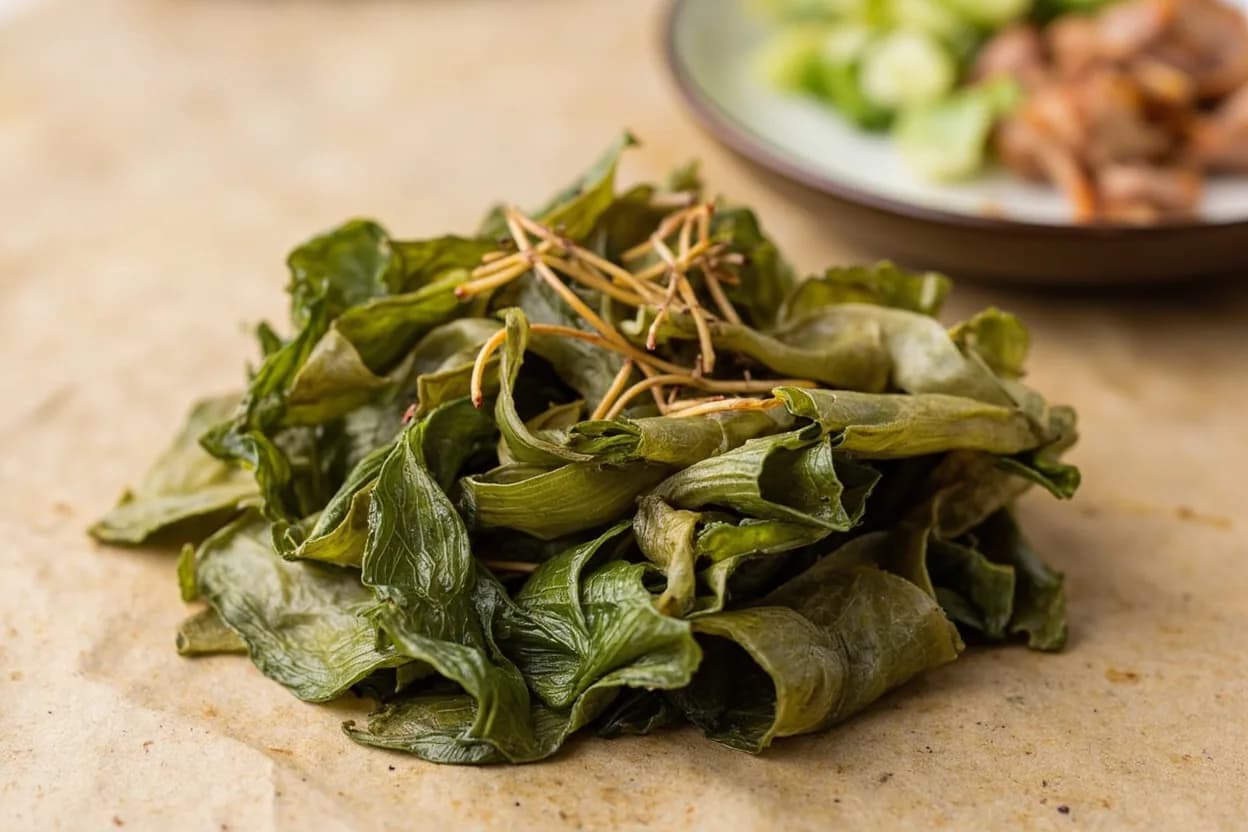
Mei cai (梅菜) is mustard greens that have been salted, pressed, sun-dried, and often lightly fermented — a preservation technique centred in the Shaoxing and Hakka communities of Zhejiang and Guangdong provinces. The process concentrates glutamates, developing a complex umami depth alongside a characteristic earthy, slightly musty sweetness. Two main styles exist: gan mei cai (dry-salted, intensely concentrated) and xian mei cai (wetter, more pickle-forward). Both must be soaked and rinsed before use to temper saltiness. The result is chewy, nutty-earthy strands that absorb fat from whatever they braise with, amplifying richness while cutting through it with their savoury tang.
In photos

Flavour profile
Classic pairings
- Pork bellyHakka Chinese / Cantonese
The canonical pairing — mei cai kou rou (braised pork belly with preserved mustard greens) is a Cantonese/Hakka classic; the greens absorb pork fat and soy while their umami amplifies the meat's richness.
- Steamed minced porkCantonese
Mixed into ground pork with ginger and soy before steaming; the greens add textural contrast and savoury depth to an otherwise simple home dish.
- Shaoxing rice wineZhejiang / Cantonese
Mei cai braises invariably include Shaoxing wine; the wine's caramel-nuttiness harmonises with mei cai's fermentation notes in a regional flavour idiom.
- Dark soy sauceCantonese
Dark soy's molasses depth mirrors mei cai's own concentrated sweetness; together they build the lacquered, mahogany braising glaze essential to mei cai kou rou.
- Tofu (firm, pressed)Hakka Chinese
Braised alongside mei cai, firm tofu absorbs the savoury liquid and provides mild protein contrast to the dominant umami.
- Steamed white riceCantonese
The braising liquid alone, poured over plain rice, is considered a complete comfort meal in Cantonese households — mei cai's intensity means a little goes a very long way.
Adventurous pairings
- Duck confit
Mei cai's umami depth and fat-absorbing texture apply directly to duck leg braised in its own fat — a Cantonese-French crossover with genuine logic.
- Aged cheddar
Finely chopped and scattered over a grilled cheese or a cheese board, mei cai's salted-earth funk echoes aged cheddar's crystalline sharpness.
- Lamb shoulder
The greens' earthy bitterness is one of the few vegetable flavours strong enough to complement lamb's gaminess in a slow braise with five-spice.
- Congee (rice porridge)
A small amount stirred into plain congee adds instant, brothy complexity without any additional seasoning — effective emergency pantry cooking.
Tread carefully
- Delicate seafood (scallops, sole)avoid
Mei cai's concentrated salinity and earthy fermentation notes crush the subtle sweetness of mild seafood; use only where the protein can hold its own.
- Lightly dressed fresh saladsavoid
Its intense saltiness and fermented depth will overwhelm fresh, raw vegetables without a fat (pork fat, sesame oil) to mediate.
- Unsalted preparations without prior rinsingavoid
Used straight from the package, mei cai is typically far too salty to taste — always soak in cold water 20–30 minutes and rinse well before use.
How to use it
- Soak in cold water for 20–30 minutes, rinse thoroughly to remove excess salt before use
- Braise low and slow — mei cai reaches its potential in long cooking (90+ minutes) where it absorbs braising fat and liquid
- Squeeze dry before stir-frying to prevent steaming and achieve caramelised edges
- Use the braising liquid as a flavour base for congee or noodle soups
- Steam over minced pork or fish to infuse during cooking, then serve together
- Chop finely and fold into dumpling filling for concentrated umami punch
Appears in
Related flavours
- Yibin Yacai
A Sichuan cousin — also pickled mustard green but crunchier, tangier, and paired with numbing heat rather than rich braises
- Zha Cai (Sichuan Pickled Mustard Root)
Same mustard genus, different part of the plant; zha cai is crunchier and more pungent — both are umami-forward but zha cai lacks mei cai's sweetness
- Douchi (Fermented Black Beans)
Another Cantonese fermented-umami cornerstone; similarly amplifies braised pork and steamed fish
References
- 1.Land of Plenty — Fuchsia Dunlop
- 2.The Hakka Cookbook — Linda Lau Anusasananan
- 3.Chinese Food Made Easy — Ching-He Huang
- 4.Every Grain of Rice — Fuchsia Dunlop
Confidence: high
Notes
Two styles, one name
Dried mei cai (gan mei cai) is the tightly compressed, dark-brown block sold vacuum-packed and used in long braises. Wet mei cai (xian mei cai) is lighter in colour, sold loose or in jars, and better suited to steaming and quick stir-fries. The flavour logic is similar but the technique requirements differ — wet mei cai does not need extended soaking.
Hakka identity
Mei cai is one of the defining ingredients of Hakka cuisine — an itinerant ethnic group whose preservation techniques reflect centuries of migration. The dish mei cai kou rou is sometimes called 'the soul of Hakka cooking' because it transforms two cheap ingredients (salt-preserved greens and fatty pork) into something genuinely luxurious.