Dairy & Eggs
Nonfat Dry Milk Powder
Skim milk dehydrated to a shelf-stable powder. Reconstitutes into fat-free milk and enriches bread doughs, caramels, and yogurt for added body without extra liquid.
Nonfat dry milk (NFDM) is simply pasteurized skim milk with the water removed — typically down to 3–4% moisture — leaving a shelf-stable powder composed mostly of lactose (about 50%) and milk protein (roughly 35%), with milkfat capped at 1.5% by weight. In the US it is defined legally under FDA 21 CFR 131.125 (with the vitamin-fortified version at 131.147), and traded internationally under Codex Stan 207-1999. Because the water is gone, the lactose and casein are concentrated into a form that behaves very differently from liquid milk in the oven, on the stovetop, and in the dough bowl.
For a cook, the value of NFDM is not that it replaces fresh milk one-for-one — though it can — but that it concentrates two things liquid milk only delivers in dilute form: milk proteins that strengthen gluten and contribute body, and lactose that fuels both yeast and deep Maillard browning. A tablespoon or two stirred dry into a yeasted dough will give you a softer, longer-keeping crumb and a noticeably more golden crust than the same flour and water would produce. The same concentration explains its quiet but crucial role in smooth caramels, sturdy ice cream bases, and thickened homemade yogurt.
The practical catch is that not all NFDM is the same. Drying method, heat treatment, and whether the powder has been agglomerated for instant dispersion all change how the powder behaves once it leaves the can. A baker who grabs whatever box is on the shelf is rolling dice with crust color, crumb softness, and reconstituted drink quality; a cook who learns to match grade to task gets reliably better bread, cleaner confections, and milk on hand whenever the fridge is empty.
- Measured in
- g
- Storage
- Pantry
Allergens
Find it in
Suits
Types & varieties
The everyday baking powder. Fine, dense particles that need warm water to disperse; ideal for stirring dry into doughs, where it dissolves during mixing and bake.
Agglomerated into porous granules that wet and dissolve in cold water; the right choice for drinking milk, smoothies, and quick pantry recipes.
Made on steam-heated drums; coarser particles and a faintly scorched, caramelized flavor. Mostly of historical interest, though some old-school baking mixes still specify it.
Heat-treated to denature the whey proteins; the right grade for bread, rolls, bagels, and pizza, where it strengthens gluten and supports a deeply browned crust.
Lighter heat treatment preserves fresh-milk flavor and solubility; preferred in ice cream bases, recombined milk, and some confectionery where dairy flavor matters more than dough strength.
Standardized under 21 CFR 131.147 with added vitamins A and D; the form most often sold in US supermarkets.
Made for recombined milk, ice cream, and cheese plants; tightly specified for bacteria count, solubility, and browning — usually available only through foodservice suppliers.
Heat Class: The Detail That Decides Your Bread
Heat class is the single most useful piece of information printed on a sack of NFDM, and the easiest one to ignore. It is set by the Whey Protein Nitrogen (WPN) index, which measures how much of the original whey protein has survived the drying process intact. High-heat NFDM has had most of its whey proteins denatured; those damaged proteins grab onto gluten strands and water more aggressively, which is exactly what you want in a lean bread dough. Medium- and low-heat powders preserve more native whey, so they dissolve more readily and taste more like fresh milk — but they do less structural work in a dough.
- Choose high-heat NFDM for yeasted breads, rolls, bagels, and pizza: stronger dough handling, more oven spring, and a noticeably browner crust from the extra available lactose and protein.
- Reach for medium- or low-heat NFDM when flavor and solubility come first: ice cream bases, recombined drinking milk, milk chocolate, and any confection where a fresh-dairy taste matters more than gluten support.
- Many retail NFDM bags, especially the standard instant sold in supermarkets, are medium-heat; bakers looking for high-heat should seek out a baking-oriented brand (such as SACO) or read the label carefully.
Spray vs. Roller: A Quick Sensory Guide
Almost every modern NFDM is spray-dried: liquid milk is atomized into a hot chamber and the droplets flash to powder. The result is a fine, pale, free-flowing powder with a clean milky smell. Roller-dried powder, made by drying a thin film of milk on heated drums, is coarser, slightly tan, and carries a faint cooked or caramelized note. Roller powder was once prized in baking mixes for that toasted-milk flavor; today it survives mainly in heritage recipes and a few industrial cake and cookie formulations.
- If a recipe calls for roller-process NFDM and you only have spray, expect a cleaner, sweeter dairy note — a small splash of vanilla or a pinch of browned butter can nudge the flavor back toward the toasted-milk character.
- Spray-dried regular powder is denser than instant and will sink; whisk or bloom it rather than just stirring.
- Instant powder is spray-dried powder that has been re-wetted and re-dried into porous granules, which is why it disappears into cold water with a stir.
Reconstituting vs. Dry-Adding: Two Different Moves
A recipe that wants a cup of skim milk is asking for reconstitution: hydrate the powder in water first. A recipe that wants milk solids in a dough is asking for dry-adding: whisk the powder into the flour so it disperses through the mix. The same powder can do both jobs, but the technique — and the water balance — change.
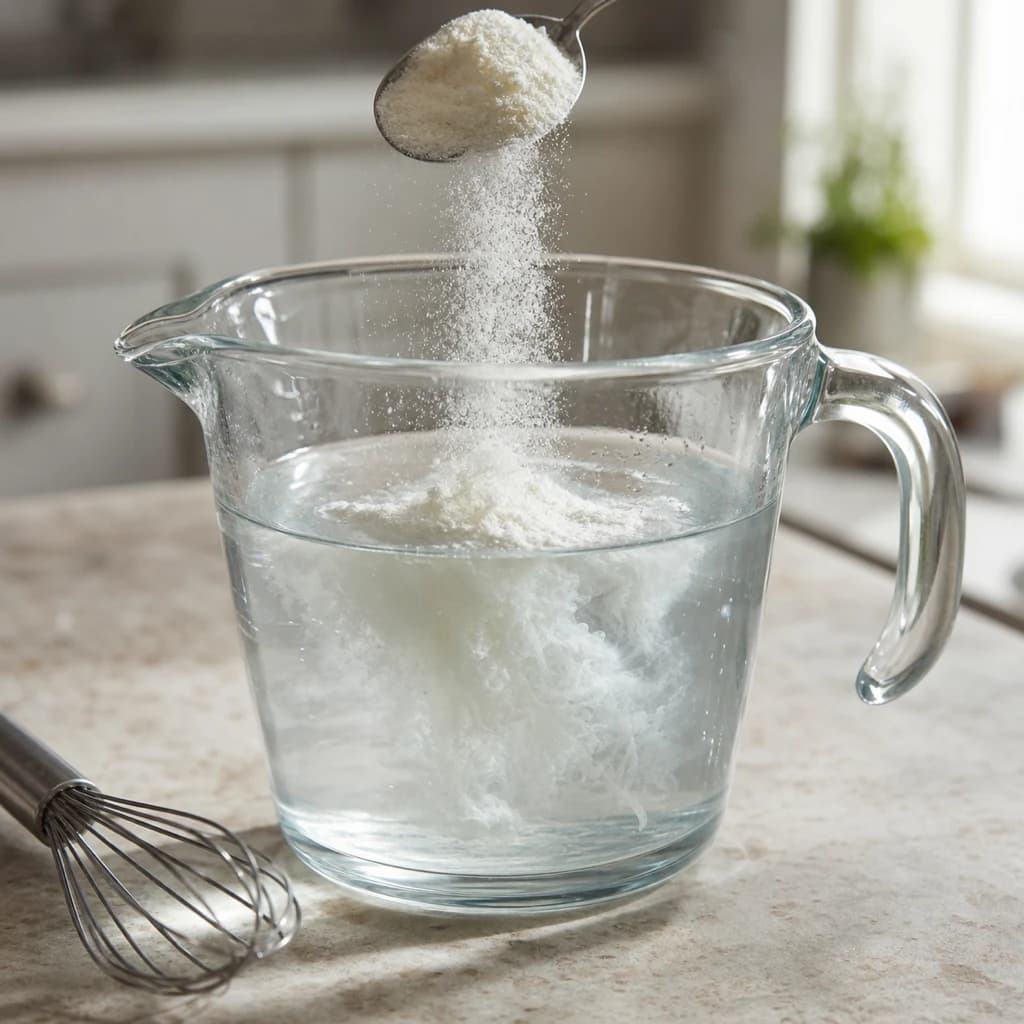
- Reconstituting: sprinkle 1/3 cup (about 32 g) of regular or instant NFDM over 1 cup of cool or warm water, whisk, and let stand a few minutes. Chill if you need it cold.
- Dry-adding in baking: whisk the powder into the flour before adding wet ingredients, or bloom it briefly in a portion of the recipe's water if you want guaranteed even distribution in a lean dough.
- Adjusting hydration: when you dry-add NFDM in place of liquid milk, do not also dump in the original liquid — replace it weight-for-weight with water to keep dough feel consistent.
Common uses
Tips & pitfalls
- Use high-heat NFDM for bread and yeasted doughs; the denatured whey proteins strengthen gluten and the extra lactose browns the crust — the upgrade is visible in the first bake.
- Sprinkle the powder over the water before whisking rather than plopping it in. Even instant powder will clump if it hits the surface in a heap and gets wet on the outside before the inside hydrates.
- Store opened NFDM in a tightly sealed jar or zip bag, ideally with a small desiccant packet, and never next to onions, coffee, or spices — the powder is a sponge for both moisture and odor.
- Label the can with the date you opened it. Drinking quality drops noticeably after 2–3 months; baking quality holds considerably longer.
- Do not swap NFDM one-for-one for buttermilk powder. Buttermilk powder is acidified and salted; using NFDM in its place will leave your pancakes or biscuits flat and missing their tang.
- If the powder smells cardboardy, stale, or faintly painty, the lipids have oxidized. It is still safe to bake into a strongly flavored loaf or roll, but taste a small amount before reconstituting it as a beverage.
- Freeze NFDM in vacuum-sealed single-use bags for long storage; thaw in the unopened bag to keep condensation off the powder, then re-seal tightly.
- When a dough calls for milk powder and you want a more pronounced dairy flavor, bloom the powder in a portion of the recipe's warm water for 5–10 minutes before mixing in — it hydrates fully and distributes more evenly in lean doughs.
Nutrition
Energy
1498 kJ · per 100 g
Where the calories come from
Protein
35.1g
70% DV
Carbs
52.2g
19% DV
Fat
0.7g
1% DV
Fiber
0g
0% DV
Sugars
52.2g
of which
Sodium
549mg
24% DV
Source · USDA FoodData Central · Milk, dry, nonfat, instant, with added vitamin A and vitamin D
View on FDC →In the shops
Matched grocery products
No matched grocery products for Nonfat Dry Milk Powder yet.
Good to know
- Standard of Identity (US)
- FDA 21 CFR 131.125 for plain NFDM; 21 CFR 131.147 when fortified with vitamins A and D
- Composition (dry basis)
- Roughly 49–52% lactose and 34–37% protein, with moisture held to 3–4% and milkfat capped at 1.5% by weight
- Reconstitution ratio
- About 1/3 cup (≈32 g) powder to 1 cup (240 ml) water yields 1 cup of skim milk; 3–4 Tbsp per cup of water for lighter drinks
- Heat classification
- High-, medium-, and low-heat grades, defined by the Whey Protein Nitrogen (WPN) index, predict how the powder will perform in bread versus ice cream
- Drying methods
- Spray-drying (the modern standard, fine and free-flowing) and roller-drying (older, coarser, with a slightly cooked flavor)
- Shelf life
- 12–24 months unopened in a cool, dry, sealed container; effectively indefinite when frozen in moisture-proof packaging
- Weight per cup
- Approximately 90–100 g per US cup, varying by brand and whether the powder is instant or regular
- History
- Commercial spray-drying was patented by Charles E. North in 1922 (US Patent 1,447,757); NFDM became a NASA staple on early missions including Apollo
Substitutes
- Fresh skim (fat-free) milk — Direct volume-for-volume swap when the recipe has enough other liquid; not shelf-stable and not a substitute for the dry milk solids in enriched doughs.
- Whole milk powder — Swap 1:1 in baking when fat is welcome; adds about 26% milkfat, more richness, and a slightly softer crumb.
- Buttermilk powder — Use only when tang and a little extra salt are acceptable; will change the flavor profile of breads, biscuits, and pancakes.
- Evaporated skim milk (canned) — Dilute one part evaporated skim with one part water for a 1:1 swap for liquid skim; does not supply the dry, concentrated milk solids that strengthen dough.
- Soy milk powder (or other plant-based milk powders) — A dairy-free option for drinking; proteins and Maillard behavior differ, so expect different crust color and crumb in bread and a different flavor in caramels.
- Dry whey or whey protein concentrate — Useful in bread for browning and protein boost, but lacks casein and milk fat, so flavor and crumb softness will be noticeably thinner.
Pairs with
Also called
skim milk powder · nonfat dried milk · dry skim milk