Proteins
Spanish Mackerel
Oily, full-flavored fish with firm gray-pink flesh; best grilled, broiled, or seared quickly and brightened with citrus or vinegar to balance its richness.
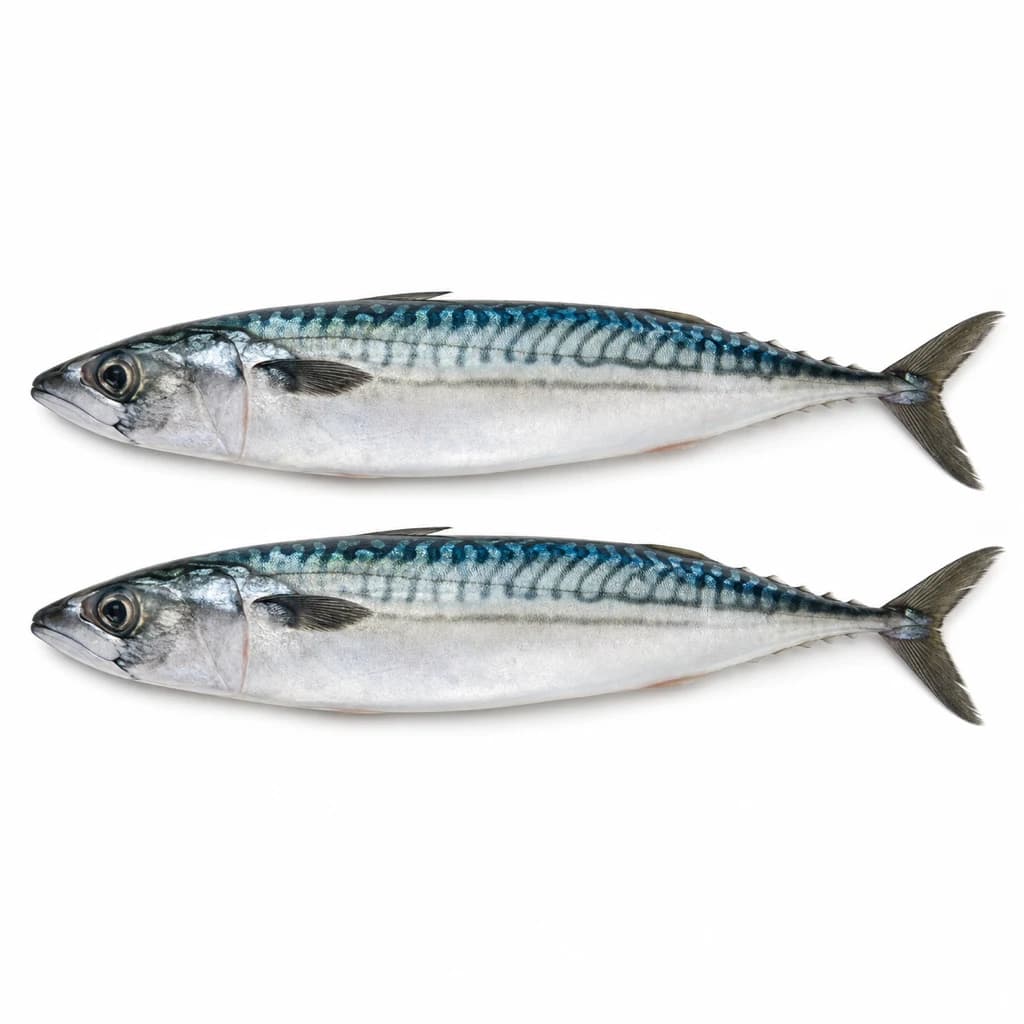
Despite its name, Spanish mackerel isn't a true mackerel — it belongs to the same family (Scombridae) as tuna and bonito, sharing their firm, steak-like flesh and high oil content. Two species dominate U.S. markets: the Atlantic Spanish mackerel (Scomberomorus maculatus), a silver-bronze fish with three rows of yellow spots pulled from the warm western Atlantic, Gulf of Mexico, and Caribbean, and the Pacific Sierra (S. sierra), a slightly smaller, milder cousin caught from California to Peru. At the fish counter it usually arrives gutted and whole at 1½ to 2½ pounds, with skin so iridescent it looks metallic under the lights.
The fish's appeal sits in a middle ground most cooks find forgiving: oilier and more assertive than delicate Atlantic mackerel, but cleaner and more manageable than heavyweight king mackerel. The flesh runs about 8–10 percent fat, gray-pink when raw and turning ivory-white with heat, and holds its shape in big flakes that survive grilling, broiling, and aggressive searing without falling apart. That oil is also why Spanish mackerel rewards acid — a squeeze of citrus, a pour of sherry vinegar, or a salsa verde brightens the richness the way a vinaigrette rescues a fatty steak.
It's a fish that punishes indecision in the kitchen. The window between translucent and overcooked is narrow — past 130°F (54°C) the flesh dries out fast — so an instant-read thermometer earns its keep. Spanish mackerel also oxidizes more quickly than leaner fish, so buying from a high-turnover counter and cooking it within a day or two of purchase makes the difference between a briny, savory meal and a tired, oily one. Mercury is moderate (current FDA/EPA guidance lists it as a 'Good Choice' for one weekly serving for adults), but pregnant women should treat it like albacore tuna.
- Measured in
- g
- Storage
- Keep On Ice In The Coldest Part Of The Fridge; Very Perishable, Use Promptly.
Allergens
Find it in
Types & varieties
Scomberomorus maculatus; the classic Gulf and Atlantic fish with vivid yellow spots — the dominant market variety on the U.S. East Coast and Gulf.
Scomberomorus sierra; smaller (often under 2 lb), slightly milder and softer-fleshed; common in Mexican and Central American markets.
Scomberomorus cavalla; much larger, oilier, and stronger-flavored, frequently substituted; identified by a dip in the lateral line under the second dorsal fin.
Scomberomorus regalis; Caribbean cousin with a striped pattern instead of spots, prepared identically.
Scomberomorus japonicus; the East Asian relative, prized for spring sashimi and tataki when in season.
King mackerel vs. Spanish mackerel: don't confuse them
King mackerel is routinely sold next to Spanish mackerel — and sometimes mislabeled as it. They're close cousins in the same genus, but king is the heavyweight: it grows past 20 pounds, runs noticeably oilier, carries stronger 'fishy' flavor, and accumulates more mercury. A few rules of thumb keep you on the right fish:
- Spanish mackerel maxes out around 9 lb; kings run larger and are typically cut into much bigger steaks.
- The lateral line on a Spanish mackerel runs straight from gill to tail; on a king mackerel it dips sharply under the second dorsal fin.
- Spanish has three rows of round yellow spots; cero has longitudinal stripes; king has no spots at all.
- When in doubt, ask the seller to identify the species in writing. Lower price, larger steaks, and a heavier smell are all red flags that king is being passed off as Spanish.
Common uses
Tips & pitfalls
- Cook it medium-rare to medium — pull the fish from heat when the center still looks translucent, ideally around 130°F (54°C) internal; past that the flesh dries out fast.
- Score thick fillets or whole fish with 3–4 shallow diagonal slashes on each side so heat penetrates evenly and the skin crisps without buckling.
- Take the temperature on the thickest part of the back, not the belly — the belly is fattier and runs cooler, so it gives a misleadingly low reading.
- Strip off the dark lateral bloodline before cooking for a milder flavor; leave it on if you want iron-rich, almost steak-like depth.
- Lean on bright acid — lemon, lime, sherry or rice vinegar, or a caper-and-olive salsa verde — to cut through the fish's richness.
- A quick 10-minute brine in a 5% salt solution tightens the flesh and helps it hold moisture during high-heat cooking.
- For skin-on searing, start in a hot oiled pan skin-down, press flat for 30 seconds, and don't move it until it releases on its own — that prevents tearing.
- Go easy on the oil: the flesh is already fatty, so a thin film plus a hot grill is enough. Too much oil drips, smokes, and turns acrid.
- For raw or lightly cured service (ceviche, tataki, sashimi), freeze to -4°F (-20°C) for at least 7 days to kill parasites before preparation.
- Common mistake: treating Spanish mackerel like a lean white fish. Don't overcook it, drown it in cream, or bury it under delicate herbs that vanish against the oil.
Nutrition
Energy
582 kJ · per 100 g
Where the calories come from
Protein
19.3g
39% DV
Carbs
0g
0% DV
Fat
6.3g
8% DV
Fiber
0g
0% DV
Sugars
0g
of which
Sodium
59mg
3% DV
Source · USDA FoodData Central · Fish, mackerel, spanish, raw
View on FDC →In the shops
Matched grocery products
No matched grocery products for Spanish Mackerel yet.
Good to know
- Scientific names
- Scomberomorus maculatus (Atlantic) and Scomberomorus sierra (Pacific, often sold as Monterey or Sierra Spanish mackerel)
- Family
- Scombridae — the same family as tuna and true mackerel; a mackerel-like fish, not a true mackerel
- Identifying marks
- Iridescent silver-bronze body with three rows of round yellow or bronze spots; elongated, fully-spined first dorsal fin
- Typical size
- 1–3 lb (0.5–1.5 kg) whole, up to about 9 lb (4 kg); usually sold at 1.5–2.5 lb
- Flesh
- Gray-pink raw, ivory-white cooked; firm, large flakes; about 8–10% fat
- Mercury
- Moderate — FDA/EPA classify as a 'Good Choice' (one weekly serving) in current advisories; pregnant women should limit
- Freshness cues
- Clear bulging eyes, bright iridescent skin with crisp spots, tight red-tinted gills; flesh springs back and smells briny, never sour or oily
- Storage
- Keep at 32–38°F (0–3°C) and use within 1–2 days fresh; freezes well for 2–3 months if vacuum-sealed
Substitutes
- King mackerel — Closest relative; same genus but much larger, oilier, and stronger. Use a smaller portion and the same cooking method.
- Cero mackerel — Caribbean look-alike; a true drop-in substitute when available.
- Atlantic mackerel — Same family but smaller and more delicate — scale cook time down and handle it more gently.
- Bluefish — Similar oil content and assertive flavor; sear hot, finish with acid, and trim away any dark flesh thoroughly.
- Large sardines — Same flavor profile in miniature and bony; a strong alternative when Spanish mackerel isn't around.
- Bonito or skipjack — Leaner than Spanish mackerel but holds up to aggressive grilling and accepts the same vinegar-and-citrus treatments.
Pairs with
Also called
sierra · Scomberomorus · atlantic spanish mackerel