Tying & Fastening
Bamboo Skewer
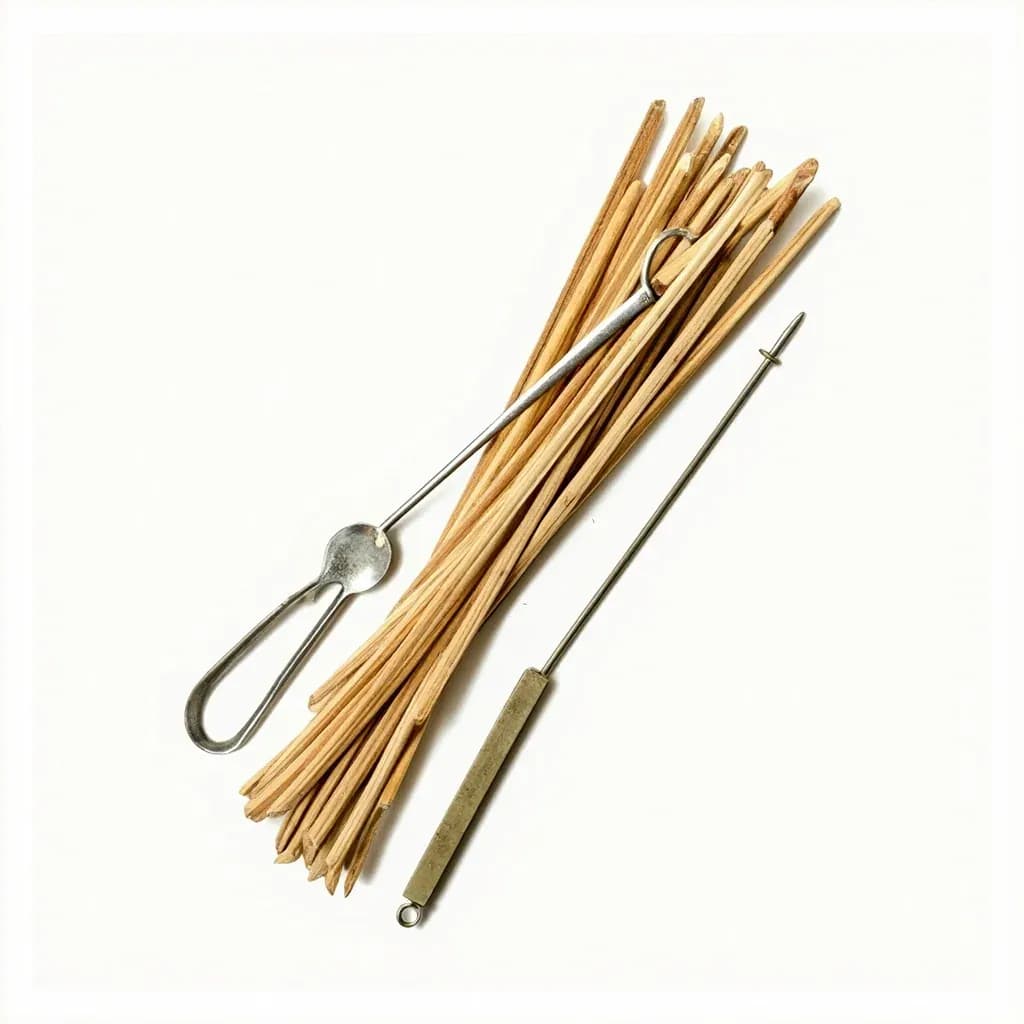
Thin disposable bamboo stick for kebabs, satay and yakitori; soak in water before grilling so the exposed ends don't scorch, unlike a reusable metal skewer.
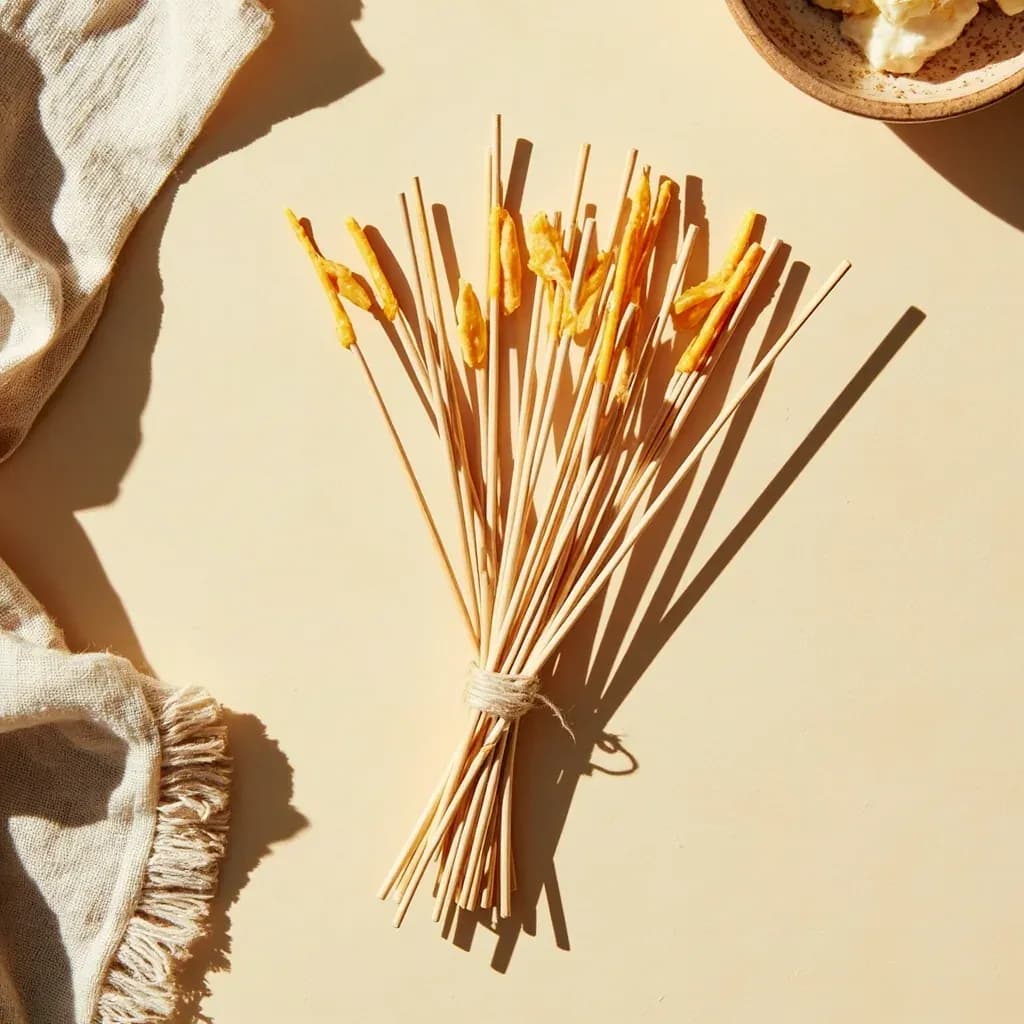
A bamboo skewer is a thin, straight stick cut from the inner culm of bamboo, tapered at one or both ends, and sold in a range of diameters and lengths for threading food over direct heat. Cheap, sanitary, and disposable, it is the default tool for weeknight kebabs, party appetizers, and most of Asia's great grilling traditions — Japanese yakitori, the satay of Indonesia, Malaysia and Thailand, and the cumin-and-chili lamb chuan'r of Xinjiang. Unlike a metal skewer, bamboo carries almost no thermal mass: its exposed ends scorch quickly and, if dry, will ignite around 400 °F / 200 °C. That single fact is why every cook who uses them learns the same short ritual — a long soak in water before the sticks ever see the fire.
What bamboo buys you is convenience. There is nothing to wash, no flavor carryover between batches, and a fresh skewer threads as easily into a cherry tomato as into a chunk of pork shoulder. What it costs you is durability under heat: even well-soaked sticks will char to ash if a kebab sits too long over an open flame. The trade-off shapes every decision around them — loading technique, grill setup, glaze timing, and how long the bundle sits in a bowl of water on the counter before the cook.
The real skill with a bamboo skewer is less about the stick than about the assembly. Uniform cuts, light loading, and the discipline of leaving a small handling gap at each end matter more than the brand you buy. Get those right and bamboo is hard to beat; ignore them and you will spend the cook fishing charred sticks and half-off kebabs out of the coals.
Alternatives
Types & varieties
Cocktail and appetizer length (10–15 cm); used for fruit, caprese, mini satay, and presentation picks where the stick is part of the look.
The workhorse 20 cm size sold in most supermarkets; suited to uniform cubes of chicken, pork, beef, and vegetables.
25–30 cm; for denser meats, whole prawns, and larger vegetable pieces; less prone to splitting when loaded.
Flat cross-section keeps food from spinning when you flip the skewer over the fire; the traditional choice for yakitori.
Pointed at both ends so the food sits between the points and no stick protrudes; common for passed hors d'oeuvres.
When to Skip Bamboo and Use Metal Instead
Bamboo is the right tool most of the time, but not always. Reach for stainless or other metal skewers when any of the following apply, because the cost of a charred stick or a snapped kebab outweighs the convenience of disposability.
- Long cooks over wood or charcoal where the sticks will sit near flame for more than a few minutes — whole fish, large lamb pieces, or indirect-grill setups.
- Reverse-seared or low-and-slow applications where the meat holds for an hour or more; the bamboo will give up long before the food is done.
- Dishes where you want heat conducted through the skewer into the food, like chunks of dense root vegetable or thick steak cubes where the metal helps carry heat inward.
- Any plating where a clean, reusable, food-grade metal pin is preferred for hygiene or appearance — tasting menus, buffets, or catered events.
- High-volume cooking, where the labor of soaking 200 skewers and disposing of them outweighs the small upfront cost of a set of flat metal skewers.
Common uses
Tips & pitfalls
- Soak in cool water for at least 30 minutes before grilling, and weigh the bundle down with a plate or a damp towel so the sticks stay fully submerged; thicker skewers benefit from an hour or more.
- Leave a small gap — roughly 1 cm / 0.5 in — at each end of the skewer for safe handling and to keep food from sliding off when you turn it.
- Cut all ingredients to the same size so they finish at the same time; a 2 cm cube of chicken and a 2 cm cube of pepper will both reach the right internal temperature together.
- Use two parallel skewers through flat items like fish fillets, scallops, or large prawns so the food stays flat and doesn't spin or fold when you flip it.
- Don't force food onto the skewer — split bamboo loses its grip and may snap mid-cook; shift the entry point slightly or step up to a thicker skewer.
- Brush the assembled kebab with oil after threading rather than slathering the ingredients beforehand, which makes your fingers slippery and the threads hard to load; save sugar-heavy glazes for once a crust has started to form, since raw sugar glazes burn and glue food to the bamboo.
- Keep a spray bottle of water handy to douse flare-ups from dripping fat — drippings are the main reason skewers ignite in the middle of a cook.
- Wrap the exposed tips in a small piece of aluminum foil if you are cooking over very hot coals and want extra insurance against charring.
- Discard after one use; burned, stained, or cracked skewers can snap unexpectedly and are not worth the risk.
Good to know
- Material
- Bamboo (typically the inner culm of Moso or similar species); natural, untreated wood with a smooth, slightly fibrous surface.
- Origin
- Produced primarily in China, Vietnam, Indonesia and Japan; skewered grilling is ancient and widespread across Asia.
- Standard diameter
- ~3 mm cocktail/pickup, ~4 mm general purpose, ~5 mm heavy-duty, ~6–8 mm for fish or large cuts.
- Standard length
- 15 cm / 6 in, 20 cm / 8 in (most common in U.S. retail), 25 cm / 10 in, 30 cm / 12 in.
- Ignition point
- Around 400 °F / 200 °C when dry; sustained contact with flame or coals chars the exposed ends quickly even after soaking.
- Pre-soak time
- 30–60 minutes in cold water; longer for thicker skewers, and some cooks soak overnight for extra insurance on very hot fires.
- Reusability
- Single-use; burned, stained, or cracked skewers can snap unexpectedly and should be discarded.
- Storage
- Indefinite shelf life if kept dry; store sealed so the sticks don't absorb humidity and need re-soaking before use.
Also called
bamboo stick · wooden skewer · satay skewer · kebab skewer