Tying & Fastening
Cocktail Pick (Frill)
Short decorative pick that spears olives, onions, and citrus garnishes for drinks or pins canapés and appetizers, with a frilled or beaded top.
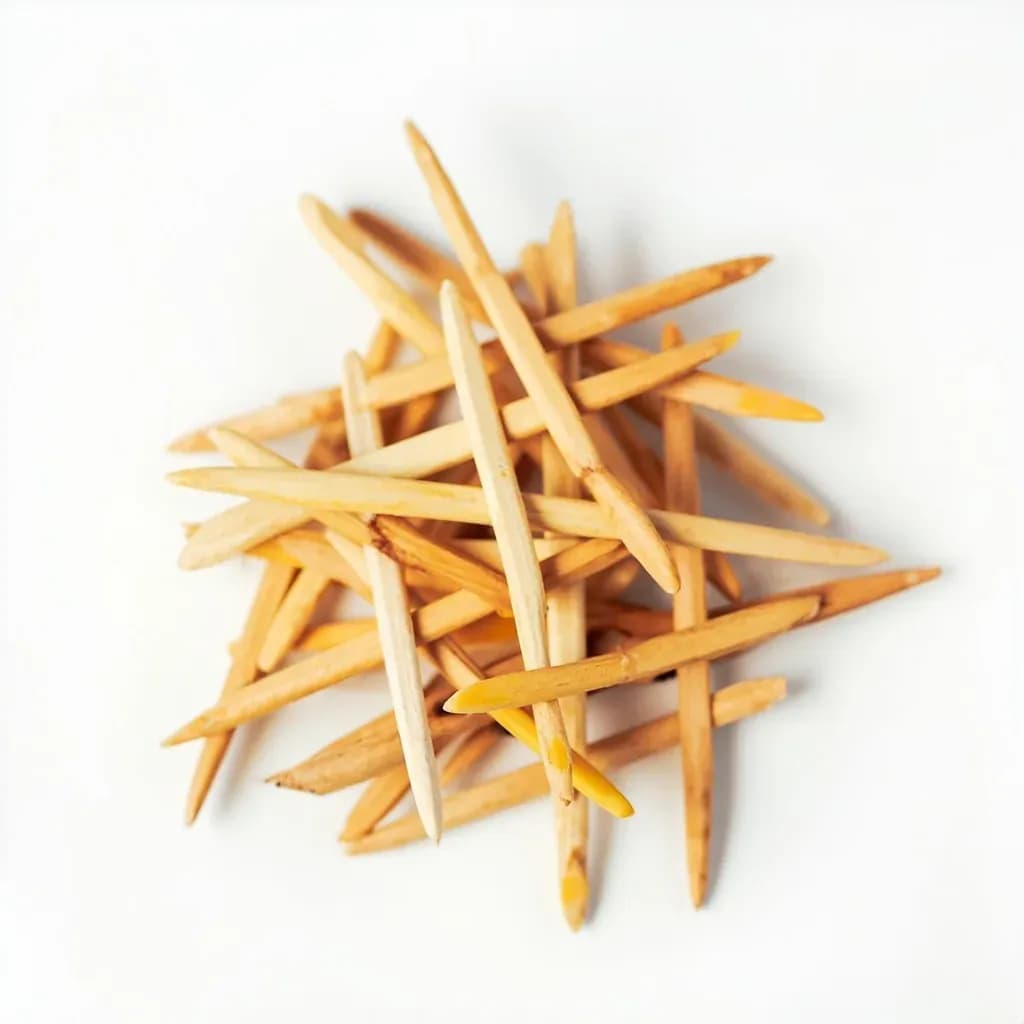
A cocktail pick is a short, pointed stick designed to do two things at once: hold a garnish in a drink and act as a small piece of visual theater at the rim of the glass. At its simplest it is a splinter-buffed wooden pick about 7–10 cm long, sharpened at one end and finished with a decorative top — traditionally a pleated paper frill, which is the source of the name "frill pick." Modern versions use bamboo, food-grade plastic, or stainless steel, and the tops range from plain to beaded, cellophane-flagged, or molded into novelty shapes.
Beyond the bar, the cocktail pick is one of the most under-appreciated tools on a buffet line. Its short length and sharp point make it ideal for pinning together layered canapés, tea sandwiches, and charcuterie components that would otherwise slide apart or need toothpicks buried so deep guests cannot find them. It is, in effect, a miniature skewer scaled for single bites and small glasses — and that scale is the whole point. A standard bamboo skewer looks clumsy in a coupe; a proper cocktail pick disappears into the garnish and lets the drink do the talking.
Because cocktail picks sit in contact with food and often with clear or shaken cocktails, material matters. Look for splinter-buffed wood, BPA-free plastic, or stainless steel, and remember that paper frills are decorative only — they are not meant to be eaten and should be discarded along with the pick after service.
Types & varieties
Plain wood pick topped with a pleated paper frill — the classic martini olive pick, available in striped red/white, black/white, and rainbow
Wood or plastic pick finished with colored plastic or wooden beads; reusable dishwasher-safe versions exist for higher-end service
Pick with a crimped cellophane flag instead of a pleated paper frill; common on Tiki and tropical drinks
Undecorated, splinter-free bamboo pick — the workhorse for canapés, tea sandwiches, and buffet platters
Stainless steel pick shaped like a miniature sword, used in martinis and craft cocktails where a reusable, photogenic pick is wanted
Pick with molded plastic toppers — mustaches, umbrellas, palm trees, skulls, anchors — for themed parties and holidays
Pick with a closed loop in place of a sharp point, designed to cradle a cherry or olive without piercing it
Elongated 12–15 cm version that doubles as a stirrer for tall drinks like highballs and Collinses
Picking the right pick for the drink
The pick should match the drink in scale and mood. A coupe or Martini glass wants a short 7–9 cm pick so the garnish sits at or just above the rim without dominating it. A highball or Collins can take a longer stirrer-pick that doubles as a small spoon for the guest. For clear spirits served up, choose white or transparent picks so the eye reads the garnish, not the stick. For shaken or opaque drinks — fizzes, sours, Tiki drinks — a colored frill or cellophane flag reads clearly against the liquid and adds to the theater of the serve.
Spearing technique for garnishes
How you load the pick matters as much as the pick itself. A few habits separate a tidy garnish from an awkward one.
- Spear olives and cherries through the side, parallel to the long axis, so the pick lies flat against the rim instead of jutting out.
- For a Gibson, slide the pickled onion onto the pick through the equator so it sits like a bead on a string.
- Stack three garnishes (olive, onion, cherry) by spearing each through its center, alternating colors for visual contrast.
- When pinning a citrus twist, fold the twist peel-side out and spear it once near the fold so the oils spray when the pick is lifted.
Picks on the buffet line
On a platter, cocktail picks are doing structural work, not just decoration. Use them to anchor prosciutto around melon, to pin a stuffed date closed, or to hold together a layered tea sandwich whose top slice keeps sliding. For canapés taller than about 2 cm, switch to a longer bamboo skewer — a cocktail pick is too short to reach the base and will leave the bite leaning. Keep a small dish of brine or simple syrup next to your prep station and stand pre-loaded picks in it so garnishes stay glossy until service.
Common uses
Tips & pitfalls
- Choose splinter-buffed or sanded wood picks so fibers do not shed into clear or shaken cocktails — visible splinters ruin the drink's appearance.
- For clear drinks, reach for white or transparent picks so the garnish, not the stick, is the visual focus.
- Spear olives through the side, not end-to-end — a side-speared olive lies flat against the rim and looks intentional instead of skewered.
- Pre-load garnishes during prep and stand picks in a small dish of brine (for olives and onions) or simple syrup (for fruit) so they stay glossy and hydrated until service.
- Anything thicker than about 2 cm belongs on a longer bamboo skewer, not a cocktail pick — short picks cannot anchor a tall canapé and the bite will lean.
- If you only have bamboo skewers, snap or cut them to cocktail-pick length (about 8 cm) so they look proportional to the glass instead of towering over it.
- Avoid colored cellophane picks in hot or sunlit service — the dye can bleed into the drink and stain lighter spirits.
- Discard paper-frill picks after one use; frills wilt quickly once wet and look tired by the second round.
- For catering, color-code picks by garnish type (red for olive, black for cherry, white for onion) to speed glass identification on a busy bar.
- Reusable stainless steel picks should be washed and dried flat so the decorative tops do not bend in a glass rack.
Good to know
- Category
- Bar and buffet garnish / fastening pick
- Common materials
- Wood (birch, bamboo), food-grade plastic, stainless steel; decorative tops in pleated paper, cellophane, or molded plastic
- Typical length
- 7–10 cm (about 3–4 in) overall, with a 2.5–4 cm sharpened point
- Decorative top styles
- Pleated paper frill, crimped cellophane flag, plastic or wooden beads, novelty molded shapes (swords, umbrellas, mustaches, skulls)
- Typical point
- Standard pointed tip; loop-top versions have a closed loop instead of a point to cradle olives or cherries without spearing
- Single-use vs. reusable
- Wood, bamboo, and plastic are single-use; stainless steel picks and beaded picks with metal shafts are reusable and dishwasher-safe
- Pack size
- Sold in bulk boxes of 50, 100, 200, 500, or 1000
- Food safety note
- Paper frills are decorative and not consumed; wood should be splinter-buffed; plastic should be BPA-free
Also called
cocktail toothpick · frill pick · garnish pick · appetizer pick · olive pick