Storage & Containers
Cork / Bottle Stopper
Cork or stopper used to seal bottles of wine, oil, vinegar, and infusions.
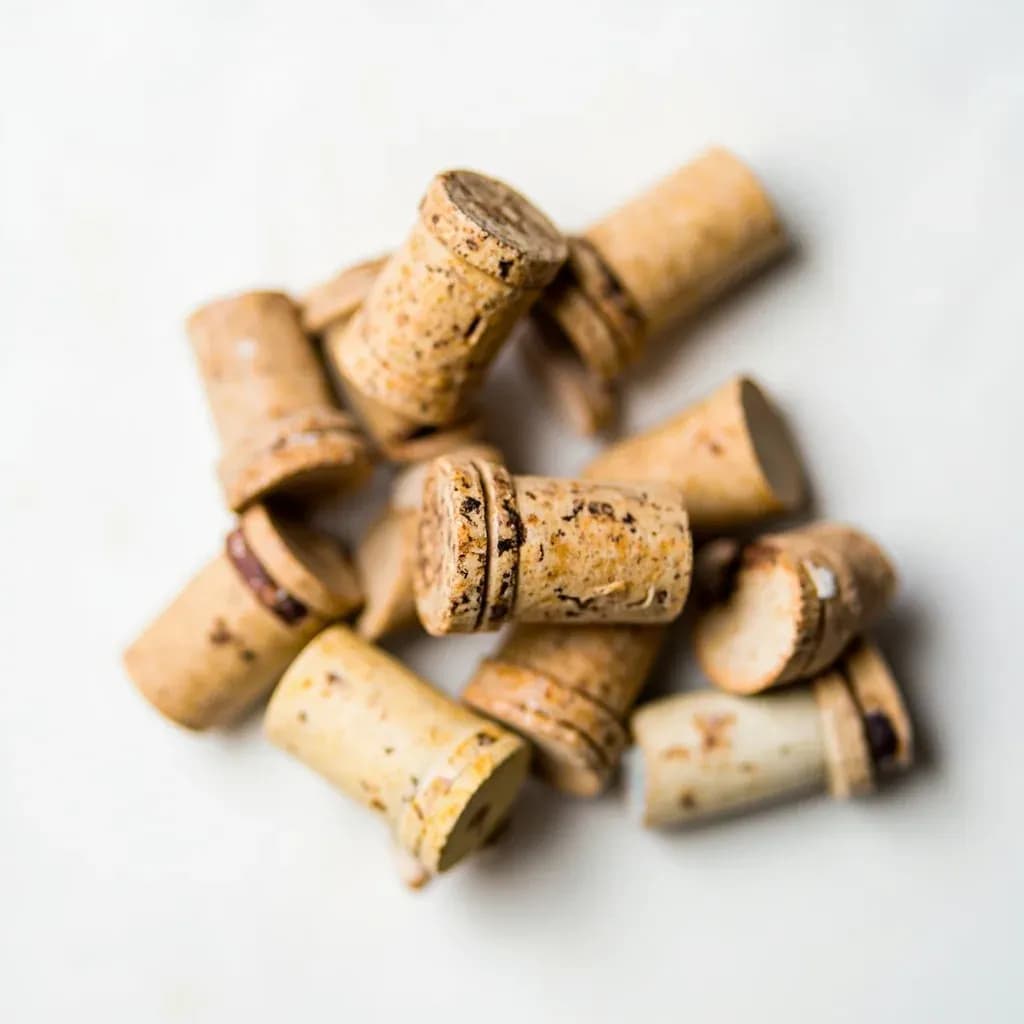
A natural or synthetic cork used to seal bottles of wine, oil, vinegar, syrups, and homemade infusions. It plugs the neck airtight to slow oxidation and prevent leaks during storage and pouring. Pour-spout and non-refillable stopper variants combine sealing with controlled dispensing for oils and spirits.
Few kitchen supplies are as quietly essential as the bottle stopper. The traditional version — cork — is the harvested bark of the cork oak (Quercus suber), prized above all for its compressibility: a cylinder of cork can be squeezed to roughly half its diameter and still spring back to form a tight seal against glass. That single property is what made cork the closure of choice for wine bottles for centuries, and it remains the reason cork, in many forms, still lines the kitchens of home cooks who bottle their own oils, vinegars, ferments, and infusions.
Cork does, however, have a well-known flaw. A small percentage of natural corks (industry estimates generally run 1–3%) harbor TCA (2,4,6-trichloroanisole), a compound that migrates into wine and produces a musty, wet-cardboard aroma known as cork taint. Cork is also porous in ways that matter to a cook: it absorbs strong odors from the surrounding environment, and over months of contact with oil it can soak up fat and become a vector for rancidity. That is why serious cooks increasingly reach for non-porous alternatives — food-grade silicone, glass stoppers with silicone gaskets, stainless steel pour-spouts — for everyday kitchen storage, while reserving traditional cork for wine and decorative use.
Matching the stopper to the bottle is a small but real piece of kitchen practice. A bar-top cork with a porcelain cap suits a bottle of aged balsamic; a glass stopper with a silicone gasket is better for an olive oil cruet kept on the counter; a wide champagne-style cork belongs on a sparkling ferment, not a decanter of still wine. Knowing the variants, the grades, and the limits of the material saves a cook from leaks, off-flavors, and ruined bottles.
Alternatives
Types & varieties
Single piece of cork bark; the premium grade for still wines, graded 'Flor' and 'Super' at the top end, down through numbered grades
Natural cork whose surface pores have been filled with cork dust and glue; smoother appearance, slightly lower grade
Compressed cork particles bonded with food-safe adhesive; inexpensive, common for everyday still wines and many kitchen stoppers
Two discs of natural cork glued to an agglomerated body; combines the seal of natural cork with size consistency and lower cost
Wider diameter, often agglomerated body with one or two natural cork discs at the wine-contact end; mushrooms out after insertion
Short, mushroom-shaped cork with a decorative wooden, plastic, or porcelain cap; standard for spirits, oils, and vinegars
Cylindrical cork with a T-shaped handle for easy hand insertion; popular for decanters, carafes, and infusion bottles
Short straight cylinder; widely used for oil cruets, vinegar bottles, and homemade infusions
Natural cork dipped in colored sealing wax; traditional for liqueurs, homemade spirits, and gifts
Extruded food-grade polymer (Nomacorc-style); consistent size, no TCA risk, but limited oxygen transmission — not ideal for very long wine aging
Flexible food-grade silicone; dishwasher-safe, airtight, reusable; common in vacuum wine-saver systems and home storage
Solid glass with an integrated silicone ring; favored for olive oil bottles and decanters because it is non-absorbent and odor-neutral
Ceramic top with cork or silicone insert; traditional for cruets and decorative bottles
Flanged metal stopper with a silicone gasket; used for spirits, oils, and controlled-pour dispensing
Metal cap with a cork or PVC liner; standard for beer and carbonated ferments rather than wine
Sizing, Grading, and Inserting a Cork
The seal a cork makes depends on a precise match between the cork's diameter and the bottle's bore. A cork that slides in with only light hand pressure and a gentle twist almost always seats correctly; one that needs to be forced will either compress unevenly, fail to bounce back, or crumble.
- Standard still-wine bottles have a bore of roughly 18–19 mm; a #9 cork (about 24 mm nominal) compresses into it.
- Champagne and sparkling-wine bottles have a similar bore to still wine (around 18 mm), but require a much wider cork (30–31 mm) compressed tightly into the neck to withstand internal carbonation pressure.
- Natural wine corks are graded by visual quality — 'Flor' is the top tier with no visible lenticels, 'Super' has very few, and grades descend through first, second, third, and so on, with more visible lenticels at each step. Higher grades are usually reserved for wines intended to age.
- For kitchen bottles (oils, vinegars, infusions), measure the inner mouth and choose a tapered bar-top cork or plug whose top diameter slightly exceeds the opening; the taper lets it seat cleanly.
- Insert with a gentle twisting motion, never a hammer or mallet.
Cork, TCA, and Flavor Taint
Cork taint from TCA is the most common reason a wine smells off, and it travels with the cork into the bottle. The compound forms when natural cork interacts with chlorinated compounds and certain molds. It can also develop in wooden barrels, so a corked wine is not always the cork's fault, but in roughly 1–3% of bottled wine cork is the source.
- Taint smells like damp cardboard, wet dog, or musty basement; if a wine smells flat and stale rather than flawed, it is probably not TCA.
- Synthetic polymer and silicone stoppers carry no TCA risk and are a good choice for wine you plan to drink within a year.
- If you bottle your own wine, sanitize corks in a sulfite solution before insertion and store finished bottles on their side so the wine stays in contact with the cork end.
Common uses
Tips & pitfalls
- Never reuse a natural wine cork for long-term wine storage — its cell structure is permanently compressed after the first insertion and will eventually leak.
- Match cork diameter to the bottle bore: a stopper that slides in with light hand pressure and a gentle push gives the best, longest-lasting seal.
- Sanitize corks for ferments and infusions by simmering in water for 10–15 minutes or by dipping briefly in a no-rinse sanitizer; skip this for wine corks, which should be used as supplied.
- Keep corks away from strong odors (onions, spices, cleaning products) — cork is highly porous and will taint whatever it later seals.
- For oils stored on the counter, skip natural cork entirely: a glass stopper with a silicone gasket or a stainless pour-spout is non-absorbent and will not go rancid.
- If a cork crumbles on insertion, do not push fragments into the bottle — decant the contents and reseal with a fresh stopper.
- Store unused corks in a cool, dry, dark place at roughly 50–70% humidity; overly dry corks lose elasticity and crumble, overly damp corks grow mold and risk TCA.
- Glass stoppers with silicone gaskets are usually dishwasher-safe; natural cork stoppers are not — rinse them briefly and air-dry upright.
Good to know
- Material
- Bark of the cork oak (Quercus suber); also manufactured as synthetic polymer, silicone, glass, porcelain, or stainless steel stoppers
- Source regions
- Portugal, Spain, Algeria, Morocco, Tunisia, Italy, France — Portugal alone produces roughly half of the world's cork
- Harvest cycle
- First harvest at about 25 years of tree age; subsequent harvests every 9–12 years; bark regenerates each time
- Typical wine-cork dimensions
- Length 38–45 mm; diameters from ~22 mm (#7) up to ~26 mm (#10) for still wine; champagne corks are wider (~30–31 mm) and often composite with a disc base
- Bar-top cork size
- Top diameter ~15–25 mm; tapered body to fit standard bottle openings
- Compressibility
- Cork can be compressed to roughly half its diameter and still spring back to form a seal — the defining functional property of the material
- Key flaw
- TCA (2,4,6-trichloroanisole) causes cork taint, a musty/moldy off-aroma in wine; industry rate is generally cited around 1–3% of bottles
- Working temperature
- Cork performs reliably from about −20 °C to +90 °C; silicone stoppers tolerate much higher heat, often to ~200 °C or more
- Lifespan in use
- A natural wine cork is effectively single-use for long-term wine aging; for oil, vinegar, and infusions it can be reused many times if kept clean and dry
Also called
Cork · Cork Stopper · Cork / Non-Refillable Pourer Stopper · Non-Refillable Pourer Stopper · Bottle Stopper
Related

Freezer Bags
Thick, sealable bags built to fight freezer burn

Storage Bags
Resealable bags for fridge storage and marinating

Storage Container
Lidded container for leftovers, prep, and meal kits

Glass Container
Oven-to-fridge glass that won't stain or hold odors

Plastic Container
Lightweight, stackable storage for everyday leftovers

Vacuum Sealer Bags
Airtight bags for long freezing and sous-vide

Reusable Bags
Washable silicone bags that replace single-use plastic

Mason Jar
Sealed glass jar for preserves, pickles, and storage