Heat & Safety
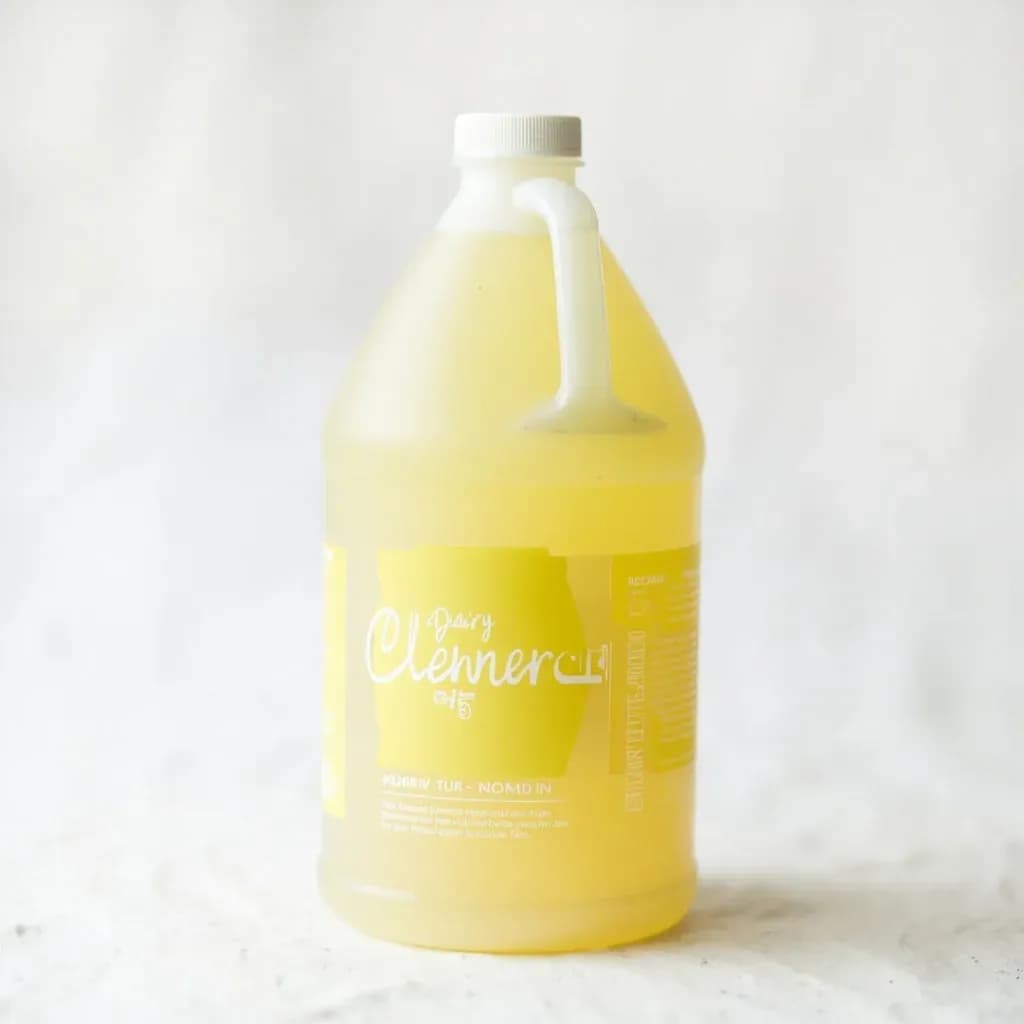
Dairy Acid Cleaner (CIP)
An acidic cleaning agent that dissolves mineral scale and milkstone in dairy equipment.
A dairy acid cleaner is an acidic detergent used in clean-in-place (CIP) cycles for milk and cheese equipment. It strips away mineral deposits and milkstone that alkaline detergents leave behind, keeping tanks, pasteurizers, and pipes sanitary. It is typically alternated with an alkaline detergent in a regular cleaning rotation.
Dairy acid cleaner is the acid detergent used in the second wash stage of Clean-In-Place (CIP) systems that clean milk-processing equipment without disassembly. Its job is singular and specific: dissolving milkstone — the hard, grayish-white film of calcium phosphate, calcium citrate, and denatured milk protein that alkaline cleaners cannot touch. While the chlorinated alkaline wash that runs before it lifts butterfat, whey protein, and most organic soil, it leaves the mineral fraction baked onto hot stainless surfaces, particularly inside plate heat exchangers, separators, and cheese vats. The acid stage, circulated at 50–70 °C in a 0.5–2% solution for 20–30 minutes, protonates those calcium salts and carries them away as soluble ions, leaving the metal clean and the next product run free of off-flavors and grit.
The reason the acid stage matters as much as the alkaline one comes down to heat transfer and bacterial harborage. A milkstone layer only 1 mm thick on a pasteurizer plate can reduce heat transfer efficiency by 20–30%, which forces steam pressure up, scorches product at the hot spots, and quietly inflates energy bills. The same porous film shelters thermoduric bacteria and biofilms that survive the alkaline wash, so an incomplete acid cycle is one of the most common root causes of failed coliform and standard plate-count tests in regulated dairies. Most CIP programs therefore alternate acid and alkaline every cycle, with a documented concentration, temperature, and contact time that an inspector can audit against the Pasteurized Milk Ordinance in the US or EU Regulation 852/2004 in Europe.
In practical terms, dairy acid cleaners are mild-to-strong mineral or organic acids — phosphoric, nitric, sulfamic, citric, or nitric/phosphoric blends — usually sold as liquid concentrates, occasionally as powders. They are formulated for stainless steel (300-series), EPDM rubber, and most food-grade plastics, and they should never see copper, aluminum, galvanized steel, tin, or mild steel. Used correctly and in the right sequence, an acid cleaner is what keeps an HTST pasteurizer running cleanly day after day, and what allows a small farmstead creamery to turn out consistent cheese without mysterious metallic or rancid notes creeping into the wheel.
Alternatives
Types & varieties
The mildest standard dairy acid; good for routine milkstone removal on stainless with a food-safe residue profile; favored in smaller creameries and farmstead operations
Stronger and more aggressive; excellent on tenacious milkstone and rust; passivates stainless steel by enriching the chromium oxide layer; corrosive fumes demand good ventilation
Solid form, easy to ship and store; a strong descaler for heat exchangers, boilers, and hot-water circuits; slower acting than liquid acids at lower temperatures
Naturally derived, biodegradable, low-toxicity; the preferred choice in organic, artisan, and farmstead dairies; less aggressive so requires higher concentration or longer contact
The industry workhorse; combines nitric's passivation and descaling strength with phosphoric's buffering and safer handling; the most widely specified acid in commercial CIP
Acid-stable surfactant added so the product clings to vertical surfaces; intended for manual cleaning of open cheese vats, curd tables, and equipment exteriors — not for CIP circulation loops
Formulated for plate heat exchangers, evaporators, and HTST pasteurizers where foam would cause pump cavitation and incomplete coverage
Acidified sodium chlorite or peroxyacid blends that combine acid wash and sanitizing in a single stage; used in some HTST plants under strict regulatory controls
Why acid comes after alkaline, never before
The CIP sequence exists in this order for a specific chemical reason. A chlorinated alkaline wash (typically 1–2% sodium hydroxide with sodium hypochlorite at 70–80 °C) is what emulsifies butterfat and solubilizes the bulk of milk protein — the organic soil that makes up most of what is on the surface after a run. The acid stage, run cooler and at lower concentration, then attacks the inorganic residue that the alkaline wash leaves behind: calcium and magnesium salts precipitated by heat, plus a thin layer of denatured protein fused onto them. If the order is reversed, acid first drops the pH of any residual protein film below its isoelectric point and causes it to coagulate and bond tightly to the metal, where it then bakes on during the subsequent alkaline stage and becomes nearly impossible to remove without mechanical scrubbing. Most CIP controllers therefore enforce hard interlocks — the acid pump will not start until the alkaline rinse conductivity has returned to baseline.
- Pre-rinse with warm water (40–45 °C) to push residual product out of lines and recover solids before chemical dosing
- Chlorinated alkaline wash: 1–2% NaOH + 50–150 ppm available chlorine, 70–80 °C, 20–30 min circulation
- Intermediate potable-water rinse until runoff conductivity and pH approach incoming water
- Acid wash: 0.5–2% dairy acid, 50–70 °C, 20–30 min circulation
- Final potable rinse until runoff pH matches incoming water (typically 6.5–8.0)
Milkstone and the cost of skipping the acid cycle
Milkstone is the quiet failure mode of any dairy operation that lets its acid cycle slip. It forms fastest on the hot side of plate heat exchangers, on the bowl and disc stack of separators, inside cheese vat jackets, and along the walls of cream storage silos — anywhere mineral-rich milk sits against stainless above 60 °C. Because it is only weakly soluble in alkaline detergent, it accumulates in thin, hard layers that are nearly invisible until a test swab or a heat-transfer drop reveals them. The downstream consequences are mechanical, microbiological, and economic at once.
- Heat transfer: a 1 mm milkstone layer can cut plate heat exchanger efficiency by 20–30%, raising steam pressure and scorching product at hot spots
- Microbiology: milkstone harbors thermoduric bacteria and biofilms that survive the alkaline wash and resurface in the next product run as elevated standard plate counts
- Product quality: dissolved mineral scale contributes calcium and off-flavors to cheese, yogurt, and fluid milk; grit from flaking scale is a recall trigger in regulated plants
- Equipment life: under-deposit corrosion and crevice attack shorten the service life of expensive plates and gaskets
Passivation: the one-time acid treatment for new stainless
New stainless dairy equipment — particularly fabricated tanks, welded lines, and replacement plates — benefits from a deliberate nitric acid passivation before its first product run. The treatment enriches the chromium oxide layer on the steel surface, dramatically improving its resistance to chloride pitting and to the long-term corrosive stress of repeated CIP cycles. Passivation is not part of the routine CIP; it is a commissioning step, run once and not repeated unless the surface has been mechanically abraded or chemically stripped.
- Typical bath: 20–25% nitric acid in water, 40–60 °C, 30–60 minutes contact time
- Followed by a thorough potable-water rinse and a pH check of the runoff
- Not necessary for routine operation — over-use of strong nitric accelerates corrosion of gaskets and any 400-series components
- Standard commissioning practice in plants supplying Grade A milk, and commonly called for in equipment manufacturers' installation manuals
Common uses
Tips & pitfalls
- Always run the acid stage AFTER the alkaline wash. Acid first drops residual protein below its isoelectric point and bakes a film onto the steel that no later cycle can remove.
- Add acid concentrate to water, never the reverse. The exothermic mix of water into strong acid spatters and is the single most common cause of operator burns.
- Alternate acid and alkaline cycles every CIP run. Running acid every cycle accelerates chloride pitting on 304 stainless, especially in plants with chloride-bearing water.
- Keep acid use temperature at or below 70 °C. Above roughly 75 °C, phosphoric and nitric attack 300-series stainless aggressively and shorten gasket and plate life.
- Test for residual milkstone monthly with a milkstone test kit — the acid drop test. A visible foaming reaction confirms active deposits and signals an extra descaling-strength (3–5%) acid cycle.
- Verify concentration with a titration kit or conductivity probe. Weak solutions leave scale; over-strong solutions waste product, raise corrosion risk, and increase effluent cost.
- Rinse to neutrality. The final potable rinse is finished only when runoff pH matches the incoming water — typically 6.5–8.0. Anything else leaves acidic residue that will pit stainless and taint the first product through the line.
- Never mix acid cleaners with chlorinated alkaline cleaners or bleach. The reaction releases chlorine gas, and even residual chlorine in a poorly rinsed line can off-gas when the acid dose arrives.
- Ventilate nitric acid storage and use areas. Nitric fumes corrode brass fittings, electrical panels, and concrete floors within months, and are a real respiratory hazard in enclosed CIP rooms.
- For older copper or aluminum equipment — some traditional cheese vats, certain stills — use citric acid only and keep contact time under 10 minutes. Nitric and phosphoric will strip these metals.
- If the plant switches water source and new scale starts appearing, run a 3–5% descaling acid cycle before returning to the normal 1% routine. Catching a water change early prevents weeks of compounding deposits.
Good to know
- Type
- Acid detergent formulated for Clean-In-Place (CIP) circulation cleaning of dairy and food processing equipment
- Active ingredients
- Phosphoric, nitric, sulfamic, or citric acid, often in proprietary blends (nitric/phosphoric 'NP' blends are the industry workhorse)
- Typical use concentration
- 0.5–2% in water (1–3 oz per gallon); heavy descaling up to 3–5%
- Recommended temperature
- 50–70 °C (122–158 °F); some passivating nitric formulations work at 40–50 °C
- Circulation time
- 20–30 minutes per CIP cycle; minimum 10 minutes for light scale
- Use-solution pH
- Approximately 1.5–3.5 depending on acid and concentration
- Primary function
- Dissolves milkstone (calcium phosphate, calcium citrate, protein-mineral films) that alkaline cleaners leave behind
- Standard CIP sequence
- Pre-rinse → chlorinated alkaline wash → intermediate rinse → acid wash → final potable rinse; acid and alkaline typically alternate each cycle
- Compatible equipment
- Stainless steel (300-series), EPDM rubber, most food-grade plastics; do not use on copper, aluminum, galvanized metal, tin, or mild steel
- Shelf life
- 1–2 years unopened for liquid concentrates; powders up to 3 years if kept dry
- Origin
- Standardized in the early 1950s as the dairy industry adopted closed CIP systems and recognized milkstone control as essential to heat-transfer performance
Also called
Acid Cleaner · CIP Acid Cleaner · Dairy Descaler
Related

Paper Towels
Disposable sheets for spills, drying, and patting dry

Kitchen Towels
Reusable cloths for drying, gripping, and wiping

Oven Mitts
Heatproof gloves to handle hot pans and trays safely

Disposable Gloves
Single-use gloves for safe, mess-free handling

Cleaning Cloths
Reusable cloths for wiping counters and spills

Tortilla Warmer
Insulated holder that keeps tortillas warm and soft

Trivet
Heatproof stand that shields surfaces from hot pots

Ice Bath Setup
Bowl of ice water that halts cooking and sets color