Heat & Safety
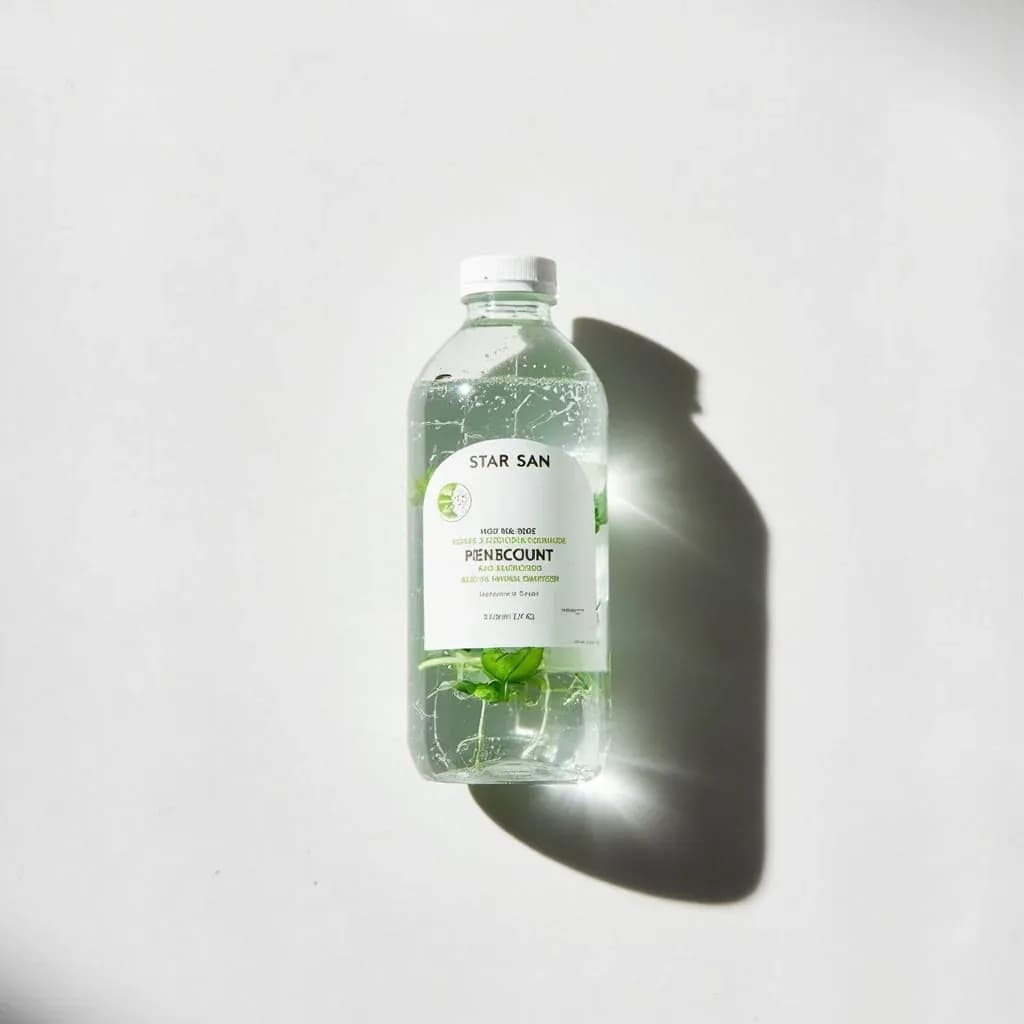
Star San (Acid No-Rinse Sanitizer)
Acid-based no-rinse sanitizer that quickly sanitizes brewing and fermentation equipment.
Star San is a phosphoric-acid no-rinse sanitizer widely used by homebrewers, fermenters, and picklers. Diluted to a low concentration in water it sanitizes bottles, carboys, kegs, and utensils in about a minute of contact, and the residual foam is food-safe so no rinse is needed. It works best at the right pH and dilution, and the harmless foam left behind is often described as a sign it's working.
Star San is the workhorse no-rinse sanitizer of the brewing and fermentation world, an acid-based liquid concentrate made by Five Star Chemicals & Supply in Colorado. At use dilution it is roughly 1.5 mL of concentrate per liter of water, and it relies on phosphoric acid to push the working pH well below 3.5 — the threshold below which most brewing-relevant bacteria and wild yeasts cannot survive — combined with dodecylbenzene sulfonic acid, an anionic surfactant that wets surfaces, carries the acid into crevices, and gives the solution its characteristic clinging foam.
Because the kill mechanism is contact-based and the residue at use-dilution is food-safe, surfaces sanitized in Star San can be drained or air-dried without a follow-up water rinse, which is the entire reason it has displaced iodophors and chlorine-based sanitizers in most home and craft breweries. It is NSF-registered for food service, shelf-stable for years in the sealed concentrate, and gentle on stainless steel, glass, and the common food-grade plastics used in fermenters and kegs. Its one hard limitation is reactive metals: aluminum, copper, brass, and galvanized steel will pit and blacken on contact, so it is not a universal kitchen sanitizer.
What distinguishes Star San from a generic acid cleaner is that it is meant to be used after, not instead of, an alkaline wash such as PBW. Acid sanitizers do not lift protein, hop resin, or dried krausen — they only kill microbes on surfaces that are already physically clean. Used in that two-step sequence, a single small bottle will sanitize dozens of carboys, kegs, and siphon assemblies with essentially zero flavor impact on the finished beer, wine, or cider.
Alternatives
Types & varieties
The flagship phosphoric-acid/surfactant blend sold in amber concentrate; the dominant choice in homebrewing and small craft use.
Closely related acid-anionic sanitizer from the same maker with the same no-rinse profile but formulated without dodecylbenzene sulfonic acid; chosen where that surfactant is undesirable on certain surfaces.
Identical formulation in 1 gal, 5 gal, 15 gal, and 55 gal containers for commercial breweries and food plants.
How It Works
Star San kills with two complementary actions working at once. Phosphoric acid drives the working pH to roughly 1–2, far below the 3.5 threshold at which most fermentation-relevant bacteria and wild yeasts can survive; the low pH denatures cell membranes and disrupts internal enzyme systems. Dodecylbenzene sulfonic acid is an anionic surfactant that lowers surface tension so the solution spreads, wets, and creeps into seams and threads, and it carries its own mild biocidal action against gram-positive organisms. Together they deliver a one-to-two-minute kill on a surface that has already been physically cleaned, and because the residue is food-safe at use-dilution the product is registered as no-rinse.
- Acid action is fast but pH-dependent — as the working solution drifts above 3.5 it loses effectiveness, which is why a fresh mix matters.
- Surfactant action is what gives Star San its clingy foam and lets it coat vertical and overhead surfaces that plain water would sheet off.
- No-rinse means no-rinse: drain or air-dry, but do not wipe the surface with a towel or rinse with water after.
Clean First, Then Sanitize
Sanitizers only work on already-clean surfaces. Protein, hop resin, dried krausen films, and yeast cake leftovers all create microscopic shields that keep acid and surfactant from reaching the microbes underneath. The standard sequence in any brewery — pro or home — is rinse, alkaline wash such as PBW or caustic, thorough rinse, then acid sanitizer. Skipping the alkaline step is the single most common cause of stuck fermentations and off-flavors that get blamed on 'bad sanitizer.'
- Alkaline detergent breaks down organic soil; acid sanitizer kills what is left on a rinsed surface.
- If a vessel has visible film or haze, sanitizer will not fix it — wash it again.
- For tubing and fittings with internal biofilm, replace the part rather than relying on sanitizer to rescue it.
Material Compatibility
Star San is gentle on stainless steel, borosilicate and soda-lime glass, PET and HDPE plastics, polypropylene, silicone, and most food-grade elastomers such as EPDM and PTFE. It is destructive to aluminum, copper, brass, bronze, and galvanized steel — even short soaks will etch, pit, or blacken them. Mild steel and cast iron should also be kept away from it.
- Safe: stainless, glass, PET, HDPE, polypropylene, silicone, EPDM, PTFE.
- Unsafe: aluminum, copper, brass, bronze, galvanized steel, carbon steel, tin.
- If you must sanitize a mixed-metal piece such as a brass-plated thermometer, rinse it with plain water immediately after contact.
Mixing and Storage
Mix 1 fl oz of concentrate into 5 US gallons of cool water (about 6 mL per gallon, 1.5 mL per liter). Use within 24 hours; discard any working solution whose pH strip reads above 3.5. Store the concentrate tightly sealed in its original HDPE bottle in a cool, dry place — the concentrate is shelf-stable for years.
- Working solution: mix fresh, use within 24 hours, do not top off an old bucket.
- Concentrate: keep sealed, away from metals and children; rinse spills immediately with water.
- Do not pre-dilute and bottle for later — pH drift will silently ruin a stored batch.
Troubleshooting
- Solution turned milky or cloudy after mixing: water was too hot, or you overdosed the concentrate — make a fresh batch with cooler water at the correct ratio.
- Persistent foam that never settles: hard water; switch to soft, RO, or distilled water for small batches.
- White phosphate haze on glass after drying: hard-water minerals; quick-rinse glassware with RO water or wipe with a clean cloth before use.
- Off-flavors after bottling: almost always a cleaning problem, not the sanitizer — re-check the alkaline wash and inspect tubing and fittings for biofilm.
- Sanitizer 'smell' carried into the finished beer: over-applied or not drained; shake or air-purge vessels before pitching.
Common uses
Tips & pitfalls
- Clean first, sanitize second: Star San is a sanitizer, not a cleaner, and will not penetrate organic soil or biofilm.
- Mix with cool or lukewarm water, never hot — above about 100 °F / 38 °C the surfactants precipitate and the solution turns milky and loses activity even if the pH still reads correctly.
- Use working solution within ~24 hours; once a pH strip reads above 3.5, dump it and mix fresh.
- Soft or RO water is best for small batches — very hard water causes heavy persistent foam and can leave phosphate haze on glass.
- Don't rinse after sanitizing. The foam is the product clinging to vertical and overhead surfaces; drain or air-dry and pitch or fill directly.
- Keep it off aluminum, copper, brass, bronze, and galvanized steel — even brief contact will etch or blacken reactive metals.
- Wear gloves and eye protection when handling concentrate; phosphoric acid at ~50% will burn skin and eyes, and the bottle should be stored sealed and out of reach of children.
- Verify with narrow-range pH strips (1–3.5) before each session if you want certainty that the working solution is still active.
- A spray bottle of mixed solution is the fastest way to sanitize assembled equipment you cannot dunk — mist, let it drip, do not wipe dry.
- Do not dilute the concentrate ahead of time and stockpile it; the shelf-stable form is the concentrate, and pre-diluted batches drift out of spec quietly.
Good to know
- Manufacturer
- Five Star Chemicals & Supply, Inc. (Colorado, USA)
- Type
- Acid-based, no-rinse, foaming sanitizer
- Active ingredients
- Phosphoric acid (~50%) and dodecylbenzene sulfonic acid (anionic surfactant)
- Effective pH
- Below 3.5; working solution typically starts at pH 1–2
- Typical dilution
- 1 fl oz per 5 US gallons of water (≈1.5 mL/L)
- Minimum contact time
- 1–2 minutes on a pre-cleaned surface
- Working solution life
- Use within ~24 hours; discard once pH rises above 3.5
- Concentrate shelf life
- Indefinite when stored sealed in original container
- Certifications
- NSF registered for food-service use
- Compatible materials
- Stainless steel, glass, HDPE, PET, polypropylene, silicone, PTFE, EPDM
- Incompatible materials
- Aluminum, copper, brass, bronze, galvanized steel, carbon steel, tin
- Common packaging
- 4 oz, 8 oz, 16 oz, 32 oz, 1 gal, 5 gal, 15 gal, and 55 gal
Also called
No-Rinse Sanitizer (Star San) · Star San · acid sanitizer · no-rinse brewing sanitizer
Related

Paper Towels
Disposable sheets for spills, drying, and patting dry

Kitchen Towels
Reusable cloths for drying, gripping, and wiping

Oven Mitts
Heatproof gloves to handle hot pans and trays safely

Disposable Gloves
Single-use gloves for safe, mess-free handling

Cleaning Cloths
Reusable cloths for wiping counters and spills

Tortilla Warmer
Insulated holder that keeps tortillas warm and soft

Trivet
Heatproof stand that shields surfaces from hot pots

Ice Bath Setup
Bowl of ice water that halts cooking and sets color