Storage & Containers
Disposable Bamboo Chopsticks
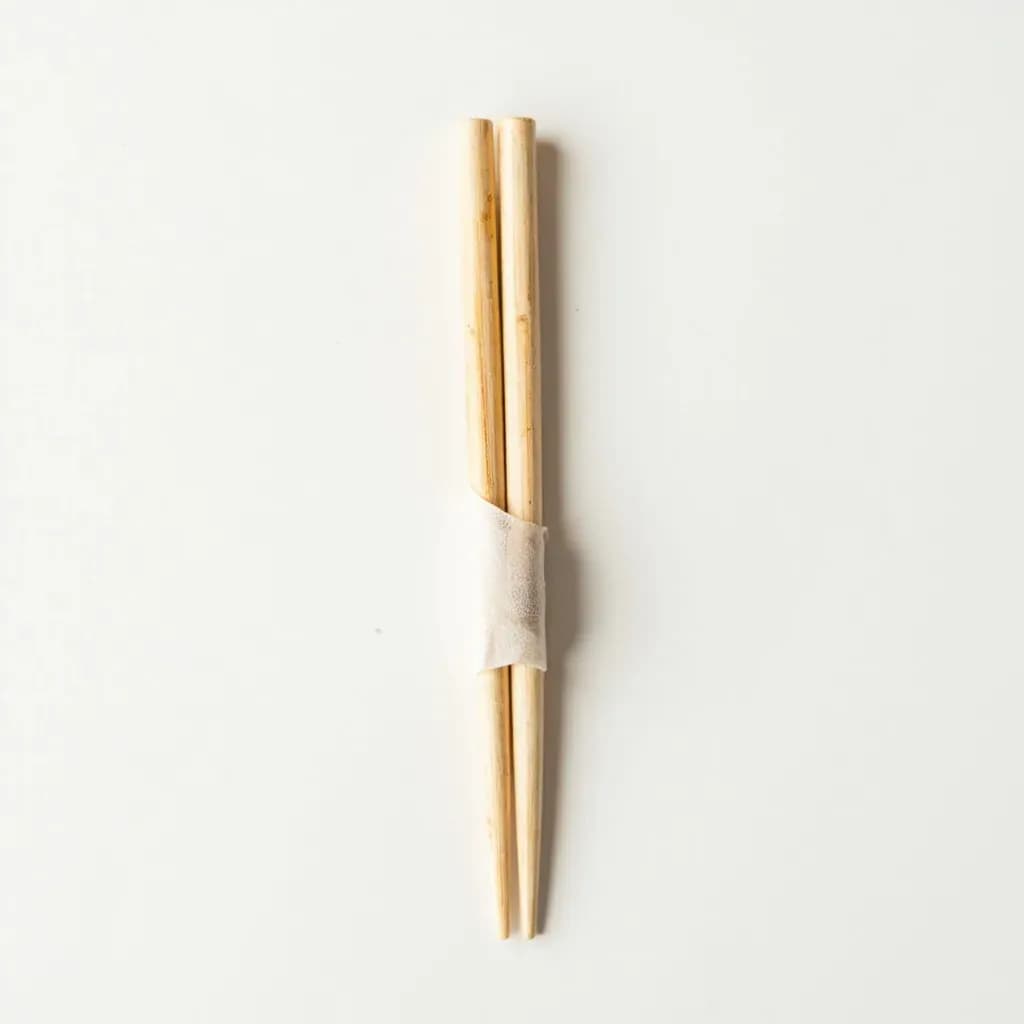
Single-use snap-apart bamboo chopsticks served with takeaway and casual Asian meals.
Disposable bamboo chopsticks are inexpensive, single-use eating sticks joined at the top so diners snap them apart before use. They come with takeaway and casual restaurant meals and are also handy in cooking for stirring, testing oil temperature, or propping lids. Made of fast-growing bamboo, they are compostable and meant to be discarded after one meal.
Disposable bamboo chopsticks are a consumable kitchen supply: two sticks pre-scored from a single piece of bamboo, designed to be snapped apart at the table and discarded after a single meal. The defining detail is the construction — one continuous piece of milled bamboo is notched near the middle so that pulling it straight apart produces a clean, matched pair with no assembly required. This lets a restaurant, food stall, or delivery order hand a diner two hygienic sticks with zero handling by staff, which is why the format dominates takeaway and casual Asian service worldwide.
Two regional shapes sit under the same umbrella. The Japanese waribashi (割り箸) has a squared, flat end for the fingers and a tapered, smooth end for the food, almost always wrapped in a printed paper sleeve that doubles as a chopstick rest when folded. Chinese-style pairs are plainer, with both ends more uniform in profile and often shipped loose or banded; this is the pair that arrives in the paper bag with most Western takeout. Korean disposable chopsticks (ilhoe-yong jeotgarak) follow a similarly pared-down format, though Korean restaurants more typically use flat stainless-steel chopsticks at sit-down tables and reserve disposables for casual and takeaway meals.
For a cook or home reader the practical questions are three: how to open a pair without splintering it, how to use the sleeve as a rest, and what to do with the sticks afterward. Bamboo is fast-growing (3–5 years to harvest versus decades for hardwoods) and plain pairs compost readily, but tens of billions are produced each year, mostly in China, so the supply is worth thinking about. Treat disposable bamboo chopsticks as a hospitality consumable — a small, useful, finite item rather than a freebie.
Alternatives
Types & varieties
One squared end for the hand, one tapered end for the food; traditionally served in a printed paper sleeve.
Both ends more uniform in profile; often loose-packed or bundled without a sleeve — the form most takeout orders arrive in.
Natural pairs are pale tan; bleached versions are whiter, slightly smoother, and marginally stiffer.
Sleeve acts as a hygiene wrap and folds into a small chopstick rest (hashioki) before the meal.
Loose or banded bundles sold for catering and food stalls; cheaper, but no hygiene wrap.
Around 16–18 cm; common at sushi counters and in kids' meal sets.
Up to 24–25 cm; preferred for deep bowls of ramen, pho, or hot pot where the hand sits well above the food.
Opening a pair the right way
The grain of bamboo runs lengthwise, so the sticks reward a clean, straight pull and punish a twist. A sideways wrench tears the fibers and leaves a raised, splintery ridge at the break — the most common complaint diners have with cheap pairs. The sleeve, if there is one, is there for two reasons: it keeps the food end clean until use, and it folds into a small chopstick rest so the tips never touch the table. Treat the sleeve as part of the utensil, not packaging.
- Hold the wrapped pair in both hands and pull the two ends straight apart along the long axis; do not twist or bend sideways.
- Identify the squared, flat end as the hand end and the tapered or smoother end as the food end — Japanese etiquette treats mixing these up as a faux pas.
- In Japan, do not rub disposable chopsticks together to smooth splinters, the way you might with well-used wooden ones; it signals that the restaurant has served poor-quality chopsticks.
- Fold the paper sleeve in half lengthwise, then fold the ends toward the center to make a small W-shaped rest (hashioki) for the tips.
Sustainability and what to do with them after
Bamboo is one of the faster-regenerating materials in mainstream tableware, typically ready to harvest in 3–5 years rather than the decades hardwoods require, and plain pairs compost readily in industrial facilities. The scale is the issue: at roughly 80–100 billion pairs a year, the cumulative forestry, milling, and shipping footprint is real, and most takeaway sticks end up in landfill rather than compost. For home cooks the practical takeaways are modest but worth keeping — strip the sleeve before composting, break the sticks into shorter lengths so they break down faster, and keep a small reusable pair in your bag for the meals where you know you'll have somewhere to wash up.
- Remove any glossy or heavily printed paper sleeve before composting; uncoated kraft sleeves can usually go in as well.
- Snap used pairs into 3–4 cm pieces before composting so they break down noticeably faster than whole sticks.
- Keep a sleeve of pairs in a desk drawer or car for emergency lunches; they weigh almost nothing and save a takeaway cutlery request.
- For readers who want to cut back, a single pair of reusable chopsticks (wood, bamboo, or metal) plus a small travel sleeve handles the majority of situations that disposables currently cover.
Beyond the table: kitchen-task uses
Once a sleeve is open in the kitchen, the sticks are useful as disposable tools — a fact home cooks underuse. They behave like cheap, food-safe tweezers and skewers that you can throw away when the job is done, which is exactly when you want a disposable tool: plating microgreens, dragging a single basil leaf through a sauce, holding a rolled sushi cylinder while you slice, or testing whether a dumpling is cooked through. They are also handy for stirring small quantities of glaze or sauce in a narrow pot where a spoon won't reach, and for retrieving items from a narrow-necked jar.
- Use as plating tweezers for garnishes — the tips are precise and the sticks can be discarded when stained by turmeric, beet, or berry juice.
- Skewer rolled items (sushi, cabbage rolls, meat rolls) while slicing so the roll doesn't compress under the knife.
- Reach into narrow pots of glaze, sauce, or hot oil where a spoon won't fit; discard after use.
- Pierce a dumpling in the center with a chopstick — when the filling is hot through and no raw paste clings to the stick, it's done.
Common uses
Tips & pitfalls
- Snap the pair apart with a firm, straight outward pull along the grain — twisting tears the bamboo and raises splinters at the break.
- Hand end versus food end: the squared or flat end is for your fingers, the tapered or smoother end touches the food; in Japan this distinction is taken seriously.
- Never rub disposable chopsticks together to smooth them — it is read as an insult to the restaurant. If the surface is rough, ask for another pair.
- Fold the paper sleeve into a small rest (hashioki) before eating so the tips never touch the table.
- Discard any pair that is warped, crumbly at the break, or visibly darkened — bamboo weakens quickly in damp storage and the failure shows up as soft spots and mold on the sleeve.
- Keep a small stash in a sealed, dry container; paper sleeves absorb kitchen humidity and can develop mold long before the bamboo does.
- Reserve a few pairs as disposable tweezers or skewers for plating — they're particularly useful for acidic or strongly colored foods you don't want stained by a reusable tool.
- If composting, strip the printed sleeve and snap the sticks into short pieces so they break down faster in the compost.
Good to know
- Material
- Bamboo, most commonly moso (Phyllostachys edulis) or similar fast-growing temperate species.
- Construction
- Two sticks pre-scored from a single piece so they can be snapped apart; often bound at the handling end with a printed paper sleeve.
- Standard length
- Adult pairs run 20–24 cm (about 7.9–9.4 in); children's and sushi-counter pairs are 16–18 cm.
- Profile
- Japanese waribashi have one squared/flat end (hand) and one tapered end (food); Chinese-style pairs are more uniform at both ends.
- Annual output
- Roughly 80–100 billion disposable chopsticks are produced worldwide each year, the great majority in China; Japan alone uses more than 20 billion pairs annually.
- Compostability
- Plain, uncoated bamboo pairs break down readily in industrial composting and, over longer periods, in home compost; printed paper sleeves and any lacquer should be removed first.
- Storage
- Store dry and sealed — humidity and food residue on paper sleeves encourage mold and weaken the bamboo.
- Names
- Waribashi (割り箸) in Japanese, yīcìxìng kuàizi (一次性筷子) in Chinese, ilhoe-yong jeotgarak (일회용 젓가락) in Korean.
Also called
Waribashi · Split Chopsticks · Bamboo Chopsticks
Related

Freezer Bags
Thick, sealable bags built to fight freezer burn

Storage Bags
Resealable bags for fridge storage and marinating

Storage Container
Lidded container for leftovers, prep, and meal kits

Glass Container
Oven-to-fridge glass that won't stain or hold odors

Plastic Container
Lightweight, stackable storage for everyday leftovers

Vacuum Sealer Bags
Airtight bags for long freezing and sous-vide

Reusable Bags
Washable silicone bags that replace single-use plastic

Mason Jar
Sealed glass jar for preserves, pickles, and storage