Bakeware & Pans
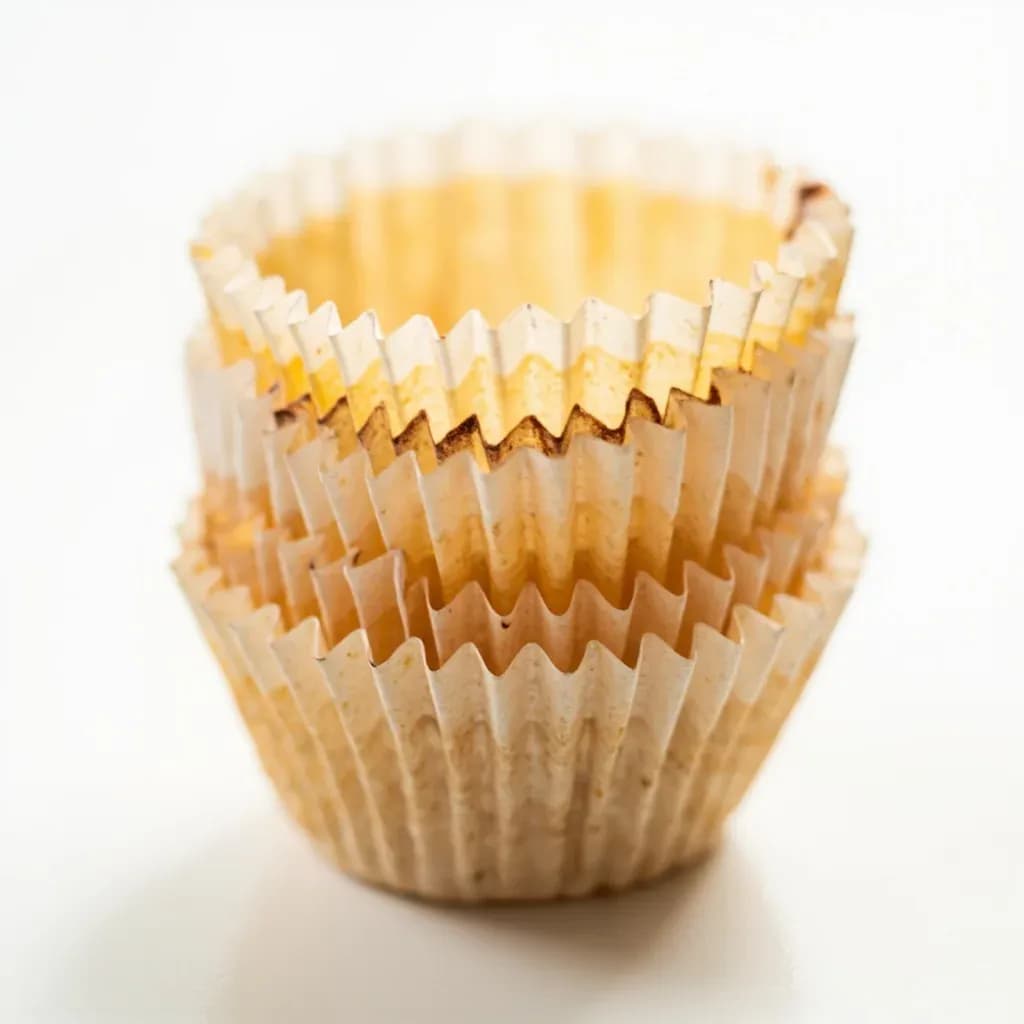
Foil Baking Cup
A pleated aluminum cup rigid enough to stand free on a tray without a muffin pan; holds its shape for cupcakes and muffins and won't go translucent with greasy batters like paper.
A foil baking cup is a thin, fluted aluminum cup that holds batter on its own—no muffin pan required. Made from a single sheet of food-grade aluminum (typically 0.03–0.05 mm thick), it is rigid enough to stand on a sheet pan yet light and inexpensive enough to treat as a disposable. The walls are pressed into a pleated pattern that mimics the look of a traditional tin liner, and the standard size holds about 2 fluid ounces, the capacity of a generous cupcake. Most retail sleeves ship in counts of 50, 100, or 250, since these cups are bought by the bagful for batch baking.
The practical reason foil cups exist is that paper liners don't, at least not for every job. Paper softens the moment a greasy batter hits it, turns translucent, and—if not braced by a muffin pan—collapses sideways. Aluminum shrugs off butter, oil, and egg yolk, keeps its shape, and conducts heat into the batter from the sides, producing slightly more rise and a deeper browning than a paper liner. That same conductivity is why these cups dominate in institutional kitchens—school cafeterias, airlines, commissaries, catered events—where a single sheet pan replaces a dozen muffin tins and cleanup is a rinse and a toss into the recycling bin.
A few limitations come with the territory. Aluminum is not microwave-safe and will arc on contact with the magnetron, and very acidic batters (lemon curd, tomato-based quiche filling) left in raw contact with the metal for an extended time can pick up a faint metallic note. A parchment round solves both problems, but most bakers use foil cups straight from the sleeve. They are freezer-safe, recyclable when clean, and reusable for a few cycles if hand-washed and dried promptly.
Alternatives
Types & varieties
The workhorse size, ~2 oz; for cupcakes and standard muffins.
~1 oz, ~1.5 in top diameter; for mini muffins, petit fours, and candies.
~3.5–4 oz, ~3 in top; for large cupcakes and individual savory bakes.
Very small; for bonbons, chocolate shots, and garnishes.
Shallower and wider than a muffin cup; for tarts and individual quiches.
Gold, silver, red, and holiday prints; dye is on the outside so bakes never stain.
Unpleated sides for a sleeker, more modern presentation; same baking performance.
Light silicone or similar coating for easier release of delicate or sugary batters.
Thicker aluminum, stiffer, and built for several reuses; common in food service.
Foil versus paper liners
The two aren't interchangeable, and the choice usually comes down to what you're baking, how much you're baking, and where it's going. Both work; each has a job it does better.
- Choose foil when you need a freestanding cup, plan to bake in large batches on sheet pans, or want extra rise and side browning.
- Choose paper when presentation matters (decorative patterns, easy peel-and-eat), when batters are extremely acidic, or when you need a gentler bake on the sides.
- Foil will not go translucent when soaked through by oily batters—financiers, butter cakes, sausage-and-cheese muffins—where paper will.
- A paper liner can be dropped inside a foil cup to combine the look of paper with the rigidity of foil, useful for tall, delicate batters that need the extra wall support.
Common uses
Tips & pitfalls
- Set cups on a rimmed sheet pan before filling and baking—they bake more evenly and move in and out of the oven as a single tray.
- Fill no more than two-thirds full; aluminum conducts heat faster than paper, so batters rise a little more aggressively.
- For sticky or sweet batters (brownie bites, financiers, very buttery cakes), lightly grease the cup or drop in a paper liner for clean release.
- Drop the oven temperature by about 25 °F (15 °C) if you notice over-browning on the bottom and sides compared with paper-lined bakes.
- Never microwave—metal will spark and can damage the oven.
- Hand-wash and dry immediately if reusing; prolonged water contact causes a harmless dulling or discoloration that does not affect performance.
- Stack with care—a dented cup leans and will spill thin batters.
- For very wet batters, double-cup by nesting one inside another to prevent leaks at the base seam.
- Avoid leaving very acidic raw batters (lemon curd, tomato-based quiche filling) sitting in the cup for long; line with parchment if a delay is unavoidable.
Good to know
- Material
- Thin-gauge food-grade aluminum sheet, ~0.03–0.05 mm thick
- Standard capacity
- ~2 fl oz (60 ml) per cup
- Standard dimensions
- ~2.5 in (63 mm) top diameter, ~1.75 in (45 mm) base, ~1.25–1.5 in (32–38 mm) tall
- Heat tolerance
- Oven-safe to ~450 °F (230 °C)
- Microwave
- No — metal will arc
- Freezer
- Yes
- Reusability
- Hand-washable for a few cycles; single-use in most pro settings
- Recyclable
- Yes, when clean of baked-on residue
- Standalone
- Yes — rigid; does not require a muffin tin
Also called
foil cupcake liner · foil muffin cup · aluminum baking cup