Wraps & Liners
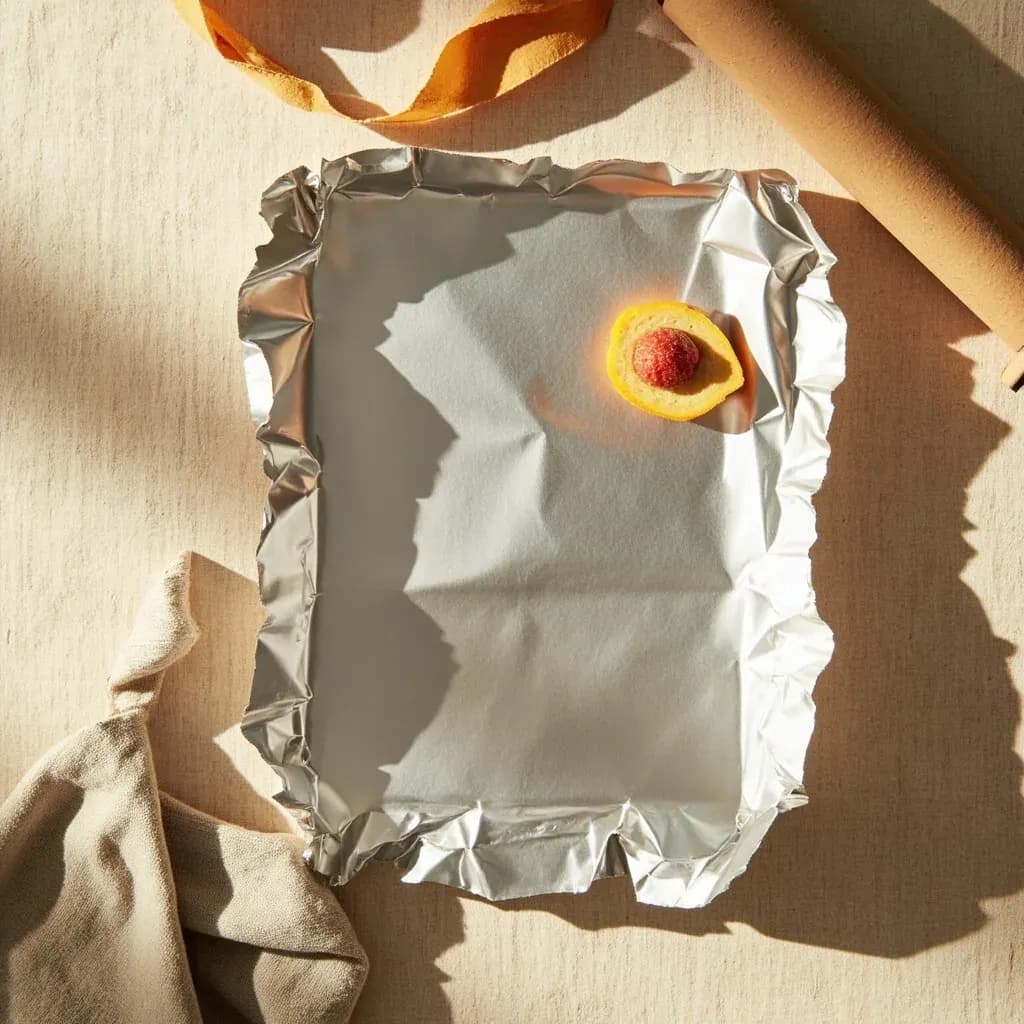
Heavy-Duty Aluminum Foil
Thicker, more tear-resistant aluminum foil for tenting roasts, sealing grill packets and lining heavy pans; holds its shape and shields better under high heat than standard-gauge foil.
Heavy-duty aluminum foil is the thicker-gauge cousin of the standard household roll, built from the same aluminum alloy but pressed to roughly 0.0007–0.001 inches (about 18–25 micrometers) — roughly 1.5 to 2 times the thickness of regular foil. That extra metal is the entire point: it resists tearing when the wrap has to bear weight, hold liquid, or sit inches from open flame or radiant coals. Where standard foil punctures, collapses, and leaks, heavy-duty holds its shape, supports a brisket through a 12-hour cook, and keeps a grill packet sealed long enough to steam fish and vegetables over direct heat.
The alloy itself is essentially identical across gauges (about 98–99% pure aluminum), so the upgrade is structural rather than chemical. Heavy-duty does not cook cooler, conduct heat differently, or block more radiation than standard foil of the same shape and placement — it simply stays intact under conditions that destroy thinner stock. That is why pitmasters, caterers, and anyone working with big roasts or open-flame grills reach for it instinctively: the failure mode of standard foil in those jobs is a torn seam, a leaking packet, or a collapsed tent, and the cost of that failure is dried-out meat or a sooty grill.
What heavy-duty does not solve are the limits shared by all aluminum foil. It should not go in a microwave at any gauge, where it can arc and damage the appliance. Prolonged contact with highly acidic foods — tomato sauce, citrus, vinegar-heavy reductions — can pit the surface and transfer a faint metallic taste, so line with parchment first or switch to a non-reactive vessel for long simmers or storage. And the familiar 'shiny side in, shiny side out' rule is a myth: both sides are the same aluminum, with the dull side simply being the one that last touched the rolling mill.
Alternatives
Types & varieties
Lighter gauge (~0.0003–0.0004 in); fine for wrapping sandwiches, covering casseroles, and lining sheet pans. Tends to tear with heavy, bony, or frozen foods.
Thicker gauge; the all-purpose upgrade for grilling packets, tenting roasts, lining heavy pans, and any wrap that has to support weight or sit near open flame.
Thickest consumer option (often ≈0.0015 in); used by butcher shops, caterers, and competition pitmasters for wrapping briskets, supporting very heavy loads, and high-heat grills.
Aluminum sheet coated with a food-grade silicone release layer; useful for cheesy bakes, sticky glazes, and candy work where release matters.
Interleaved 12×10 or 12×12 in sheets on a perforated, pop-up roll; popular in food service and for quick pan and sandwich wrapping.
Pin-holed sheets designed for steaming, draining, or letting smoke reach food in cold smoking; not a heavy-duty workhorse.
Low-and-Slow Barbecue: The Texas Crutch
Heavy-duty foil earns its reputation most decisively in long barbecue cooks, where ribs, briskets, and pork shoulders hit a 'stall' somewhere between 150 °F and 170 °F internal temperature and stop climbing for hours. Wrapping the meat in heavy-duty foil — the 'Texas crutch' — traps steam, prevents further evaporative cooling, and powers the meat through the stall in a fraction of the time. Standard foil almost never survives this treatment intact; the seams tear, juices escape, and the bark the wrap was meant to protect turns soggy or scorched.
- Wrap at 160–170 °F internal for brisket and 165–170 °F for ribs; cook another 1–2 hours, then rest unwrapped for 30–60 minutes to let the bark re-form.
- Add a tablespoon of rendered tallow, beef stock, or apple juice per pound of brisket inside the wrap to keep the meat from braising in its own concentrated juices.
- For competition-style bark, wrap in butcher paper for the first portion of the stall and switch to foil only for the final push.
- Double-wrap where the brisket's edge or point presses hardest against the foil — that is where blowouts happen on overnight cooks.
When Standard Foil Is Fine (And When It Isn't)
The gauge upgrade is worth paying for only when the wrap is asked to do more than cover or contain. For everyday jobs — covering a casserole, wrapping a sandwich, lining a sheet pan for cookies — standard household foil performs identically to heavy-duty and costs less per square foot. Reach for heavy-duty the moment the wrap has to hold liquid, support weight, or face open flame.
- Use heavy-duty for grill packets, water-bath slings, tenting large roasts, and any wrap that will sit near coals or a burner.
- Standard foil is plenty for covering a bowl in the fridge, lining a sheet pan for dry-heat baking, or capping a casserole.
- If you find yourself folding a standard foil sheet three or four times to make it strong enough, you should be using heavy-duty instead.
- Restaurant and competition cooks default to extra-heavy or professional-grade for brisket and for lining sheet pans that go under salamanders or broiler elements.
Common uses
Tips & pitfalls
- Reach for heavy-duty any time the wrap will bear weight, hold liquid, or sit near open flame or coals — thinner foil punctures and collapses.
- For grill packets, build at least a double layer and crimp the seams with three tight folds; a single layer of any foil can leak.
- When tenting a roast, crimp around the pan edges and leave a 1–2 in vent on top — a fully sealed tent will steam the food rather than shield it.
- Avoid long cooks or storage of highly acidic foods (tomato sauce, lemon, wine reductions) in direct foil contact; line with parchment first or use a non-reactive pan.
- Never line the floor of an oven with foil — it blocks airflow, can fuse to the enamel, and creates a fire risk when contacting heating elements.
- For a water-bath sling, use two long sheets in a cross pattern under the springform pan so the overhanging ends give you clean lifting handles.
- Recycle only clean foil, balled to at least 2 in across; greasy or food-caked foil goes in the trash.
- Press the foil flat against the counter and run your hand across it before measuring to remove the curl from the roll.
Good to know
- Material
- Aluminum alloy (typically 1xxx or 8xxx series), roughly 98–99% pure aluminum
- Typical Thickness
- Approximately 0.0007–0.001 in (≈18–25 micrometers), roughly 1.5–2× the gauge of standard household foil
- Standard Roll Widths
- 12 in (30 cm), 18 in (45 cm), and 24 in (61 cm)
- Heat Tolerance
- Safe in conventional ovens, grills, and smokers at normal cooking temperatures (≈500 °F / 260 °C); aluminum itself melts at ≈1,220 °F (660 °C)
- Microwave Use
- Not recommended; can arc, spark, and damage the appliance regardless of gauge
- Acidity Caution
- Prolonged contact with highly acidic foods (tomato, citrus, vinegar-heavy sauces) can cause pitting, pinholes, and a faint metallic taste transfer
- Recyclability
- Widely recyclable when clean; must be balled to at least 2 in (5 cm) so optical sorters can read it
- Shiny vs. Dull Side
- Both sides are the same aluminum; the dull side is the one that contacted the mill rollers during the final pass — there is no functional cooking difference
Also called
heavy duty foil · thick aluminum foil · extra-strong foil · grilling foil
