Heat & Safety
Ice
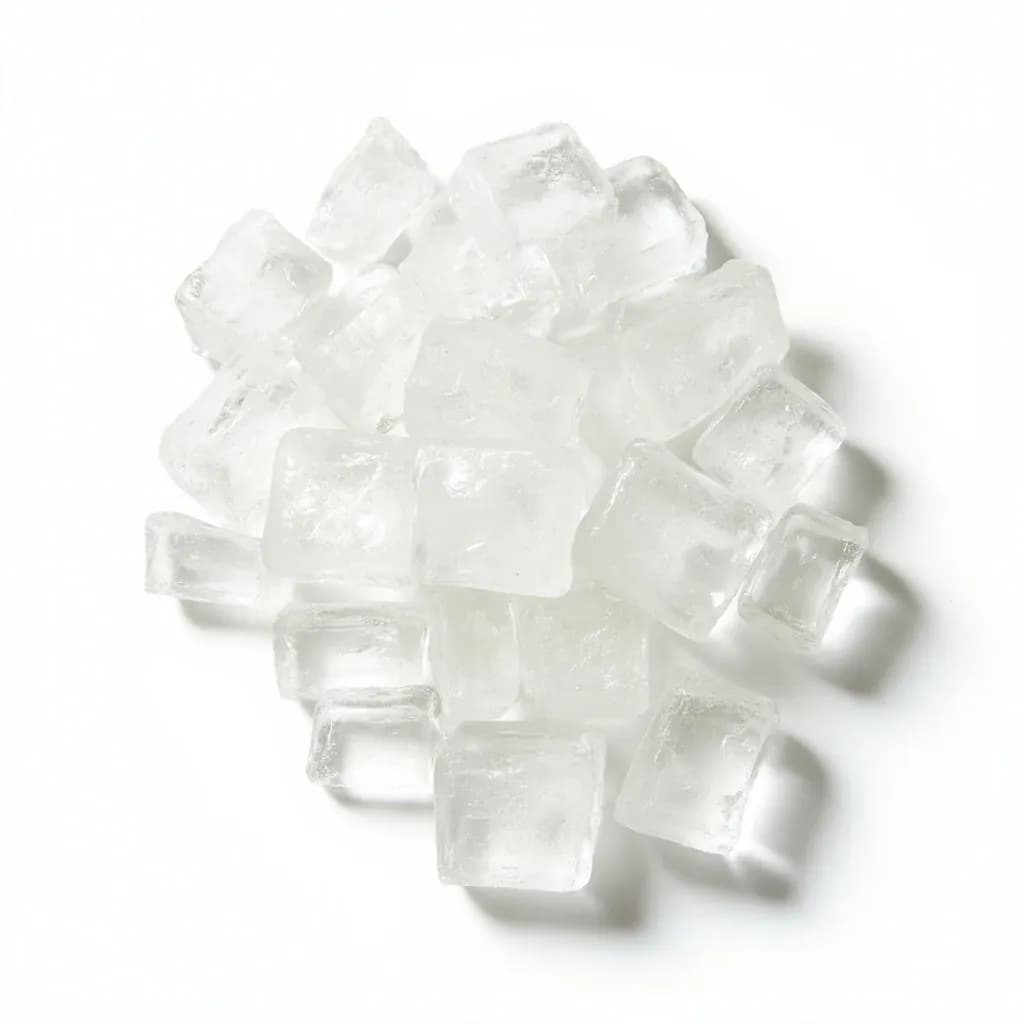
Frozen water used to chill drinks, set ice baths, and hold food at safe temperatures.
Ice is frozen water, supplied as cubes, crushed, nugget, or block, and is a core cooking consumable for cooling. Cooks shock blanched vegetables in ice baths to lock color, chill stocks quickly through the danger zone, keep raw fish and oysters cold on display, and dilute and chill cocktails. Cube clarity and shape matter for presentation and melt rate, while crushed and shaved forms are used for desserts and rapid cooling.
Ice is the cook's most underrated precision tool. It is simply frozen water, but its value in the kitchen comes from a single, extraordinary physical property: a latent heat of fusion of roughly 334 joules per gram. That number is the energy ice absorbs while melting, and it is far larger than the energy water absorbs when cooling by a single degree (about 4.18 J/g). In practical terms, melting a tray of ice pulls more heat out of a sauce, a stockpot, or a cocktail than cooling the same mass of water from 20 °C down to 0 °C ever could. This is why a salt-and-ice bath can drop a small pot of stock from a simmer to cool in a fraction of the time a refrigerator would need, and why a well-built ice bath can halt the carryover cooking of a custard in under a minute.
A few behavioural quirks follow from ice being water in a less dense crystalline form. Ice floats because it is roughly 9% less dense than liquid water, and that same 9% is how much it expands on freezing — so a filled-to-the-brim ice tray will crack, and a glass bottle left in the freezer will split. Clear ice forms when water freezes slowly in one direction, pushing dissolved air and minerals out ahead of the advancing crystals; the cloudy cubes from a home tray are simply ice that froze too fast to exclude those impurities.
In the kitchen, ice is rarely used for its own sake. It exists to move heat, and the cook's job is to choose the right shape and the right partner (water, salt, an ice-cream canister) so that heat moves in the right direction at the right speed. Used well, ice chills a drink without flattening it, sets the crumb of a biscuit dough, and saves a sabayon from scrambling; used carelessly, it dilutes a Negroni, taints a sorbet with freezer odours, or contaminates a cooler of raw chicken.
Alternatives
Types & varieties
Standard half-dice or full-dice trays. A modest surface-area-to-volume ratio chills steadily without over-diluting drinks.
The curved, hollow shape from most home ice makers. Thin walls melt noticeably faster than a solid cube.
Also called 'Sonic' or 'chewable' ice; small flakes compressed into soft porous pellets. Cools drinks fast and is easy to chew.
Thin irregular flakes from a flaker drum. Conforms to the shape of fish, shellfish, and salad-bar displays and is the standard for cold transport.
Solid blocks from 5 to 150 kg, frozen in cans or moulds. The base for crushed ice, for cooler transport, and for shaving into kakigōri.
Cubes or blocks broken into small pieces. Very high surface area — chills and dilutes fast. The right choice for ice baths, juleps, and mojitos, the wrong choice for a drink meant to last.
Frozen slowly in one direction (top-down in an insulated cooler, or with a Clinebell-style plate freezer) so air and minerals are pushed out, leaving a transparent, dense, slow-melting block.
5–8 cm round moulds. The lowest surface-area-to-volume ratio of common shapes; melts very slowly and looks the part in spirit-forward drinks.
Long narrow rods for highballs, Collins glasses, and bottled water — slow melt, clean lines, no clatter against the glass.
Very fine flakes shaved from a dense block with a hand plane or shaver. The base for kakigōri, ais kacang, snow cones, and the soft top of Italian-style granitas before the final freeze.
A short history of ice
People have been harvesting, storing, and trading natural ice for at least a thousand years. China stored winter-cut lake ice in insulated pits from at least the Tang dynasty; Rome and ancient India chilled desserts with mountain snow and ice; and medieval Persia built the yakhchāl, a beehive-shaped icehouse that could make ice in arid climates by night-time radiation cooling. The modern international ice trade began in 1806, when Frederic Tudor of Boston — the 'Ice King' — began shipping New England lake ice to the Caribbean and, eventually, to the tropics. The Wenham Lake Ice Company in Massachusetts and the Norway Ice Trade (exporting blocks cut from frozen Norwegian lakes to London and beyond) kept the industry running until mechanical refrigeration made natural ice commercially obsolete in the early twentieth century. Clarence Birdseye's later work on quick-freezing is a related but separate story: his concern was freezing the food, not the medium.
Distinguishing the three 'ices'
Three terms look identical in a recipe or on a label but behave very differently in the kitchen:
- Ice: water frozen to 0 °C or below. What an ice tray makes.
- Ice water: water held at 0 °C, usually with cubes still floating in it. A recipe that calls for ice water wants the temperature, not the crystals; it is not the same as 'cold water' or 'chilled water'.
- Dry ice: frozen CO₂ at −78.5 °C, not water at all. It sublimates rather than melts, gives off CO₂ (a suffocation risk in closed rooms), and should never be handled bare-handed or dropped into a drink.
Common uses
Tips & pitfalls
- For an ice bath, use at least a 1:1 ratio of ice to food by weight, plus enough cold water to surround the food, and stir occasionally — water conducts heat far better than still air, so a 'dry' ice bath chills much more slowly than one with water in it.
- Add roughly 1 part rock salt to 3–4 parts crushed ice to push an ice bath into the −10 to −20 °C range; this is what a hand-crank or electric canister ice-cream freezer needs to pull heat out of the cream fast enough.
- Don't drop a hot stockpot onto a few cubes in a metal bowl and walk away — the ice melts before much chilling happens. Use a large basin, plenty of ice, a splash of cold water, a handful of salt, and stir.
- For pie dough, biscuit dough, and rough puff, use true 'ice water' (a jug of water with a tray of cubes floating in it) rather than just chilled water — the cubes guarantee the water is at 0 °C and keep it there as you work the dough.
- To make clearer ice at home, boil the water once, let it cool, and freeze it slowly in a small insulated cooler with the lid off. Freezing proceeds top-down and pushes air bubbles and dissolved minerals out the bottom, leaving a transparent slab that melts more slowly than cloudy tray ice.
- Choose large-format ice (spheres, big cubes, spears) for spirit-forward cocktails where you want chill and visual impact without watering the drink down; reserve crushed ice for drinks — juleps, mojitos, cobblers — where quick dilution is part of the recipe.
- Keep ice bins, scoop tongs, and home trays covered. Ice is porous and picks up garlic, fish, and stale freezer odours within hours, and uncovered bins are an open invitation to cross-contamination.
- Never return ice that has been in a cooler with raw meat, fish, or eggs to a drink or to ready-to-eat food — pathogens from raw juices survive on the surface and in the meltwater.
- If the power goes out, full ice blocks last far longer than cubes because of their lower surface-area-to-volume ratio. Stack blocks at the bottom of the freezer, fill in with cubes, and resist opening the door.
- Clean ice-machine bins and home ice trays every few weeks with baking soda or a dilute food-safe sanitiser; the warm, dark, wet environment inside an ice bin is a classic biofilm risk.
Good to know
- Form
- Frozen water (solid H₂O)
- Melting point
- 0 °C / 32 °F
- Density
- 0.917 g/cm³ — about 9% less dense than liquid water, which is why ice floats
- Volume expansion on freezing
- ≈9% — don't overfill ice trays, bottles, or jars before freezing
- Latent heat of fusion
- 334 J/g — the energy absorbed while melting, the source of ice's chilling power
- Salt–ice bath floor
- ≈ −21.1 °C, the eutectic point of the NaCl–water system; rock-salt ice in practice reaches roughly −10 to −20 °C
- Ice-bath ratio
- At least 1 part ice to 1 part food by weight, plus enough cold water to make full contact and conduct heat away
- Food-safety note
- Never serve ice that has touched raw meat, poultry, or fish — pathogens survive on the surface and in the meltwater
Also called
ice cubes · crushed ice · shaved ice · block ice
Related

Paper Towels
Disposable sheets for spills, drying, and patting dry

Kitchen Towels
Reusable cloths for drying, gripping, and wiping

Oven Mitts
Heatproof gloves to handle hot pans and trays safely

Disposable Gloves
Single-use gloves for safe, mess-free handling

Cleaning Cloths
Reusable cloths for wiping counters and spills

Tortilla Warmer
Insulated holder that keeps tortillas warm and soft

Trivet
Heatproof stand that shields surfaces from hot pots

Ice Bath Setup
Bowl of ice water that halts cooking and sets color