Tying & Fastening
Metal Skewer (Flat)
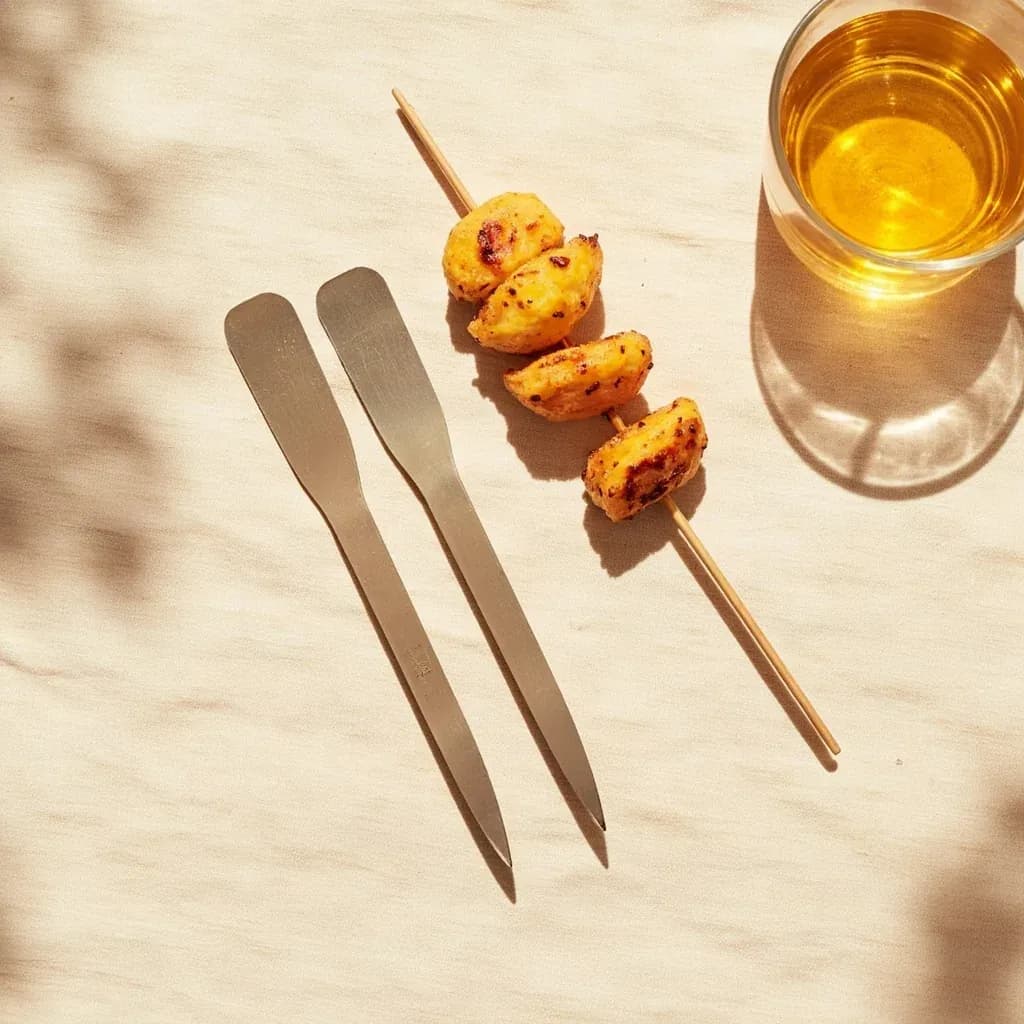
A flat-bladed steel skewer that grips meat and stops chunks spinning when you turn a kebab, reusable and heat-conducting so it helps cook the center, unlike round wooden sticks.
A flat metal skewer is a length of stainless or plated steel, blade-shaped in cross-section, with a tapered point and usually no handle. The single design choice that defines it — flat rather than round — solves the most common complaint about kebab cookery: food spinning inside the meat instead of turning with it when you flip. A round rod has no flat face for the food to grip, so it rotates freely; the flat blade bites into the food and the whole kebab moves as one.
Beyond that mechanical advantage, the flat profile gives the metal more surface contact with the food, which turns the skewer into a passive heat conductor. Heat travels from the grill, along the blade, and into the center of each piece — useful over direct, fierce heat (a mangal, a ripping-hot grate) where the outside can scorch before the inside is cooked. The trade-off is that you may need to pull kebabs off a minute earlier than you would on a bamboo stick, because the interior reaches temperature faster than expected.
In practice these skewers range from short 20 cm blades for weeknight grilling to 90 cm-plus versions used over open charcoal troughs in Levantine, Persian, and South Asian cookery. The shorter forms sold for backyard grills are a modern convenience version of that older tool, with the same engineering logic and the same name in different languages: brochette in French, seekh or sikh in South Asia, kushi in Japan.
Alternatives
Types & varieties
The standard form: a single flat steel blade that resists spinning inside the food, grips meat, and conducts heat inward.
Two parallel flat blades joined at the base; holds delicate items like fish fillets or scallops without tearing or spinning.
Broader blade (often 10–15 mm), similar to Japanese yakitori kushi; more grip and faster heat transfer for larger or denser pieces.
40–90 cm, sometimes longer; the traditional form used over open charcoal troughs in Levantine, Persian, and South Asian cooking.
Flat shaft with sliding rings or spring clips to lock food in place along the length.
Flat metal frame with a mesh basket; holds small or loose items (diced vegetables, shrimp) so they don't fall through the grates.
Stainless flat blade with a riveted wooden or composite handle for comfort during long grilling sessions.
Flat or square steel skewer used for yakitori; behaves the same as the Western flat blade — resists spin, conducts heat.
Why flat beats round
The whole reason this tool exists as a flat blade rather than a round rod comes down to two things: rotational resistance and heat transfer. A round skewer can spin freely inside the meat — particularly once the meat has shrunk away from the rod during cooking. The flat blade prevents this because the food has flat faces to press against, creating friction that locks it to the metal. Heat transfer works on the same principle: a flat blade presents more surface area than a round rod of similar thickness, so heat from the grill travels into the meat along a wider path. Over very hot direct heat — a charcoal mangal, a tandoor, a screaming grate — that extra heat path can be the difference between a charred outside and a center that's still raw.
- A round rod has no flat face — meat can spin around it freely once it shrinks.
- The flat blade creates friction — meat locks to the metal and turns with it when flipped.
- Flat profile increases contact area — more heat conducted inward, faster interior cook.
- Worth the trade-off most on fierce direct heat where the exterior would otherwise scorch before the center catches up.
Common uses
Tips & pitfalls
- Oil the blade lightly before threading — reduces sticking, especially with chicken, fish, and halloumi.
- Leave a 3–5 mm gap between pieces so heat reaches all sides and the kebab cooks evenly.
- Don't pack the food so tight it bulges off the blade — the middle will stay raw and the outside will scorch.
- Pull the kebab off roughly a minute earlier than you would on a bamboo stick; the metal is conducting heat into the interior as well.
- Square off the cut edges of meat before threading — if a piece spins, the cut is too rounded for the flat blade to bite into.
- Use two parallel flat skewers for whole small fish or thin fillets so they don't fold over the hot grate.
- Preheat the skewer on the grill for 30–60 seconds before adding food; cold metal can cool the surface and delay browning.
- Hand-wash after use and dry promptly to prevent pitting or rust at the tip, even on 'dishwasher-safe' models — and don't soak flat metal skewers in water; that's a wooden-stick ritual.
Good to know
- Material
- Stainless steel (most common); also nickel- or chrome-plated steel; occasionally aluminum
- Profile
- Flat, blade-shaped cross-section rather than round rod
- Home length
- 20–30 cm (8–12 in)
- Commercial length
- 40–90 cm (16–36 in); some professional skewers exceed 1 m
- Blade width
- Roughly 5–10 mm flat; wider Japanese-style kushi can be 10–15 mm
- Reusability
- Reusable indefinitely; most stainless models are dishwasher-safe
- Heat conduction
- Yes — conducts heat from the grill into the interior of the food
- Also called
- Brochette (French); seekh / sikh skewer (South Asian, often for minced-meat kebabs); kushi (Japanese, flat or square steel)
Also called
flat skewer · kebab skewer · steel skewer