Storage & Containers
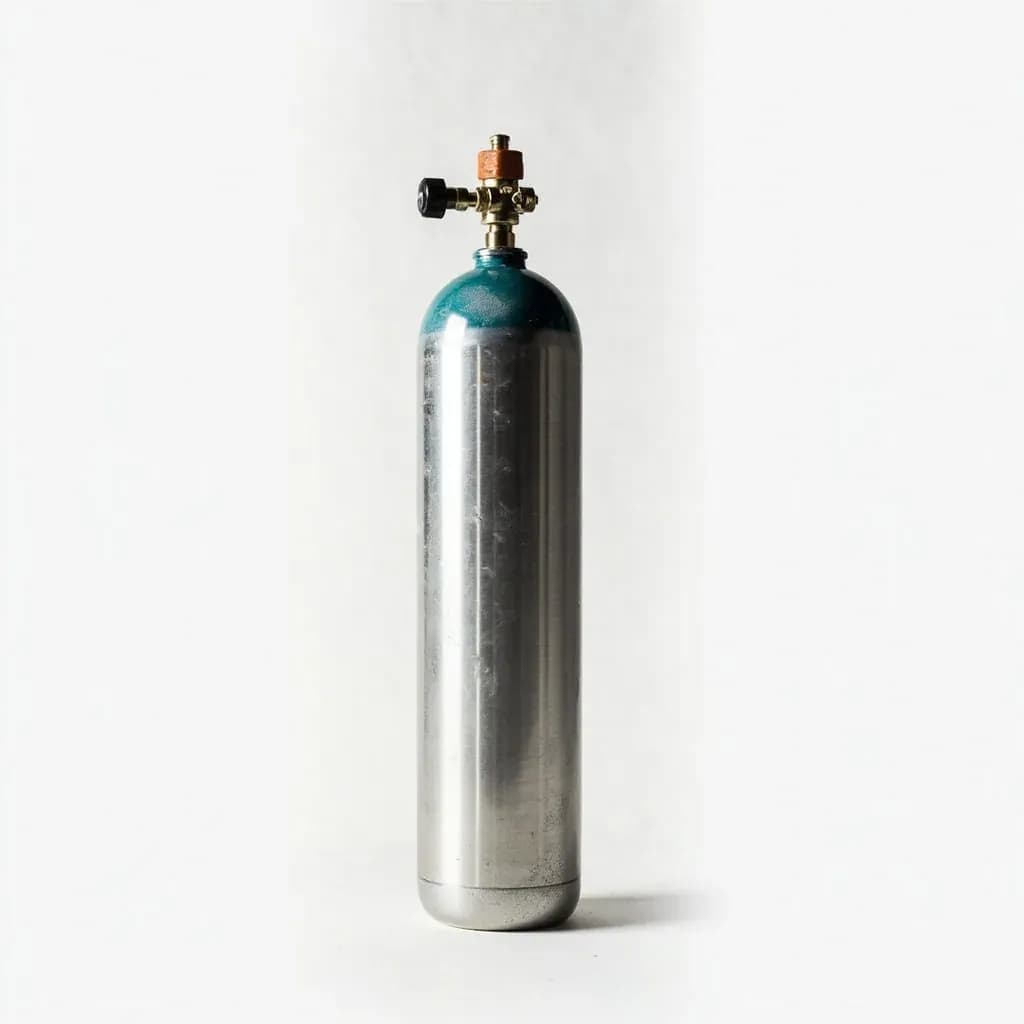
Nitrogen Cylinder
Pressurized food-grade nitrogen tank used to flush packaging and dispense or preserve foods without oxidation.
A nitrogen cylinder supplies inert food-grade nitrogen gas used to displace oxygen in cooking and storage. Kitchens use it to flush coffee, oils, and vacuum bags to slow oxidation, and to charge nitro coffee or beer taps. Because nitrogen is inert and tasteless, it preserves color and flavor without altering the food, and it must be handled as a pressurized vessel.
A nitrogen cylinder is a high-pressure steel or aluminum vessel that holds food-grade N₂ gas compressed to roughly 2,200 psi at 70 °F. Nitrogen itself is inert — it makes up about 78 percent of the air we breathe and reacts with almost nothing at room temperature — which is precisely why cooks and food packagers use it. By displacing the oxygen around a food, it halts the oxidation reactions that stale coffee, darken cut fruit, rancidify oils, and discolor cured meats.
In the kitchen, the cylinder is most often plumbed to a two-stage regulator and a delivery line that feeds either a packaging machine, a draft system, a wine-preservation device, or a simple sparging tube. The cylinder itself does nothing; the value comes from pairing food-grade gas with the right regulator (CGA-580 fitting, appropriate delivery pressure) and a use that genuinely benefits from an oxygen-free environment. Wine bars, roasteries, butcheries, snack packagers, and commissaries that ship cheese all use the same basic hardware, configured differently.
It is critical to distinguish food-grade nitrogen (N₂, E941) from the related gases that share the cylinder rack. Liquid nitrogen (LN₂) is the cryogenic –196 °C liquid used for flash-freezing and grinding, and nitrous oxide (N₂O, E942) is the propellant in whipped-cream chargers. Each is a different product with different hardware, different regulators, and different culinary applications — and none of them should ever be cross-connected.
Alternatives
Types & varieties
The standard industrial format, most common in restaurant commissaries and packaging rooms. Heaviest, but lowest cost per cubic foot, and what most gas suppliers stock.
Lighter, non-rusting, often DOT-rated for a longer service life. Preferred for portable carts, mobile wine programs, and small prep rooms where weight matters.
Vacuum-insulated pressurized container (commonly 50–240 L) holding LN₂ at –196 °C. Used for flash-freezing, cryogenic grinding, and molecular-gastronomy techniques — not for flushing or blanketing.
Blends of 75% N₂ / 25% CO₂ or 50/50 are supplied in the same letter-coded cylinders, clearly tagged for the blend. Used for nitro stouts, cold-brew coffee on draft, and other nitrogen-pushed beverages.
Small disposable or refillable canisters (typically 0.95 L or 2 L) used in countertop systems such as Coravin wine preservers, single-cup dispensers, and small catering setups.
On-site cryogenic tanks (250–1,500+ gallons) for high-volume food processors and roasteries, refilled on a schedule by the gas supplier rather than swapped.
Setting up a food-grade nitrogen system
The cylinder is the storage vessel; the regulator is the working component. A typical installation runs cylinder → CGA-580 nut → two-stage regulator (the high-pressure gauge reads cylinder pressure, the low-pressure gauge reads delivery pressure) → delivery hose or line → application-specific hardware, whether that is a flush-and-seal packaging machine, a stout faucet with restrictor plate, or a wine-preservation needle.
When you take delivery of a new cylinder, check three things before connecting anything: the shoulder stamp or label must read 'Food Grade,' 'USP,' or 'NF' — industrial welding nitrogen can carry trace oils and moisture that have no business in food; the tare weight is stamped on the cylinder shoulder so you can weigh it on a scale and calculate how much gas remains; and the valve cap should be in place and tight until the regulator goes on. A leaking valve cap is the single most common source of slow gas loss in a working kitchen.
Nitrogen versus argon, CO₂, and N₂O
A working kitchen's gas rack can hold several cylinders that look similar but behave very differently. Nitrous oxide (N₂O) dissolves into fat and water and gives whipped-cream siphons their body and texture. Carbon dioxide (CO₂) carbonates and acidifies slightly; it is the workhorse of most draft systems and of carbonated beverage production. Argon is denser than air and forms a more stable, longer-lasting blanket, which is why many wine-preservation systems — including Coravin, which uses argon specifically — prefer it. Nitrogen is lighter than air, cheap, and ideal for blanketing, purging, and dispensing nitrogen-only beverages where you do not want carbonation.
The hardware is deliberately not interchangeable. CGA-580 is the nitrogen valve, CGA-320 is CO₂, and N₂O siphon cartridges are a completely different format. These fittings exist to prevent cross-connection; never grind, file, or adapt a fitting to force a match. Adapting an oxygen fitting (CGA-540) to a fuel-gas cylinder is especially dangerous because residual oil in the regulator can ignite violently under oxygen pressure.
Common uses
Tips & pitfalls
- Verify the cylinder label reads 'Food Grade,' 'USP,' or 'NF' before connecting; industrial welding nitrogen can carry trace oils, moisture, and particulates that will contaminate food and clog regulators.
- Always install a two-stage regulator. A single-stage regulator lets delivery pressure climb as cylinder head pressure falls and ambient temperature shifts, which can rupture downstream lines or ruin a packaging seal.
- Use a CGA-580 regulator dedicated to nitrogen. Never adapt a fitting intended for oxygen, CO₂, or nitrous oxide; the fittings differ by design specifically to prevent dangerous cross-connection.
- Store cylinders upright, chained or strapped to a wall or rack, with the valve cap on when not in use. Heat above 125 °F can trigger the pressure-relief device to vent the cylinder, and a toppled cylinder with a broken valve becomes a guided missile.
- For wine preservation, blanketing oils, or purging jars, keep delivery pressure low — 2 to 5 psi through a check valve. More pressure does not protect better; it splashes product, pushes corks out, and starves the regulator of its set range.
- Do not attempt to 'top off' a partially used cylinder yourself. Refills require a certified reclaimer who will evacuate, leak-test, and refill to spec; home-topping is unsafe and often illegal under DOT rules.
- Keep a simple oxygen monitor in any walk-in, cellar, or small prep room where nitrogen is vented. Nitrogen is odorless and gives no physiological warning; atmospheres below 19.5% oxygen cause dizziness and below 16% can cause loss of consciousness with no prior symptoms.
- For wine preservation specifically, argon is often the better choice over nitrogen because it is denser than air and sits more stably on the liquid — check your system's manufacturer guidance rather than assuming the gases are interchangeable.
Good to know
- Chemical identity
- Nitrogen gas (N₂), an inert, colorless, odorless diatomic gas that constitutes about 78% of Earth's atmosphere.
- Food-grade designation
- E941 in the European E-number system; classified Generally Recognized As Safe (GRAS) by the U.S. FDA.
- Typical purity
- 99.9% (3.0 grade) for most kitchen work; 99.99% (4.0 grade) for sensitive packaging; 99.999% UHP is reserved for laboratory and pharmaceutical use.
- Filling pressure
- Industrial cylinders are filled to roughly 2,200 psi (~150 bar) at 70 °F; some aluminum cylinders are rated above 3,000 psi.
- Common cylinder sizes
- Letter-coded: T (~55–57 cu ft), K (~40 cu ft), Q (~25 cu ft), D (~10 cu ft); also sold by water-volume (e.g., 50 L).
- Connection
- CGA-580 valve fitting is standard for nitrogen in North America; a regulator is required to step pressure down to usable levels, typically 0–150 psi.
- Not interchangeable with related gases
- N₂ is not liquid nitrogen (LN₂, –196 °C cryogenic) and not nitrous oxide (N₂O, E942, used in whipped-cream siphons); each has its own cylinder and regulator hardware.
- Primary safety hazard
- Inert gas silently displaces oxygen; leaks in confined spaces create an asphyxiation risk with no odor or irritation to warn the user.
Also called
nitrogen tank · N2 cylinder · food-grade nitrogen tank
Related

Freezer Bags
Thick, sealable bags built to fight freezer burn

Storage Bags
Resealable bags for fridge storage and marinating

Storage Container
Lidded container for leftovers, prep, and meal kits

Glass Container
Oven-to-fridge glass that won't stain or hold odors

Plastic Container
Lightweight, stackable storage for everyday leftovers

Vacuum Sealer Bags
Airtight bags for long freezing and sous-vide

Reusable Bags
Washable silicone bags that replace single-use plastic

Mason Jar
Sealed glass jar for preserves, pickles, and storage