Wraps & Liners
Perforated Baking Mat (Silpain)
A glass-fiber mat riddled with tiny holes that let steam escape and air circulate, giving bread, tarts, and laminated pastry a crisp browned underside a solid mat can't.
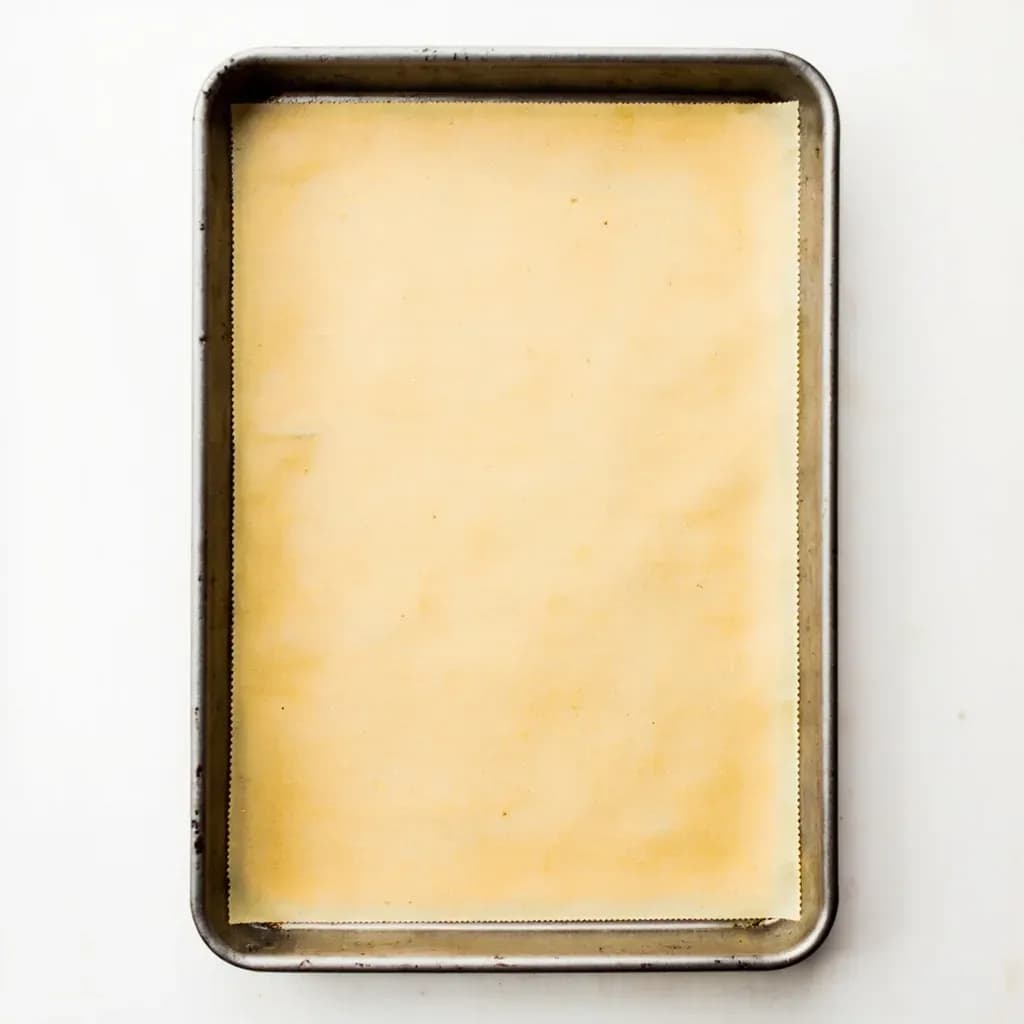
A perforated silicone baking mat is a fiberglass mesh sheet coated in food-grade silicone, with thousands of micro-holes punched through the entire surface. The holes do the work a solid mat cannot: they vent steam from wet doughs and let hot air reach the underside of whatever you are baking, which is the difference between a crackling baguette bottom and a soft, damp one. The silicone layer handles release, so the mat is naturally nonstick without greasing, and the fiberglass core keeps it dimensionally stable at roasting temperatures for thousands of bakes.
The mat occupies a useful middle ground in a baker's kit. Parchment is convenient and disposable but flat — it traps moisture under the dough and yields a pale, sometimes leathery underside. A perforated aluminum tray gives superb airflow but nothing releases on its own, so delicate viennoiserie can weld itself to the metal. A baking stone delivers fierce bottom heat but holds moisture against wet doughs and is heavy to handle. A perforated mat delivers airflow, release, and reusability in one piece, which is why it is a fixture in baguette production and viennoiserie work.
The mat only does its job when it is supported on something rigid. Set it on a sheet pan — ideally a perforated one — and never directly on an oven rack, where it can sag, lose contact with the food, and degrade at the edges.
Alternatives
Types & varieties
The original perforated mat from Demarle (France), the reference product; typically half-sheet dimensions.
Demarle's perforated counterpart to its classic solid Silpat; same silicone-fiberglass build.
Demarle's perforated rigid silicone tray with raised edges, designed for tarte tatin and open tarts that need support at the rim.
Professional-grade perforated mat common in pastry kitchens.
Long, narrow perforated silicone mat shaped for baguettes and ficelles.
Circular perforated silicone mat sized for home and deck ovens.
How it compares to other liners
No single liner wins every job. The perforated mat is a hybrid, and choosing it over the alternatives comes down to what your bake needs most: airflow, release, bottom heat, or convenience.
- Parchment paper — convenient and disposable, but flat. It traps steam under the dough, so crusty breads and wet-fillings tarts often come out pale on the bottom. Reach for parchment when cleanup is the priority and browning is not.
- Perforated aluminum tray — excellent convection, no release. Ideal for very dry, low-fat doughs (lean baguettes, crackers) but laminated doughs and sugared fruits can weld to the metal without a release layer.
- Baking stone or steel — ferocious bottom heat, but moisture pools on the surface. Great for pizza and flatbreads, less so for sugar-heavy tarts and egg-enriched custards that need to vent steam.
- Solid silicone mat (classic Silpat) — great release, but no airflow. A solid mat is the right call for candy work, meringues, and anything where you want gentle, even contact.
- Perforated silicone mat — the hybrid. Pair it with a perforated sheet pan for the strongest effect: the pan handles convection, the mat handles release, and both let steam escape.
Common uses
Tips & pitfalls
- Preheat the mat on the sheet pan for 5–10 minutes before loading dough — the burst of contact heat sets the bottom and boosts crust formation.
- For best results, lay the mat on top of an already perforated aluminum baguette tray or perforated sheet pan: double the airflow and you get a noticeably drier, browner underside.
- Never cut on the mat with a knife; trim with scissors if you need a custom size, since blade nicks shred the fiberglass mesh underneath.
- Skip abrasives, scouring pads, and sharp utensils during cleaning — they damage the silicone skin and expose the fiberglass core, shortening the mat's life.
- A faint silicone smell on first uses is normal; it dissipates after a few bakes or after an initial wash with warm soapy water.
- If the mat warps, sticks, develops tears, or shows frayed fiberglass at the edges, retire it. Exposed fibers are a contamination risk and a sign the silicone skin has failed.
- Don't place the mat directly on an oven rack; always support it on a rigid baking sheet or tray so it stays flat and the edges don't cook against the bars.
- Avoid broiler elements and open-flame contact — silicone-fiberglass mats are not rated for radiant direct heat from above and can scorch or ignite.
- Cool the mat fully before washing; thermal shock (hot mat into cold water) can warp it or delaminate the silicone from the fiberglass mesh.
- Resist over-oiling pastry on the mat; heavy fats pool in the perforations and can smoke at high heat.
Good to know
- Material
- Fiberglass mesh coated with food-grade silicone
- Hole pattern
- Micro-perforations across the entire surface for airflow and steam release
- Max oven temperature
- Approximately 480°F / 250°C (verify on the manufacturer's spec sheet)
- Standard size
- Half sheet ~16.5 × 11.75 in (42 × 30 cm); full-sheet and baguette-tray sizes also sold
- Reusability
- Designed for thousands of bake cycles when cared for
- Greasing
- Not required — release is built into the silicone
- Dishwasher
- Most mats are dishwasher-safe on the top rack
- Broiler / direct flame
- Not recommended — heat source must be below or around, not on, the mat
- Storage
- Store flat or loosely rolled; never folded or creased
Also called
Silpain · perforated silicone mat · bread baking mat