Wraps & Liners
Plantain Leaf (Wrapping)
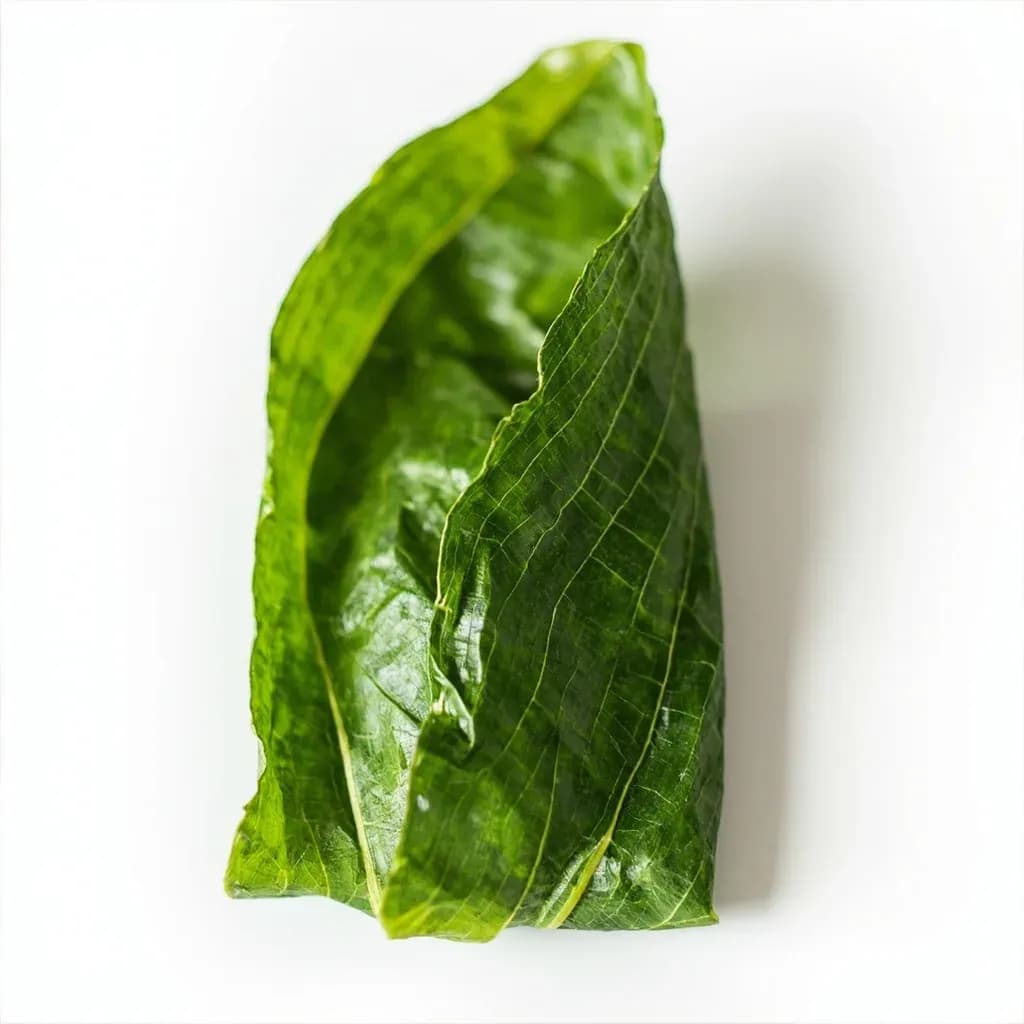
Broad green leaf used to wrap and steam foods, lending a mild herbal aroma.
Plantain leaf is a broad, pliable green leaf used much like banana leaf to wrap food for steaming, grilling, and roasting in African, Caribbean, and Latin American cooking. It seals in moisture and adds a subtle earthy, herbal aroma to wrapped rice, fish, and tamales. Cooks soften it over heat or in hot water before folding so it bends without splitting.
The plantain leaf is one of the most generous wrappers a cook can ask for: a single mature leaf can measure a meter or more in length, broad and supple enough to fold around a whole fish, a tray of pasteles, or a mound of sticky rice. It comes from the same genus (Musa) as the banana, but the leaves of true plantains and their wild relatives are thicker, waxier, and sturdier than common banana leaves, which is why they are favored across the Caribbean, West Africa, South Asia, and parts of Southeast Asia for jobs that involve long steaming or direct grilling. The leaf is never eaten; its role is functional and aromatic, lending a faint grassy, faintly herbal scent to whatever it holds while keeping in moisture and protecting food from scorching or sticking.
In the kitchen it behaves somewhere between parchment and foil, but with more character. It is flexible when warmed, sheds water and fat on its glossy upper side, and tolerates wet heat, dry heat, and smoke up to roughly 200 °C (400 °F). Because the plantain plant is grown primarily for its fruit, the leaves are an inexpensive agricultural by-product — a renewable, compostable wrapper that turns everyday steaming, grilling, and presentation into something quietly special. Treat them with the same respect you would give a good piece of cookware: condition them before folding, trim the woody midrib, and match leaf thickness to the cooking method.
Alternatives
Types & varieties
From Musa × paradisiaca cultivars that produce large, angular fruits; the leaves are among the largest and most commonly used for Caribbean pasteles and tamales.
Slightly smaller and more pointed; widely used in West African cooking for steaming and grilling parcels.
A wild, seedy plantain relative with notably tough, thick, waxy leaves prized for long cooking and direct grilling; common across South and Southeast Asia.
Not a true plantain but a close cousin (Musa acuminata); thinner, more pliable, and more aromatic; many cooks treat the two interchangeably, though plantain leaves fold stiffer and hold up longer over fire.
Anatomy and how it cooks
A plantain leaf is built in two distinct surfaces, and a cook who learns to read them gets better results. The upper face is glossy and heavily waxed, which is why rain runs off a plantain tree in the tropics; the underside is matte and fibrous, with the network of veins that branch off the thick central midrib. Heat, moisture, and fat all behave differently on each side, and so does the leaf's willingness to be folded.
- The waxy upper surface is your exterior face: it sheds water and grease, resists tearing, and gives parcels a clean sheen after steaming.
- The matte underside is more absorbent and grippy; it is the side that should sit against the food so steam and juices stay in contact with what's cooking.
- The midrib is woody and will crack if you try to fold it; always slice it flat with a sharp knife or kitchen shears before shaping the leaf.
- Younger, paler leaves are tender and best for delicate wraps and short cooking; mature, dark green leaves are tougher and preferred for grilling and long steaming.
Conditioning before use
A cold plantain leaf is brittle and will split the moment you try to roll it. A few seconds of gentle heat relaxes the fibers and brings out the leaf's flexibility, the same way you would soften corn husks for tamales. The conditioning step is the difference between a neat, leak-proof parcel and a shredded mess.
- Wipe both sides with a barely damp cloth — never soak; trapped water turns the leaf soggy and prone to tearing.
- Hold the leaf a few centimeters above a gas flame, pass it over a hot dry skillet, or warm it in a 180 °C (350 °F) oven for 10–20 seconds until it darkens slightly and feels pliable.
- Lay the warmed leaf on a clean surface and slice away the raised midrib with shears or a paring knife so the leaf lies flat.
Matching leaf to method
Not every plantain leaf is right for every job. Thickness, age, and variety all change how a leaf performs over a fire, in a steamer, or on a plate. A cook who has more than one type on hand — or who knows how to double-wrap — can adapt to nearly any technique.
- Thick, mature Musa balbisiana or French plantain leaves: best for grilling, smoking, and baking in parcels; they tolerate direct flame and long cook times.
- Medium French or falsehorn leaves: ideal for steaming pasteles, hallacas, nacatamales, kenkey, and other masa or dough parcels.
- Younger, paler leaves: gentler and more aromatic, suited to brief steaming, lining steamer baskets, and wrapping delicate fish.
- When in doubt, double-wrap — layer two leaves with the waxy sides facing out — for anything that will sit over direct heat or be turned repeatedly.
Regional traditions worth knowing
Plantain leaves carry a passport. The same basic wrapper anchors very different cuisines, and recognizing the dishes helps a cook understand what the leaf is supposed to do in each context — hold a heavy masa parcel together, perfume a grilled fish, or simply present a meal on something greener than a plate.
- Puerto Rico and the Dominican Republic: pasteles — grated root vegetable and meat masa wrapped in plantain leaves, tied with twine, and boiled.
- Venezuela: hallacas — corn dough stuffed with a savory meat stew, wrapped in plantain leaves, and simmered, a Christmas staple.
- Nicaragua: nacatamales — large, tamale-like masa parcels steamed in plantain leaves.
- Ghana, Nigeria, and across West Africa: kenkey, banku, and grilled fish or tilapia parcels steamed or roasted in plantain leaves.
- Kerala and Tamil Nadu (South India): fish and rice preparations such as meen pollichathu variants and pathiri steamed or grilled in plantain leaves.
- Indonesia and the Philippines: sticky rice, pepes, and seafood cooked in folded leaf packets over steam or coals.
Common uses
Tips & pitfalls
- Wipe leaves with a barely damp cloth rather than soaking them — water trapped in the waxy surface causes sogginess and tearing during cooking.
- Pass the leaf briefly over an open flame, a hot pan, or a few seconds in a hot oven to make it pliable; a cold leaf will crack and split when folded.
- Trim the thick central midrib with scissors or a knife before folding so the leaf lies flat and seals cleanly.
- Brush the inner surface lightly with neutral or coconut oil before wrapping fish or meat; this helps conduct heat and prevents sticking.
- Wrap with the matte underside against the food and the glossy waxy side facing out — the waxed surface sheds water and grease better.
- Do not pre-salt food that will sit on the leaf for long; salt draws out moisture and can make the leaf soggy and prone to tearing.
- For grilling over direct flame, double-wrap or use a sturdier Musa balbisiana leaf; single layers of thinner leaves scorch and split quickly.
- Reuse leaves that held dry or grilled foods — rinse, dry, and re-condition them; discard any leaf that held raw fish or meat for food-safety reasons.
- When substituting for banana leaves in a recipe, expect a slightly more robust, less sweet aroma and a stiffer fold; compensate with a longer softening pass over heat.
Good to know
- Source plant
- Plantain plant (Musa × paradisiaca and related Musa species, family Musaceae); the same genus as banana but a distinct, sturdier cooking leaf.
- Leaf size
- Typically 1–2 m (3–6 ft) long and 30–60 cm (12–24 in) wide at maturity; among the largest leaves of any commonly cultivated plant.
- Appearance
- Deep waxy green on top, paler matte green beneath, with a thick pale central midrib that runs the full length of the leaf.
- Flavor imparted
- Very mild — slightly grassy and herbal, with faint green-banana notes when heated; aromatic rather than flavorful.
- Heat tolerance
- Withstands steaming, grilling over open flame, and baking up to about 200 °C / 400 °F without burning through.
- Edibility
- The leaf is not eaten; it is used as a wrapper and removed before eating.
- Storage (fresh)
- Refrigerate wrapped in a damp cloth or paper towel inside a sealed bag for 5–7 days; do not wash until ready to use.
- Storage (frozen)
- Can be frozen whole or trimmed flat for 6+ months; thaw at room temperature before use.
- Availability
- Year-round in tropical growing regions; in temperate markets, supply is steady because leaves are imported or grown in greenhouses.
- Difficulty
- Easy; requires only basic conditioning (wiping and softening) before use.
- Cost
- Inexpensive; in U.S. markets roughly $2–5 per large leaf or $10–25 per bundle, varying by region and season.
- Sustainability
- An agricultural by-product of plantain cultivation; fully biodegradable and compostable.
Also called
plantain-leaf-wrap · plantain-leaves
Related

Aluminum Foil
Wraps, covers, and tents food for the oven and grill

Parchment Paper
Nonstick liner for clean, even baking and easy release

Wax Paper
Moisture-resistant sheet for wrapping and counter prep

Plastic Wrap
Clings tight to cover bowls and wrap leftovers

Silicone Baking Mat
Reusable nonstick liner that replaces parchment

Cheesecloth
Loose-woven cloth for straining stock and bundling herbs

Beeswax Food Wrap
Reusable wax wrap that molds around bowls and produce

Piping Tips
Shaped nozzles that turn frosting into stars and rosettes