Wraps & Liners
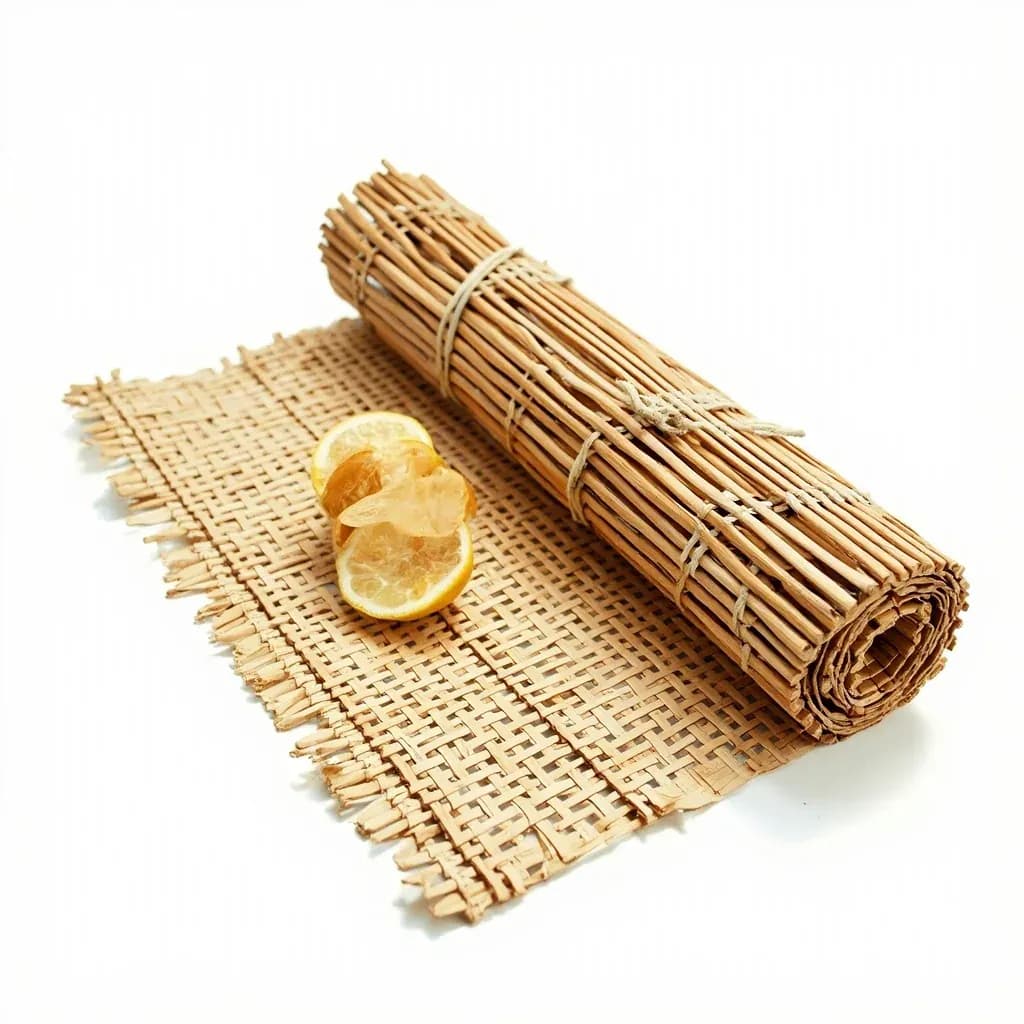
Straw Drying Mat
Woven bamboo or straw mat used to air-dry and roll foods like sushi and rice noodles.
A straw drying mat is a flexible mat of woven bamboo or straw slats used to air-dry, cool, and roll foods. In sushi making it becomes a makisu for rolling, while in noodle and rice-paper kitchens it lets sheets and herbs dry with airflow on both sides. The open weave keeps food off flat surfaces so moisture escapes evenly.
The name "straw drying mat" is a useful catch-all that covers two related but functionally distinct tools long used in East Asian kitchens: the slatted bamboo sushi-rolling mat (makisu) and the flat-woven straw or bamboo screen used to air-dry fresh noodles. Both are built from natural plant fibers — bamboo, rice straw, or igusa rush — bound into a flexible rectangle, and both belong to the broader wraps-and-liners family alongside muslin, cheesecloth, and steamer liners. The bamboo mat's rigid slats give it the structure needed to compress and shape rice into tight rolls, while the open weave of a drying screen allows maximum airflow around delicate extruded noodles. Understanding which one you need, and how to keep either in working condition, is the difference between a clean, even sushi roll and a torn sheet of nori stuck to dry bamboo.
In practice, the makisu is the workhorse of a sushi station: 15 to 20 thin bamboo slats lashed at even intervals with cotton or nylon string into a square roughly 24 cm across, flexible enough to curl around a filling yet firm enough to apply even, repeating pressure. A flat-woven straw or rush mat (mushiro) or a long, open-weave somen-drying screen serves the opposite purpose — it holds food still while air moves freely around it, and it has been used by noodle makers in Japan, China, and Korea for centuries to dry freshly extruded wheat and rice noodles in cool, breezy conditions. Both tools are inexpensive, traditional, and remarkably long-lived when cared for properly, but both share the same vulnerability: trapped moisture leads to mold, splitting slats, and off-flavors that will transfer directly into the food you lay on them.
Alternatives
Types & varieties
Japanese bamboo sushi-rolling mat; the most common form in sushi kitchens. Slats are typically 2.5–3 mm thick, bound with cotton or nylon string. Standard square size for hosomaki and futomaki.
Half-length mat used for thick rolls (futomaki), inside-out rolls (ura-maki), and pressing oshi-zushi; gives more leverage and a tighter seal.
Woven straw or rush mat (often igusa) used as a draining surface, table liner, or platter. Not used for rolling but commonly grouped with bamboo mats in the wraps-and-liners category.
Long, open-weave bamboo or straw mat on which freshly extruded wheat noodles are draped and air-dried in cool, breezy conditions — the traditional method behind regional Japanese somen, including the well-known Naruto-style.
Slatted bamboo screen used in kitchens to air-dry herbs, mushrooms, tofu, and cut fruit; functions as the drying side of a straw mat's role.
Similar to makisu but often wider and bound with rivets or metal pins; used for spring rolls, rice-paper rolls, and pressed rice cakes such as nian gao.
Choosing the Right Mat for the Job
Before buying, decide which job the mat will do most often, because the two main forms are not interchangeable. A slatted bamboo makisu has the rigidity to compress rice into a tight cylinder or a flat pressed block; a flat-woven straw or bamboo drying screen has the openness to let air circulate around wet noodles, herbs, or sliced fruit. Trying to roll sushi on a mushiro will produce a loose, lopsided roll because the mat flexes instead of gripping; trying to dry noodles on a tightly woven makisu traps moisture and invites mold.
When sourcing a makisu, look for food-grade bamboo with smooth-finished slats and food-safe cotton or nylon binding. Avoid decorative bamboo blinds, which are often treated with lacquer, dye, or anti-mold chemicals unsuitable for direct food contact. New mats shed fine slivers on the first use — run a cloth across the surface, sand the edges lightly with fine sandpaper, and rinse once before the first roll.
- Look for smooth, even slats with no splinters or cracks along the grain.
- Check the binding: tight, even knots of cotton or nylon string will outlast loose or frayed lashings.
- Avoid mats with a strong chemical, varnish, or paint smell — that is a sign of a non-food-safe finish.
- For drying noodles, choose an open-weave mat with gaps wide enough to see through; a tight weave defeats the purpose.
Care, Cleaning, and When to Replace
A bamboo or straw mat that is wiped down, dried thoroughly, and stored loosely will outlast several seasons of regular use; one that gets soaked, sealed in a drawer, or scrubbed with harsh soap will be unusable within months. The single most common failure is mildew from trapped moisture — recognizable as black specks that brush off only partially and a sour, cellar-like smell. Once that odor has soaked into the bamboo, the mat should be retired, not rescued; the smell will transfer to rice, nori, and any delicate food laid on the surface.
Replacement is also warranted when slats crack along the grain, when binding strings fray and slats no longer sit flush, or when the mat has warped into a permanent curve from being stored tightly rolled while damp. A well-tended mat will darken to a honey patina over time — that is normal and not a reason to discard it.
- Wipe the mat with a damp cloth after each use; never submerge it in standing water.
- Dry flat or rolled loosely upright in a ventilated spot, never sealed in a damp drawer or plastic bag.
- Replace immediately if black mold appears, strings fray, or slats crack or splinter.
- A darkened, honey-colored patina on bamboo is normal; a sour or musty smell is not.
Common uses
Tips & pitfalls
- Wrap the mat in plastic wrap (or slip it inside a clean plastic bag) before rolling sushi — rice and nori will otherwise stick to bare bamboo and tear the roll apart on the cut.
- For drying noodles, the mat must be clean, food-grade, and fully dry — residual moisture or dust from a workshop mat transfers directly to the noodles.
- When shaping onigiri or oshi-zushi, lightly mist the mat with water rather than oil; oil soaks into the bamboo and turns rancid over time.
- If you only have a flat-woven straw mushiro, use it for pressing and draining but not for rolling — it lacks the structural rigidity of a slatted bamboo mat.
- Sand new bamboo mats lightly with fine sandpaper and rinse once before first use to remove loose slivers that can end up in the rice.
Good to know
- Material
- Bamboo slats or woven natural straw (rice straw, igusa, or wara), bound with cotton, hemp, or nylon string
- Origin
- East Asia; the bamboo makisu is documented in Japan from the Edo period (1603–1868); woven straw mats have been used across China, Japan, and Korea for centuries
- Typical size (sushi mat)
- Standard makisu is approximately 24 x 24 cm (9.5 x 9.5 in); half-mats run about 24 x 12 cm
- Typical size (drying mat)
- Somen and noodle-drying mats are larger rectangles, often 30–60 cm wide and 1–2 m long, designed to be hung or laid flat for airflow
- Construction
- Bamboo mats use 15–20 thin slats (about 2.5–3 mm thick) lashed at 2–4 mm intervals with 4–6 cross-strings; straw mats are tightly flat-woven with reinforced edges
- Heat tolerance
- Bamboo tolerates brief steam, but prolonged soaking causes splitting; straw is more heat-sensitive and should never go over direct flame or into a hot oven
- Storage
- Roll loosely and store flat or hung in a dry, ventilated space; trapped moisture promotes mold and mildew, especially on straw
- Lifespan
- A bamboo makisu lasts 1–3 years of regular use before slats crack or strings fray; straw mats are shorter-lived and often replaced seasonally
Also called
bamboo drying mat · straw mat · drying mat
Related

Aluminum Foil
Wraps, covers, and tents food for the oven and grill

Parchment Paper
Nonstick liner for clean, even baking and easy release

Wax Paper
Moisture-resistant sheet for wrapping and counter prep

Plastic Wrap
Clings tight to cover bowls and wrap leftovers

Silicone Baking Mat
Reusable nonstick liner that replaces parchment

Cheesecloth
Loose-woven cloth for straining stock and bundling herbs

Beeswax Food Wrap
Reusable wax wrap that molds around bowls and produce

Piping Tips
Shaped nozzles that turn frosting into stars and rosettes