Prep Tools
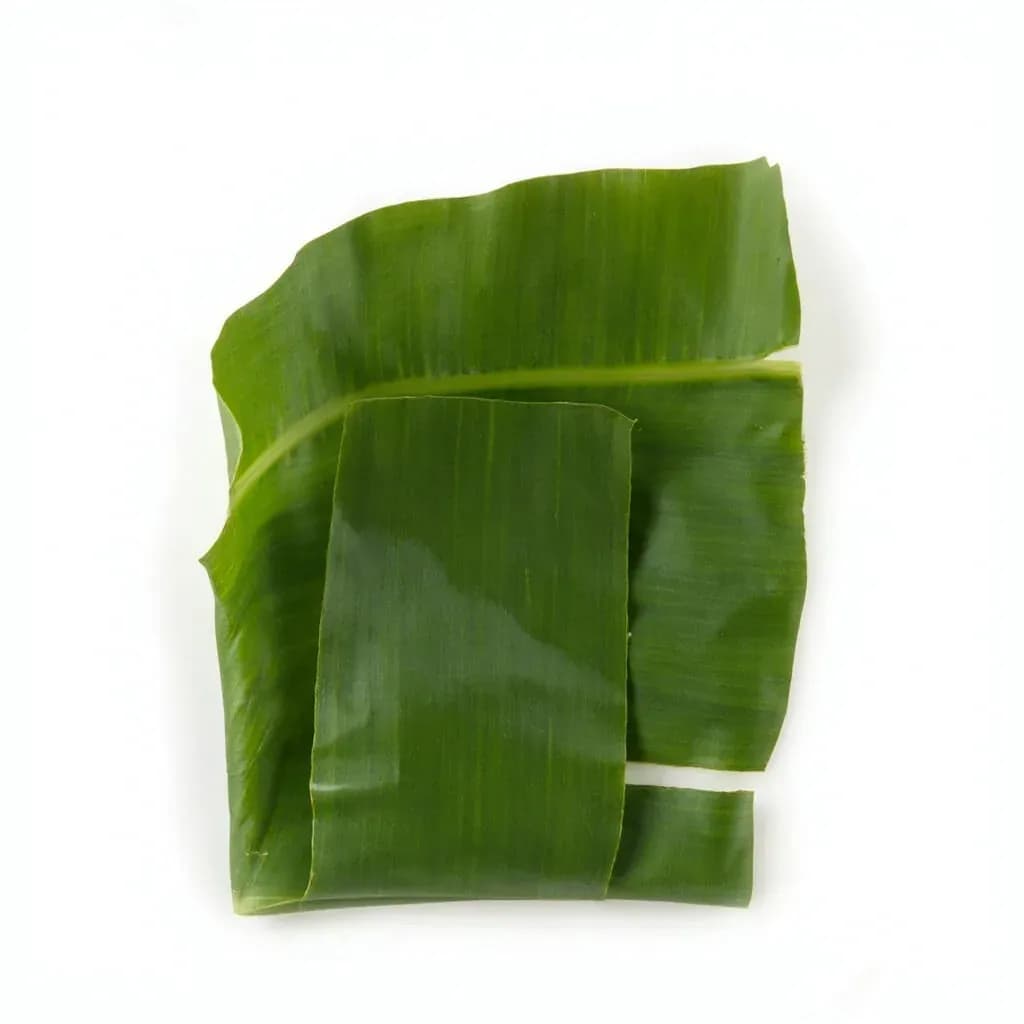
Banana Leaf
A large pliable leaf used to wrap, line, and steam foods, lending a subtle grassy aroma.
Banana leaves are broad, flexible leaves used across tropical cuisines to wrap foods for steaming, grilling, or baking. Briefly heated over a flame to make them supple, they parcel rice, fish, tamales, and dishes like Congolese liboke, sealing in moisture and imparting a faint herbal aroma. They also serve as a natural plate or pan liner and are fully biodegradable.
Banana leaf is the long, waxy blade of the banana plant (Musa spp.) — not an herb or a garnish, but a working kitchen wrapper with a job: it holds food, shields it from direct heat, traps steam, and quietly perfumes whatever it encloses. The leaf itself is never eaten; it is too fibrous for the fork, and the pleasure lies entirely in what it does for the food inside. Used in cuisines from Kerala to the Caribbean for centuries, it is one of the oldest cooking wrappers still in active service.
The leaf behaves like a flexible, heat-tolerant membrane. Cold, it is brittle and cracks along its fibers; pass it over a flame or dip it in hot water for a few seconds and it relaxes into something soft enough to fold around a fillet of fish. Under heat it releases a faint, grassy, slightly tea-like aroma — strongest over an open fire or grill, gentler in a steamer — and it weeps a small amount of moisture that keeps wrapped foods from drying out. It is also surprisingly tough: intact leaves hold up to grilling, baking to about 400°F/200°C, and long pit cooks without falling apart.
Practically, banana leaf solves two problems at once. It is a nonstick, single-use liner for steamer baskets, baking pans, and grills, and it is a moldable wrapper for parcels of spiced fish, sticky rice, or pork. The trade-off is purely logistical: fresh leaves are regional, perishable, and need a quick warm-up before they cooperate, which is why most well-stocked kitchens keep a stack of frozen pieces on hand as insurance.
Alternatives
Types & varieties
Larger, thicker, and more rigid than common banana leaf; preferred for grilling and longer cooks in Latin American and Caribbean cooking.
The everyday wrapper across South and Southeast Asian cuisines; softer and more pliable, ideal for parcels and steaming.
Smaller, more tender, and more aromatic; a good choice for delicate fish or rice parcels.
Larger, tougher, and waxy; best for lining pots, grilling, and presentation platters.
Commercially packed, often pre-cut; a convenient standby when fresh leaves are unavailable.
Preparing a leaf for the kitchen
A fresh leaf is rarely ready to use straight from the package. The fibers are stiff and will snap if folded cold, so the first job is to make the leaf pliable. Hold it briefly over a gas flame, sweep it across a dry hot skillet, or dip it in a bowl of hot water for 10–20 seconds; it will shift from waxy green to a deeper olive tone (sometimes bronzing at the edges) and turn silky. Trim the thick central rib with kitchen shears so the leaf lies flat, then wipe both sides with a damp cloth to remove any dust or residue. From this point the leaf can be cut, layered, or folded as needed.
Building a parcel
Most wrapped dishes are simple envelopes or boats rather than tight bundles. Cut the wilted leaf into a rectangle large enough to overlap the filling by an inch or two on every side. Place the food slightly off-center, fold the long sides over it, then tuck the short ends under to form a flat or pillow-shaped packet. Leave room for expansion — rice, sticky rice, and dumpling batters all swell as they steam — and secure the seams with thin strips of banana leaf, kitchen twine, soaked toothpicks, or unflavored dental floss. Avoid metal skewers or staples, which leave black stains on the leaf.
Stand-ins when no leaf is available
Banana leaf's nearest functional replacements are parchment paper and aluminum foil. Parchment is the cleanest liner for steamer baskets and baking pans and tolerates oven heat without flavor transfer; it gives no aroma of its own. Foil is more heat-tolerant and useful for grilling and pit cooking, but it lacks the breathability that lets banana leaf perfume food and prevent sogginess. Lotus leaf, where available, is the only true aromatic substitute and is used in much the same way for dim sum and sticky-rice parcels. None of these replicates the grassy perfume; they only imitate the wrapper function.
Cautions and food safety
Banana leaves are generally considered food-safe, but a few points are worth knowing. People with a latex allergy sometimes react to the sap on a fresh-cut leaf, so those cooks should rinse the leaf well and avoid handling it bare-handed. Commercially packed leaves may carry agricultural residue and benefit from a quick wipe — or a rinse and pat dry — before use. Dyed or treated leaves sold for craft use are not food-safe and should not be confused with culinary stock.
Common uses
Tips & pitfalls
- Pass the leaf briefly over a gas flame, hot pan, or dip it in hot water for 10–20 seconds before folding — a cold leaf will crack along its fibers.
- Cut along the central rib with kitchen shears; the rib is too fibrous for a clean knife cut.
- Wipe the surface with a damp cloth before use; do not soak, which leaches flavor and causes tearing.
- Place the shinier, waxy side facing the food — it is the more impermeable face and releases aroma onto the food.
- Secure parcels with strips of banana leaf, twine, or soaked wooden picks — not metal, which can stain the leaf black.
- Do not pack parcels too tight; rice and dumplings expand as they steam.
- Choose deep green, supple leaves free of large brown spots, splits, or insect damage — old, brittle leaves shatter on the fold.
- When grilling delicate items, double-wrap so a tear from the grate does not expose the food.
Good to know
- Botanical source
- Banana plant, primarily Musa acuminata; plantain leaves (Musa × paradisiaca) are used the same way and tend to be sturdier.
- Typical size
- Whole leaves run 5–10 ft (1.5–3 m) long by 1–2 ft (30–60 cm) wide; sold cut into 12–36 in (30–90 cm) pieces.
- Imparted flavor
- Mild grassy, slightly tea-like aroma; strongest on direct heat, gentler in a steamer.
- Edible
- No — used as a wrapper or liner. The leaf is too fibrous to eat and is discarded after cooking.
- Heat tolerance
- Safe on the grill, over open flame, in the oven up to ~400°F (200°C), and in the steamer.
- Storage
- Fresh leaves keep 1–2 weeks wrapped in a damp cloth in the refrigerator; do not submerge. Frozen leaves keep several months and thaw overnight in the refrigerator.
- Common forms sold
- Fresh whole leaves, fresh cut pieces, frozen stacked leaves, and thawed ready-to-use packs at Asian and Latin American groceries.
Also called
Banana Leaf (wrapping) · Banana Leaf (Liboke Wrapping) · plantain leaf
Related

Peeler
Swift blade for stripping skin off fruit and vegetables

Grater
Sharp-toothed surface for shredding cheese and vegetables

Microplane
Ultra-fine rasp for citrus zest, garlic, and hard cheese

Mixing Bowl
All-purpose bowl for combining, whisking, and tossing

Whisk
Looped wires that beat air into eggs, cream, and sauces

Spatula
Flat blade for flipping, lifting, and scraping

Slotted Spoon
Pierced spoon that lifts solids and drains the liquid behind

Wooden Spoon
Gentle, heat-friendly spoon for stirring anything