Prep Tools
Banana Leaf Serving Tray
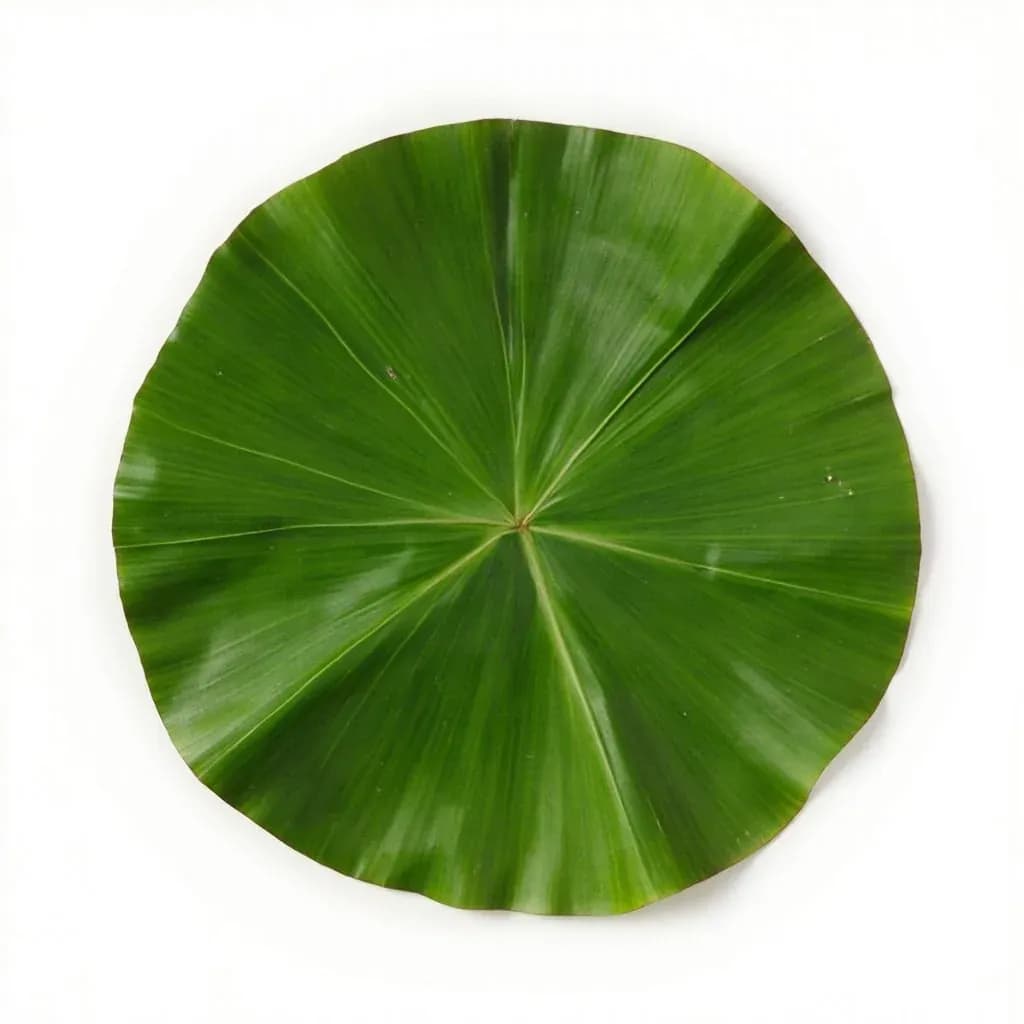
A flat banana leaf laid over a tray or table as a natural, aromatic serving surface for a meal.
A banana leaf serving tray is a large fresh banana leaf trimmed and laid flat over a platter or directly on the table to serve a full meal, as in a South Indian sadya or a Southeast Asian communal spread. Diners eat rice, curries and accompaniments straight off the leaf, which is fragrant, single-use and naturally biodegradable. The leaf is usually briefly passed over a flame or wiped down to soften and clean it before plating.
A banana leaf serving tray is a fresh, cleaned leaf of the banana or plantain plant (Musa species) laid flat across a tray, board, or table as a disposable, compostable liner for food. Mature leaves run 60–180 cm long and 30–60 cm wide, with a waxy cuticle that sheds moisture for short periods. Cold leaves are stiff and crack when folded; a few seconds over a flame or in hot water relaxes them into a soft, deep green surface with a faintly grassy, tea-like aroma that flatters almost any food placed on it.
The leaf is not an ingredient and is not eaten, but it is a true working surface — one of the few natural food-contact materials that is large, pliable, heat-tolerant, and fully biodegradable. In Kerala and Tamil Nadu a sadya (banana-leaf feast) is the defining format for a festive meal, and the leaf carries the same load in Thai, Indonesian, Malaysian, Vietnamese, Filipino, and Sri Lankan cooking, both as a tray and as a wrapper for steaming, grilling, and shaping rice. Outside the tropics it shows up in modern restaurant plating, in caterers' compostable service, and in home kitchens cooking the cuisines where the leaf is standard.
The surface has real limits. The waxy cuticle is water-resistant, not waterproof, so thin sauces and soups will eventually soak through. It scorches above roughly 200 °C / 400 °F, so the leaf belongs on top of a tray or wrapped around food, not as a direct cooking surface. And dried leaves, while decorative, shatter when folded — for a flexible, working leaf, you need a fresh or properly stored one.
Alternatives
Types & varieties
A full mature leaf or large section used as a tray liner or table covering — the classic surface for South Indian sadya and modern restaurant plating.
Leaf cut to plate- or tray-sized pieces with the thick central midrib removed; the everyday restaurant and catering form.
Small folded or stitched disposable plates and cups made from sections of banana leaf; widely used across India for street food, weddings, and temple offerings.
Leaf folded into a small vessel to hold sticky rice, curries, or grilled fish; common in Thai, Lao, and Malaysian street food.
Leaf folded into a cone or cup to serve snacks such as Vietnamese bánh tẻ, grilled meats, or small sweets.
Larger, thicker, and more durable than dessert-banana leaves; preferred in South Indian sadya and many Indonesian preparations.
Commercially packed leaves sold to restaurants outside the tropics for consistent color, pliability, and a longer shelf life.
Preparing the leaf for service
A cold leaf straight from the fridge is brittle and will crack the moment you try to fold or lay it. The standard fix in restaurant and home kitchens is a few seconds of heat: pass the leaf briefly over a gas flame, wave it over a hot pan, or dip it into hot (not boiling) water for 5–10 seconds. The waxy cuticle softens and the leaf relaxes into a flat, satin-green surface that drapes cleanly over a tray. Wipe it with a damp cloth only — soap leaves a film that carries into food. Trim off the thick central midrib with a knife or kitchen shears when laying the leaf flat, since the rib is too rigid to fold and will lift food off the surface in an awkward ridge.
- Heat-treat briefly to relax the leaf; over-softening makes it tear.
- Trim or score the central midrib before laying the leaf flat.
- Wipe with a damp cloth — no soap or detergent.
- Bring refrigerated leaves to room temperature to avoid condensation on rice or fried foods.
Sourcing and storage outside the tropics
If you don't live where bananas grow, frozen or vacuum-packed banana leaves are sold at most Asian markets and online; they arrive pliable, uniformly green, and ready to use after thawing. They are the practical choice for restaurants and caterers who need consistency. Dried leaves, by contrast, are decorative only — they look the part but snap the moment you fold them, so don't try to wrap or shape with them. For fresh leaves, wrap in a slightly damp cloth inside a sealed bag and refrigerate; they keep about a week. They also freeze well for several months, ideally interleaved with parchment so they don't fuse into a single block.
Common uses
Tips & pitfalls
- Heat the leaf briefly over a flame or in hot water before folding — a cold leaf cracks.
- Trim away the thick central midrib when laying the leaf flat; it won't bend with the rest of the leaf.
- Wipe with a damp cloth only; soap and detergent leave residue that taints food.
- Choose uniformly green, unblemished leaves — brown spots and tears split during folding.
- Don't use a banana leaf as a direct cooking surface above 200 °C / 400 °F; the waxy cuticle scorches. Use it as a liner or wrapper instead.
- Brush the leaf lightly with oil before grilling on it, to slow charring and stop sticking.
- For catering, lay the leaf on a rigid tray or board — a soft cloth underneath lets the leaf wrinkle and pool liquids.
- Wipe the leaf with a thin film of oil when serving acidic or heavily spiced dishes to slow staining and moisture penetration.
Good to know
- Material
- Leaf of banana or plantain plants (genus Musa, family Musaceae)
- Typical leaf size
- 60–180 cm long × 30–60 cm wide, depending on species and maturity
- Heat tolerance
- Comfortable with hot food contact; tolerates steaming, grilling, and low-temperature oven baking as a wrapper or liner
- Direct-flame limit
- The waxy cuticle scorches above roughly 200 °C / 400 °F — use as a liner, not a direct cooking surface
- Aroma
- Faintly grassy and herbaceous; releases a subtle green, tea-like note when warm food rests on it
- Edibility
- Not eaten; considered safe and non-toxic in direct food contact
- Compostability
- Fully biodegradable; breaks down in weeks under warm, moist composting conditions
- Storage
- Fresh leaves keep 5–7 days refrigerated wrapped in a damp cloth in a sealed bag; can be frozen for several months
Also called
Banana Leaf Plate
Related

Peeler
Swift blade for stripping skin off fruit and vegetables

Grater
Sharp-toothed surface for shredding cheese and vegetables

Microplane
Ultra-fine rasp for citrus zest, garlic, and hard cheese

Mixing Bowl
All-purpose bowl for combining, whisking, and tossing

Whisk
Looped wires that beat air into eggs, cream, and sauces

Spatula
Flat blade for flipping, lifting, and scraping

Slotted Spoon
Pierced spoon that lifts solids and drains the liquid behind

Wooden Spoon
Gentle, heat-friendly spoon for stirring anything