Knives & Cutting
Boning Knife
Narrow, flexible blade for separating meat and poultry from the bone.
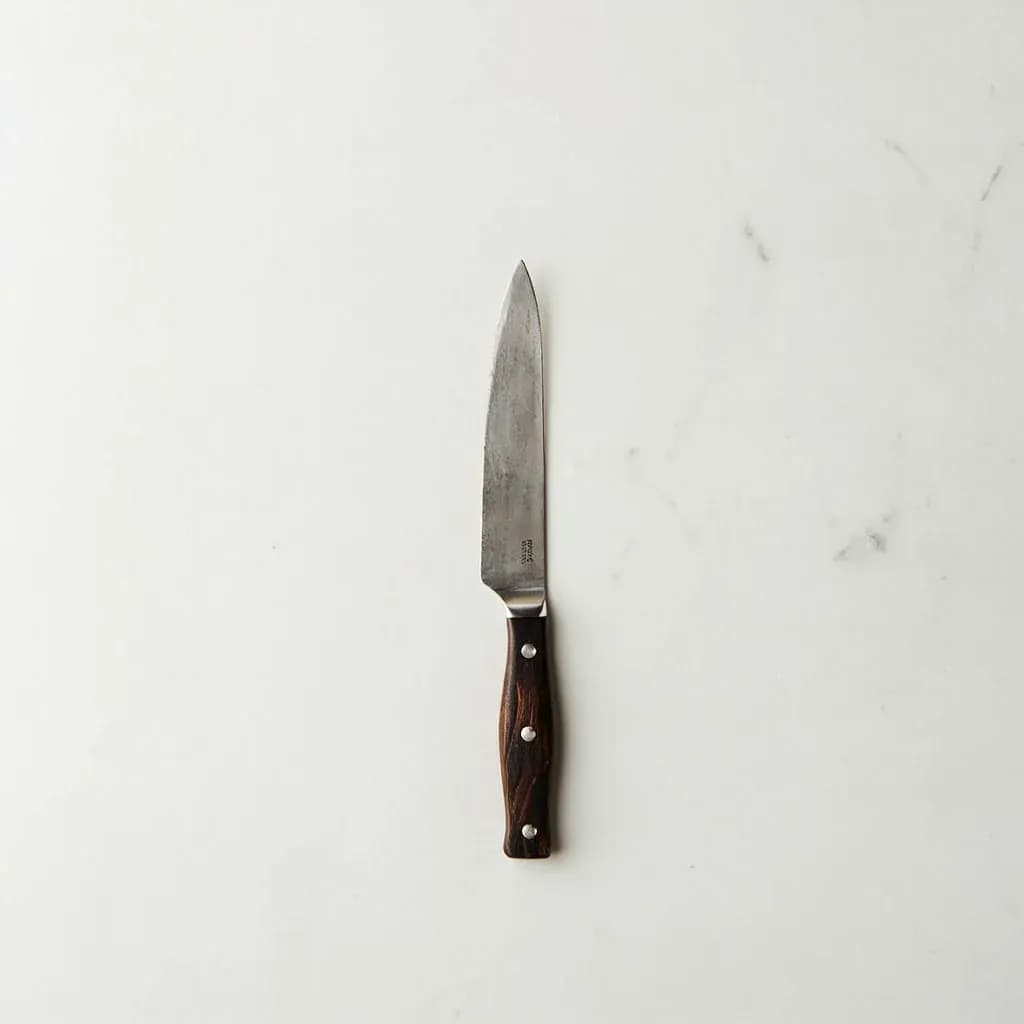
A boning knife has a thin, narrow blade, often slightly flexible, designed to work close to bones and joints when butchering meat, poultry, and fish. Its pointed tip and slim profile let cooks separate flesh from bone, trim silverskin, and break down cuts with minimal waste. Stiffer blades suit beef and pork, while more flexible ones are favored for poultry and fish.
A boning knife is a specialist blade built for one job: separating meat, poultry, or fish from bone with the least possible waste. Its narrow profile, thin spine, and fine point let it slip into the seams between muscle and skeleton — the places a chef's knife simply cannot reach — and the slim geometry gives the cook continuous tactile feedback through the handle. The result is a knife that feels almost surgical in the hand, tracing the contours of a chicken carcass or working silver skin off a tenderloin with a control that bulkier blades cannot match.
The design varies in meaningful ways. Flexibility, length, and grind all change how the knife behaves, and the right choice depends on what you are breaking down: a flexible 6-inch blade will glide around the ribcage of a duck, while a stiff 7-inch blade will push through the dense connective tissue of a pork shoulder. It is not a general-purpose substitute for a chef's knife, and it is not built to meet bone head-on. Used correctly, it recovers more usable meat, leaves cleaner surfaces for presentation, and cuts the time to break down a whole bird or a primal in half.
Alternatives
Types & varieties
Rigid blade that pushes through connective tissue; preferred for beef, pork, and lamb where clean separation matters more than following contours.
Thin, pliable blade that bends around bones and joints; the go-to for poultry, rabbit, and fish.
A compromise choice for cooks who debone a wide range of proteins with a single tool.
Standard profile around 1 cm wide at the heel; precise control in tight spots like chicken thighs.
Slightly broader blade that some butchers prefer for skinning and for working on larger primals.
Triangular, stiff, single-bevel blade traditionally used for poultry; the angled tip excels at slipping between joints and removing tendons.
Longer, heavier, often slightly curved; used to break down large sections of beef and pork carcasses — different from a true boning knife but often confused with one.
Choosing between stiff and flexible
Flexibility is the single most important choice when buying a boning knife, and it should follow the protein you handle most. A flexible blade gives up some pushing power in exchange for the ability to curve along a spine, ride a ribcage, and trim silver skin in long unbroken strokes. It is the right call for chickens, ducks, rabbits, and small fish. A stiff blade is a better lever; it drives through the silverskin and fascia of red meat and gives the butcher confidence when working against heavier structure. A semi-flex splits the difference and is a sensible choice for a home cook who does a bit of everything.
- Flexible blade for poultry, rabbit, and fish — it should bend visibly under light thumb pressure.
- Stiff blade for beef, pork, and lamb — the tip should not deflect when you press it into a roast.
- Semi-flex as a one-knife compromise for varied weekend cooking.
Honesuki versus the Western boning knife
The Japanese honesuki looks like a boning knife but is sharpened and used differently. Its single-bevel edge is ground on one side only, which makes it harder and more precise at the tip — ideal for popping chicken joints and pulling tendons — but it also means it is designed to cut in a specific orientation, not ambidextrously. Western boning knives are double-bevel and ambidextrous, with a thinner overall grind and more blade flex in the flexible models. A cook who does mainly European-style butchery will feel at home with a Western blade; a cook who breaks down whole chickens often finds the honesuki faster and more precise at the joints.
- Honesuki: single-bevel, stiff, triangular profile, optimized for poultry joints and tendon work.
- Western boning knife: double-bevel, available in stiff, semi-flex, or fully flexible versions.
- Either is a poor substitute for the other at its specialty task.
Common uses
Tips & pitfalls
- Match flexibility to the job: flexible for poultry and fish, stiff for red meat.
- Keep the edge keen — a dull boning knife slips and is the most common cause of cut fingers.
- Use long, smooth draw-cuts that follow the bone rather than short sawing strokes.
- Let the knife do the work; never twist or pry sideways, which can snap the thin blade.
- Angle the edge so it glides along the bone, not into it.
- Hone before each session on a honing rod; resharpen on a fine whetstone once the edge dulls noticeably.
- Always cut on wood or plastic — glass, stone, or marble will chip the edge instantly.
- Wipe and dry the blade the moment you finish; the thin steel stains and pits if left wet.
Good to know
- Typical blade length
- 5–7 inches (13–18 cm); 9-inch versions exist for breaking down large primals
- Blade material
- Usually high-carbon stainless steel; traditional carbon steel and Damascus versions are also made
- Blade profile
- Narrow, thin, with a fine point and a slight curve along the edge
- Flexibility
- Stiff, semi-flex, or fully flexible; each suited to a different protein
- Edge grind
- Western boning knives are typically double-bevel; the Japanese honesuki is single-bevel
- Spine thickness
- Noticeably thinner than a chef's knife — often 2–3 mm at the heel
- Not for
- Cutting through bone, frozen food, or hard squash; the thin edge will chip or snap
- Care
- Hand-wash and dry immediately; hone regularly, sharpen on a fine whetstone or rod
Also called
boning-knife
Related

Knife
The fundamental cutting tool every kitchen is built around

Chef's Knife
The do-everything blade for chopping, slicing, and mincing

Paring Knife
Small, nimble blade for peeling and detailed in-hand work

Serrated Knife
Saw-toothed blade that slices crusty bread without crushing

Cleaver
Heavy broad blade for chopping through bone and bulk prep

Cutting Board
The stable surface every cut starts on

Mandoline
Adjustable blade for paper-thin, perfectly even slices

Kitchen Shears
Heavy-duty scissors for poultry, herbs, and packaging