Prep Tools
Burger Turner
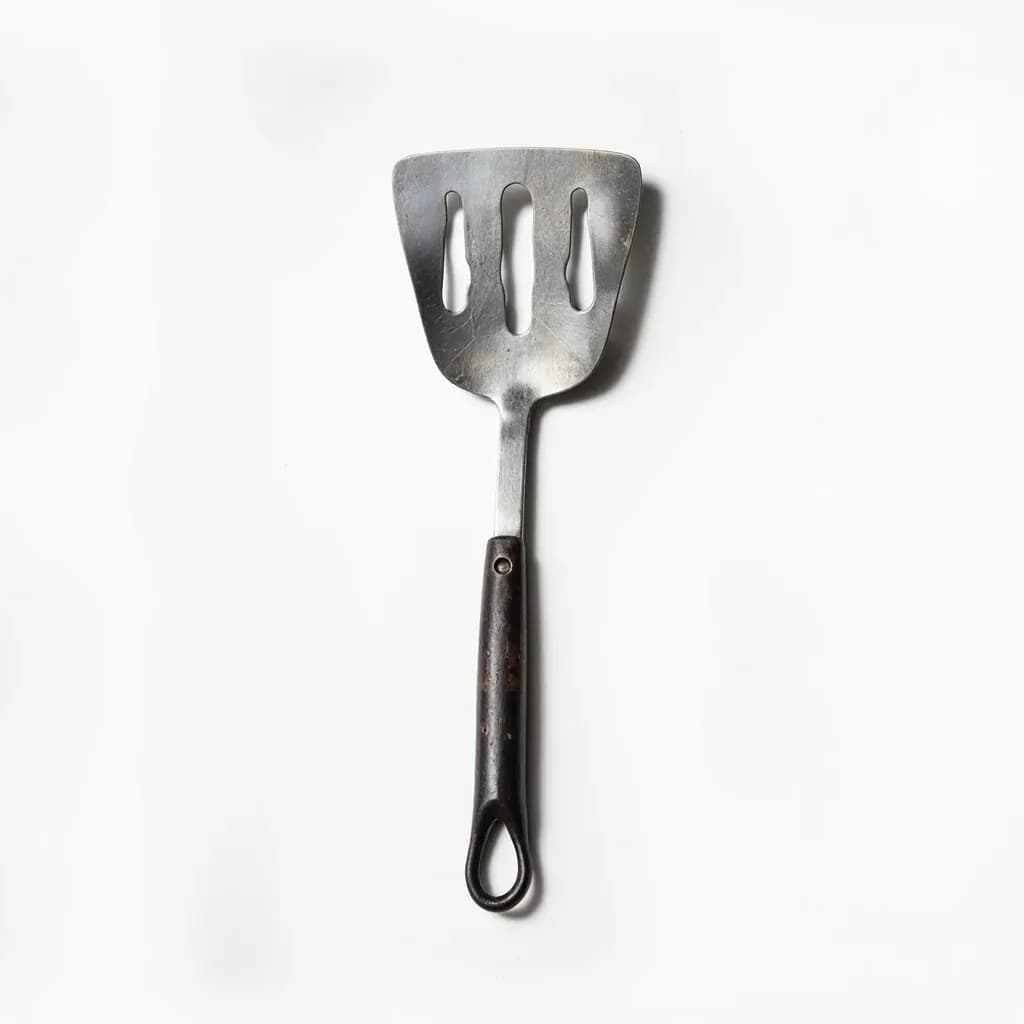
A wide, thin-edged spatula for flipping burgers and smashing patties on the griddle.
A burger turner is a sturdy spatula with a broad, beveled front edge designed to slide cleanly under patties and flip them without breaking. The wide blade supports the whole burger, and a stiff version doubles as a smashing tool for smash burgers on a flat top. It is a griddle and grill workhorse for burgers, eggs, and pancakes.
The burger turner is a stiff, wide spatula built for one job above all others: sliding cleanly under a crusted patty on a hot flat-top and moving it without tearing. Where a fish spatula is designed to flex and glide under a delicate fillet, a burger turner is rigid through the entire blade so it can bear weight, scrape fond, and press a ball of meat into a thin, edge-to-edge crust. The defining feature is a thin, beveled front edge — typically ground to roughly 15–20° — that slips under the Maillard layer the way a chisel slips under a tile.
Most blades are stainless steel, 3 to 4 inches wide and 5 to 6 inches long, mounted on a wood, polypropylene, or santoprene handle that keeps the cook's hand 10 to 14 inches from the heat. Commercial versions from makers like Dexter-Russell, Victorinox, and Vollrath are weighted (around 7 to 14 ounces) so a single press registers real force on the patty; lighter home versions trade some heft for easier wrist work. Solid, slotted, and nylon-edged variants all exist, but every variant shares that rigid core and that crisp leading edge.
Choose by surface: solid stainless for cast iron and steel flat-tops, slotted when you want to push grease rather than carry it, nylon or silicone-edged only on non-stick or enameled pans where metal would score the coating. Treat it as a long-lived tool — sharpen the bevel once or twice a year, hand-wash wood handles, and store it flat or hanging — and it will outlast several non-stick pans.
Alternatives
Types & varieties
All-metal or metal-with-wood-handle workhorse for flat-top griddles; the standard diner and restaurant model.
Has elongated slots so fat drains off the patty and grease can be pushed around the griddle without puddling under the food.
Safe for non-stick pans up to about 200 °C / 400 °F; the soft edge will not score modern coatings.
Flexible silicone tip on a rigid core; gentler on coated pans yet stiff enough to lift and flip a patty.
Larger 4 × 6 in or bigger blade with full-tang construction, usually a comfortable poly handle; built for high-volume smashburger stations.
Traditional look favored in classic burger joints; must be hand-washed to keep the handle from splitting.
Thinner and more flexible than a true burger turner; works for delicate items but lacks the rigidity to press or smash.
The leading edge
The thin, ground front edge is the whole reason the tool works. A blunt or rounded blade has to be forced under the crust, which tears the patty and pulls fat and juices with it; a crisp 15–20° bevel does it almost by gravity, especially if you approach at a shallow 10–15° angle from the front. Over time the edge rounds from contact with steel and stone, and once it does you will feel the resistance — the patty drags, the crust shreds, and you start reaching for a second tool. A yearly pass on a fine whetstone (1000-grit followed by a strop or 3000-grit) restores the geometry in a few minutes. Keep the blade flat to the stone, work only the beveled face, and finish by hanging the turner rather than tossing it back in a drawer where other tools can knock the edge.
Common uses
Tips & pitfalls
- Slide the turner in from the front of the patty, leading with the beveled edge at a shallow 10–15° angle so the juices stay in the meat.
- Do not press down on a regular thick burger — it squeezes out the rendered fat that is basting the crust; reserve the press for a deliberate smashburger or steamed-edge style.
- Sharpen the leading edge on a fine whetstone when it has gone dull; a crisp edge slips under a Maillard crust without tearing it.
- Use a dedicated metal turner for cast iron and steel flat-tops, and reserve nylon or silicone versions for non-stick and enameled pans.
- Let the burger release on its own — if it sticks, give it another 30–60 seconds so the crust can finish forming and release cleanly.
- Keep the blade flat against the griddle when smashing; angling the blade produces an uneven, lopsided puck.
- Wipe the blade on a clean rag or against the scraper bar between flips so grease does not pool and spatter on the next lift.
- Hang the turner by its handle loop or lay it flat in a drawer; tossing it into a crowded drawer rounds off the very edge you sharpened.
Good to know
- Also known as
- Hamburger turner, griddle spatula, grill spatula, bench-scraper-style turner
- Typical blade size
- 3 × 5 in to 4 × 6 in (≈7.5–10 cm wide; 12–15 cm long)
- Overall length
- 10–14 in (25–35 cm), giving reach over a hot flat-top
- Bevel angle
- ≈15–20°, often sharpened, on the leading edge
- Stiffness
- Stiffer than a fish spatula; built to lift, press, and scrape rather than flex
- Heat tolerance
- Stainless blade tolerates 200–230 °C / 400–450 °F; nylon and silicone versions max out around 200 °C / 400 °F
- Origin
- Evolved from the broad diner pancake/cake turner; commercial stainless versions standardized in 20th-century U.S. restaurant supply
- Common makers
- Dexter-Russell, Victorinox, Winco, Update International, Matfer, Vollrath
Also called
burger flipper · burger spatula · griddle turner
Related

Peeler
Swift blade for stripping skin off fruit and vegetables

Grater
Sharp-toothed surface for shredding cheese and vegetables

Microplane
Ultra-fine rasp for citrus zest, garlic, and hard cheese

Mixing Bowl
All-purpose bowl for combining, whisking, and tossing

Whisk
Looped wires that beat air into eggs, cream, and sauces

Spatula
Flat blade for flipping, lifting, and scraping

Slotted Spoon
Pierced spoon that lifts solids and drains the liquid behind

Wooden Spoon
Gentle, heat-friendly spoon for stirring anything