Prep Tools
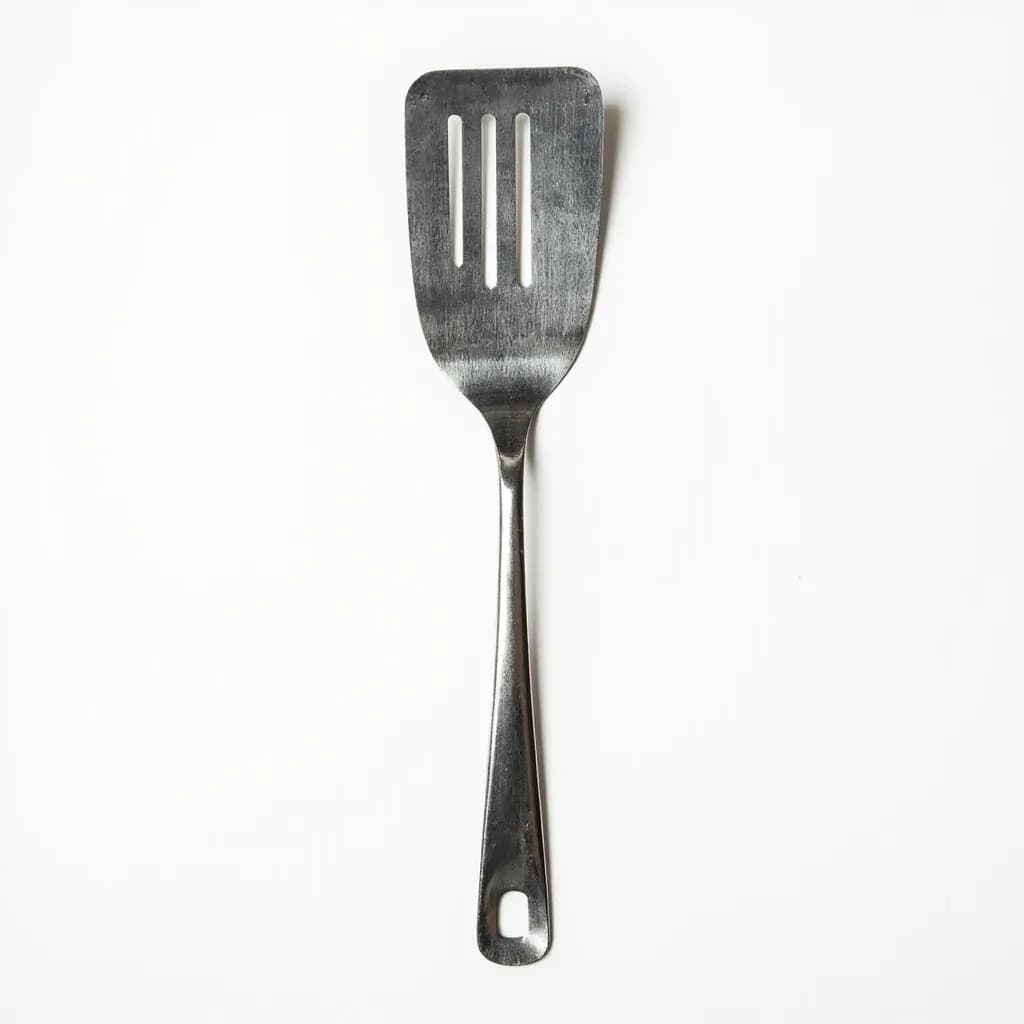
Slotted Turner
A flat slotted spatula for flipping and lifting food while letting fat and liquid drain.
A slotted turner is a flat, wide spatula head with cut-out slots, mounted on a handle, used to flip, lift, and serve foods while draining off excess oil or liquid. Its thin leading edge slides under pancakes, fish fillets, eggs, and patties, and the slots keep the food from sliding off as grease falls away. Versions for woks and fish are angled and flexible to handle delicate or curved cookware.
The slotted turner is a hybrid tool: it pairs the broad, flat blade of a regular turner with the drainage function of a slotted spoon by piercing that blade with elongated openings. That simple combination makes it one of the most frequently reached-for utensils in a working kitchen, because nearly every task that involves lifting something hot and wet — out of rendered fat, off a bed of sizzling butter, or up from a pot of boiling water — ends better when the liquid goes back where it came from. A solid turner carries that liquid with the food, leaving the plate slick and the diner holding a soggy piece of toast; the slotted version solves the problem in a single motion.
A good slotted turner balances three things: a head thin and beveled enough to slide cleanly under food, slots large or numerous enough to drain quickly without letting the food itself fall through, and a handle that stays comfortable in a wet, greasy hand. Material matters as much as shape. Stainless steel is the restaurant workhorse — rigid, dishwasher-safe, indifferent to high heat — while nylon and silicone slotted turners exist specifically to spare nonstick coatings from the micro-scratches that shorten a pan's life. Most home cooks will find that a single mid-size stainless steel slotted turner with a comfortable, slightly weighted handle covers the great majority of lifting-and-draining tasks they will encounter in a week of everyday cooking.
Alternatives
Types & varieties
Thin, beveled, slightly flexible head with angled slits; designed to slide under delicate fillets and drain oil
Wide, flat head with elongated slots or round perforations; lets steam escape and butter run off during plating
All-metal construction, dishwasher safe, safe at high heat; the workhorse of restaurant kitchens
Plastic-safe head for use on nonstick cookware; lower heat tolerance than silicone
Heat-resistant, nonstick-safe, often with a rigid nylon or steel core for stability
Head pierced with many small round or oval holes rather than a few large slots; drains more thoroughly but can let smaller food fall through
Traditional look with a metal head; preferred by cooks who want a balanced, cooler-feeling grip
Choosing the right head material
The single biggest decision when buying a slotted turner is what the head is made of, because that choice is governed almost entirely by the cookware you use it on. Metal on nonstick is a slow, cumulative mistake: each pass leaves faint scratches that eventually compromise the coating, and once that coating is gone, the pan cannot be restored. Reserve stainless steel slotted turners for stainless steel, cast iron (well seasoned), and carbon steel. Reserve nylon or silicone for nonstick, enameled, and ceramic. If you only own one slotted turner and have only nonstick pans, choose a silicone head with a reinforced core so it does not floppy-fold when lifting a heavy piece of food.
Drainage and slot design
Slot geometry controls how the tool performs. Long, narrow slots drain fast but only along their length; round perforations drain evenly across the entire head, though the holes can still be wide enough to let smaller food — chopped vegetables, shredded meat — slip through. Angled slits, common on fish turners, are cut on a bias so that as you lift and tilt the blade away from you, the slots act like little channels pushing liquid back into the pan rather than across the surface of the food. For most weeknight cooking, a hybrid of three or four elongated ovals in a wide head is the most forgiving design — it drains well, supports heavier items, and does not lose small pieces.
Common uses
Tips & pitfalls
- Match the head material to the cookware: use nylon or silicone on nonstick, metal on stainless steel and cast iron
- Hold the turner at a slight downward tilt away from you after lifting food so liquid drains cleanly through the slots rather than running onto your hand or the plate
- Choose thinner, more flexible heads for fish and delicate items; thicker, stiffer heads for lifting heavy roasts or multiple burgers at once
- Avoid using nylon or silicone slotted turners over open flames or directly on a hot coil, where temperatures exceed their rated limits and the head can soften or scorch
- Periodically scrub the slots with a stiff brush to prevent grease and starch buildup that can stain or harbor odors — a bottle brush works well
- For cleaner plating, tap the turner gently on the pan edge after lifting to shake off residual oil before transferring food to the plate
- Keep a dedicated slotted turner for fish if you cook oily fish often, since the head can hold onto smell even after washing
- Do not leave a slotted turner resting across a hot pan rim with food on it; the food continues to cook and the underside steams in its own juices
Good to know
- Primary function
- Lifting and flipping food while letting fat, oil, or cooking liquid drain back into the pan through slots in the head
- Typical head dimensions
- Approximately 3 to 4 inches wide by 4 to 5 inches long
- Overall length
- Commonly 11 to 13 inches end to end, with the head accounting for roughly one-third
- Common materials
- Stainless steel, nylon, heat-resistant silicone, or rigid plastic for the head; stainless steel, hardwood, or polypropylene for the handle
- Slot shapes
- Usually elongated ovals, narrow rectangles, or triangles; fish turners often use angled slits to channel liquid back into the pan
- Heat tolerance
- Stainless steel is safe at any stovetop temperature; silicone and high-grade nylon are typically rated to 400–450 °F; standard plastic is lower
- Edge profile
- Thin and beveled to slip under food; fish-style turners are the thinnest and most flexible
- Care
- All-metal slotted turners are dishwasher safe; wooden-handled versions should be hand washed and oiled occasionally
Also called
Fish Slice · Frying Turner · Wok Spatula · Khunti · Karchi · Slotted Spatula · Escumadeira
Related

Peeler
Swift blade for stripping skin off fruit and vegetables

Grater
Sharp-toothed surface for shredding cheese and vegetables

Microplane
Ultra-fine rasp for citrus zest, garlic, and hard cheese

Mixing Bowl
All-purpose bowl for combining, whisking, and tossing

Whisk
Looped wires that beat air into eggs, cream, and sauces

Spatula
Flat blade for flipping, lifting, and scraping

Slotted Spoon
Pierced spoon that lifts solids and drains the liquid behind

Wooden Spoon
Gentle, heat-friendly spoon for stirring anything