Cookware
Cast-Iron Griddle
Flat cast-iron plate for flatbreads, dosa, roti, pancakes, and griddled foods.
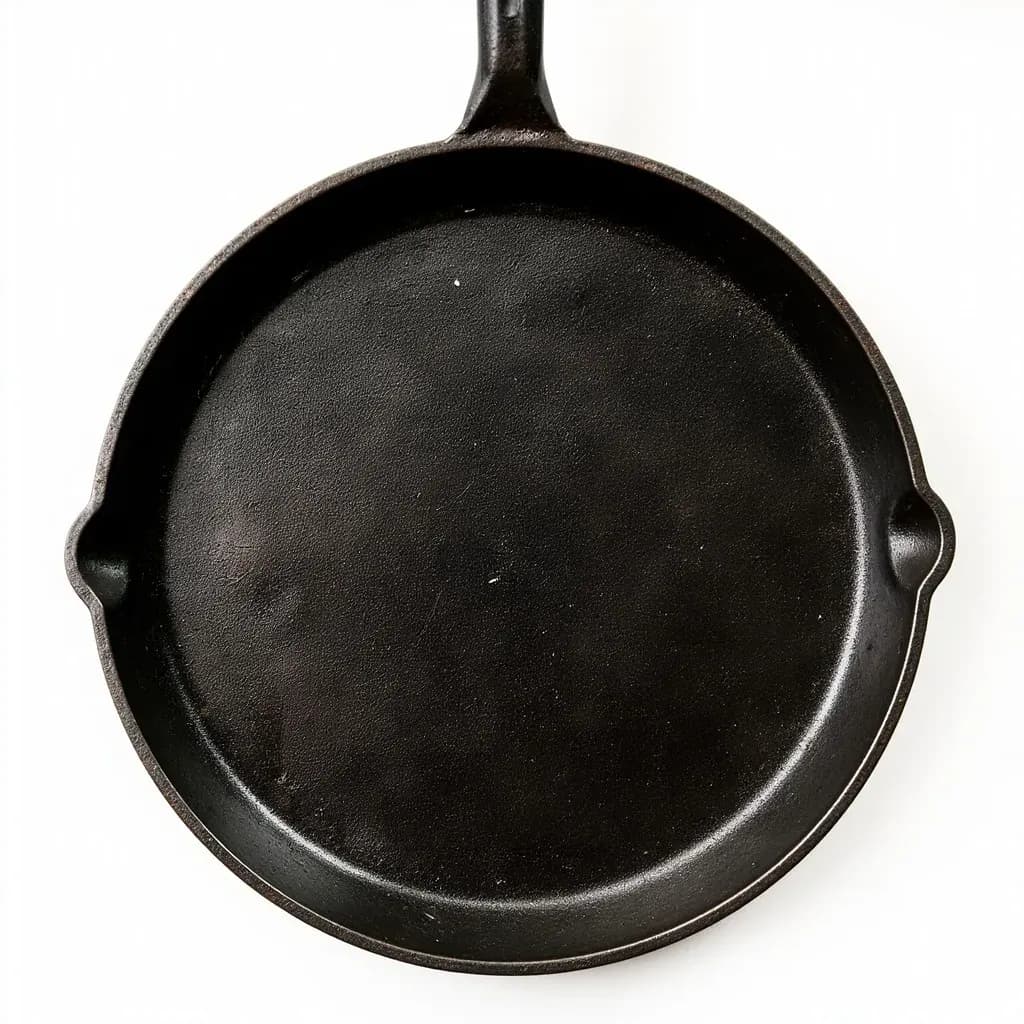
A cast-iron griddle is a flat or shallow-rimmed iron cooking plate used to make flatbreads and griddled foods, including the South Asian tawa for dosa and roti and the Scandinavian lefse griddle. Cast iron holds heat steadily for even browning and develops a non-stick patina when seasoned. It works on the stovetop, over a flame, or in the oven for high-heat, dry-surface cooking.
A cast-iron griddle is a flat, heavy plate of sand-cast iron, usually a single solid piece with either a short handle, a long French-style handle, or two loop handles. Its defining trait is thermal mass: the iron is thick enough to hold and recover temperature through long batches of pancakes, stacks of roti, or repeated rounds of smash burgers, so food browns and crisps evenly instead of steaming the moment a cold piece touches the surface. Heat arrives slowly and the metal conducts less efficiently than aluminum or copper, but once a cast-iron griddle is hot it stays hot — the practical reason it outperforms lighter pans on crust and color.
The cooking surface is not bare metal but a layer of polymerized oil, built up by seasoning, that becomes the actual nonstick interface. That layer improves with use and is the reason a well-tended griddle eventually releases eggs and crepes with little added fat. It also explains why cast iron asks for a little care: the seasoning must be dried thoroughly after washing, kept lightly oiled between uses, and kept away from long acidic cooks that strip it.
The same basic object appears in cuisines around the world — as the rectangular American breakfast griddle, the round South Asian tava, and the flat Mexican comal — and a cook who owns one well-seasoned piece can move confidently between pancakes in the morning and dosa or tortillas in the evening.
Alternatives
Types & varieties
The classic American double-burner plate, 17–20 in, low-walled or wall-less, for pancakes, bacon, eggs, and smash burgers.
Concave or flat Indian griddle, 8–12 in, used for roti, chapati, paratha, and dosa; lighter than Western griddles and often sold unseasoned.
Flat Mexican griddle, traditionally clay but widely made in cast iron; used for tortillas, quesadillas, and dry-toasting chiles and spices.
Heavy oval or rectangular griddle with one long French-style handle, sized to fit a single burner.
Cast-iron piece cast with a flat side and a ridged side, usually with two loop handles; the ridged side sear-marks while the flat side does pancakes or eggs.
Cast-iron plate inset between burners on a professional-style range; heats evenly and offers a large, steady surface.
Square or round cast-iron pan with raised sear lines for grill marks; commonly called a grill pan in the U.S.
Most American cast-iron griddles ship pre-seasoned; traditional Indian tavas are commonly sold bare and seasoned at home by the cook.
Regional traditions worth knowing
Three regional forms of the cast-iron griddle are worth distinguishing, because each shape and weight has been refined for a specific cooking rhythm.
- The American rectangular double-burner griddle is the workhorse of diner breakfasts: large, flat, low-walled, and built to cook dozens of pancakes or patties in succession without losing temperature. Lodge Manufacturing, founded in Tennessee in 1896, is the dominant current maker; pre-1940s Griswold and Wagner pieces are now collector's items.
- The South Asian tava is round, often slightly concave, and noticeably lighter than a Western griddle. That concavity helps the cook flip a roti by tossing it from edge to edge, and the lighter weight keeps the pan manageable on a home range. A cast-iron tava is largely interchangeable with a carbon-steel tava for Indian flatbreads, though a cast-iron piece holds heat longer and a carbon-steel one heats faster and weighs less.
- The Mexican comal is traditionally clay, but cast-iron versions are now common in home kitchens because they tolerate direct flame and last indefinitely. A comal is used mostly dry — for tortillas, quesadillas, toasting dried chiles, and dry-roasting pumpkin seeds and spices — and a light wipe of oil between uses is enough to maintain the seasoning.
Seasoning and day-to-day care
The seasoning is what makes a cast-iron griddle release food, and it behaves more like a finish you maintain than a coating you apply once.
- A modern pre-seasoned griddle is ready to cook on but improves noticeably after several uses; the surface darkens and slickens as the polymerized layer builds.
- If food starts sticking or the surface looks dull and gray, strip any rust with steel wool, wash and dry thoroughly, then re-season: rub on the thinnest possible film of oil, wipe it almost off, and bake the pan upside-down at 450°F for an hour; repeat two or three times.
- Mild dish soap is fine on a modern pan — the old prohibition dates from early twentieth-century pans finished with wax-based seasoning that soap truly did strip. What still matters is drying the pan immediately and rubbing a thin coat of oil on the warm surface before putting it away.
- Store in a dry spot with a paper towel between stacked pieces to absorb moisture and let air circulate.
Common uses
Tips & pitfalls
- Preheat gradually on medium heat for three to five minutes before adding food; slamming a cold griddle up to high heat can warp or crack it. Test readiness by flicking a few drops of water on the surface — they should skitter and dance, not sit and steam.
- Use less oil than you think you need. A well-seasoned griddle behaves closer to nonstick than most cooks expect, and over-oiling leaves a gummy, sticky residue that has to be scrubbed and re-seasoned.
- Avoid long, wet cooks of acidic food — tomato sauce, wine reductions, lemon-butter sauces — which strip seasoning and can leave a metallic taste. Finish those dishes in a saucepan instead.
- Clean while the griddle is still warm: scrape with a flat metal spatula, rinse with hot water, and set it on a burner over low heat until fully dry. Avoid prolonged soaking and skip the dishwasher; rust can set in within hours.
- Re-oil lightly after every use. A teaspoon of flaxseed, vegetable, or canola oil wiped on the warm, dry surface is enough; the goal is a film so thin you can barely see it.
- For dosa and crepes, work fast: a well-oiled onion half or the back of a ladle spreads batter more evenly than a brush on a hot griddle.
- Reach for steel wool only when you actually need to strip the pan — for rust or a burned-on mess. Routine cleaning wants a stiff brush or a flat scraper, not abrasion.
Good to know
- Material
- Sand-cast iron, almost always a single solid piece with no welds or coatings
- Heat retention
- Very high; recovers quickly when cold food is added, giving steady browning through long batches
- Heat tolerance
- Safe from stovetop to oven and open flame; tolerates 500°F (260°C) and well above
- Typical sizes
- Single-burner 10–11 in (25–28 cm); double-burner 17–20 in (43–51 cm); round tava 8–12 in (20–30 cm)
- Weight
- Roughly 4–14 lb (2–6 kg); double-burner griddles usually 10 lb or more
- Seasoning
- Cooking surface is polymerized oil, not bare metal; modern pans usually ship pre-seasoned
- Compatibility
- Gas, electric coil, induction, oven, broiler, outdoor grill, and campfire
- Cleaning
- Hand wash with hot water and a stiff brush; avoid prolonged soaking and the dishwasher
Also called
cast-iron-griddle · tawa · dosa-tawa · roti-griddle · lefse-griddle
Related

Steamer
Gentle moist heat that keeps vegetables, fish, and dumplings tender

Frying Pan
Shallow sloped pan for frying, sautéing, and quick sears

Saucepan
Tall, straight-sided pot for sauces, grains, and small batches

Sauté Pan
Wide straight-sided pan with room to brown and braise

Dutch Oven
Heavy lidded pot that turns tough cuts tender over hours

Stock Pot
Tall, roomy pot for stocks, pasta, and big-batch cooking

Wok
High-sided bowl pan built for blistering-hot stir-fries

Griddle
Flat, broad surface for pancakes, smash burgers, and breakfast