Cookware
Chapati Pan (Tawa)
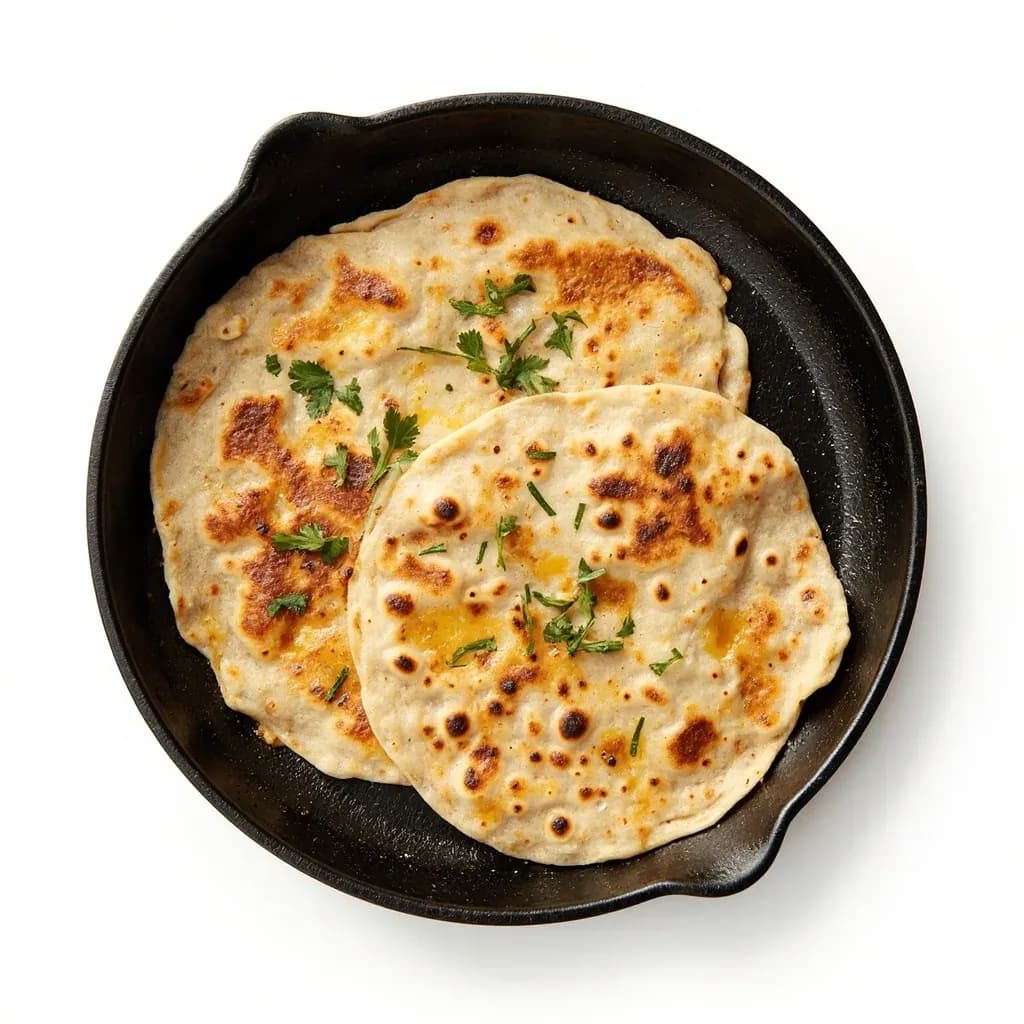
A flat or slightly concave iron griddle for cooking chapati, roti, and other flatbreads.
A chapati pan, commonly a tawa, is a round flat or gently curved iron or steel griddle used across South Asia to cook chapati, roti, and dosa. The thin, even-heating surface lets flatbreads puff and char in spots without a rim getting in the way of flipping. A well-seasoned iron tawa develops a near-nonstick surface that improves with use.
A tawa is essentially a heavy, round metal disc with a single handle — closer to a heated plate than a skillet, designed to deliver intense, even, dry heat to a thin sheet of dough. It is the central tool of flatbread cooking across the Indian subcontinent, where chapati, roti, phulka, paratha, and dosa are cooked by direct contact rather than in fat. The pan's defining trait is its low wall: there is no rim to trap moisture or grease, so steam escapes instantly and the bread's surface chars and dries in seconds rather than steaming into something tough.
Material and weight determine everything about how a tawa performs. A traditional cast iron tawa is heavy (often 2–3 kg for a 12-inch disc), heats slowly, and stores a great deal of thermal energy, so the surface temperature barely drops when a cold piece of dough lands on it. That thermal inertia is what lets a properly heated tawa puff a chapati into a balloon in under a minute. Lighter aluminum and carbon steel versions heat faster and are easier to maneuver but do not recover as quickly between breads. Over decades, a well-used cast iron tawa develops a dark, glossy patina of polymerized oil that acts as a natural non-stick surface, which is why cooks prize older tawas and why the seasoning process matters for new ones.
The shape — flat versus gently concave — is not decorative. A flat or only slightly convex surface is right for chapati and roti, where the dough is rolled and laid on; a more pronounced bowl shape is preferred for dosa, where batter is poured and spread in a spiral. Across cultures the same idea appears under different names: the Mexican comal for tortillas, the Levantine saj for markook and yufka. They are cousins rather than substitutes — each is shaped to the bread of its region — but the principle of a hot plate with a handle is universal.
Alternatives
Types & varieties
Heavy, retains heat evenly, develops a natural non-stick patina with seasoning; the traditional choice for chapati and roti.
Lightweight and quick to heat, often anodized; less even heat retention than cast iron.
Lighter than cast iron, heats fast, and can be seasoned like a wok; popular in South Indian households.
Coated aluminum or hard-anodized; convenient for beginners but the coating degrades at the high temperatures often used for chapati.
Flat or only slightly convex surface, 9–12 inches; the standard for chapati, roti, and paratha.
Larger (11–14 inches) and more noticeably concave; the slight bowl shape helps spread batter thinly.
6–8 inch diameter; useful for single-serve parathas, small chapatis, or a tabletop griddle for appetizers.
Specialized variant with a deep, rounded bowl and a domed lid, used to make appam and hoppers; not interchangeable with a flat tawa.
Levantine and Turkish domed or convex metal griddles, often copper or steel, used for saj bread, markook, and yufka.
Mexican flat griddle, traditionally clay or cast iron, used for tortillas; functionally similar to a flat tawa.
Flat or concave? Matching the tawa to the bread
The first decision when buying a tawa is whether the surface should be flat or gently curved, because the wrong shape fights the cook. A flat or only slightly convex tawa is the right tool for chapati, roti, and paratha, where rolled-out dough is laid on and cooked dry. The minimal curve keeps the dough in even contact across its full diameter so it browns uniformly and puffs when steam is trapped between the layers.
A more noticeably concave tawa — sold specifically as a 'dosa tawa' — has a shallow bowl that helps a thin, fluid batter pool and spread in a spiral without running off the edge. The trade-off is that the same curvature causes a chapati to sit higher at the rim than at the center and toast unevenly. For most households that make both flatbreads and dosas, a flat 11-inch tawa handles chapati and paratha well; dosa becomes more of a spreading challenge but is still doable. For a household that makes dosa weekly and chapati only occasionally, a concave 12-inch dosa tawa is the better investment.
- Flat or barely convex tawa → chapati, roti, paratha, phulka, and any dry-cooked flatbread.
- Gently concave (dosa) tawa → dosas, uttapam, pesarattu, Thai khanom buang, and thin crepes.
- Diameter 10–12 in suits most home burners and rolls chapatis to the common 6–7 in size.
- Mini (6–8 in) tawas work for single-serve breads and tabletop cooking over a candle or small burner.
Common uses
Tips & pitfalls
- Season a new cast iron tawa by scrubbing it with hot water, drying it on heat, coating it thinly with oil, and heating until it just smokes; repeat 3–4 times before first use.
- Heat the tawa fully on medium-high for 2–3 minutes before laying dough on it — a properly heated surface is the difference between a pale, leathery chapati and one that puffs into a balloon.
- Cook chapati and roti on dry heat with no oil on the pan, then brush the finished bread with ghee or oil after it leaves the tawa.
- Use gentle, even pressure with a folded kitchen towel or a flat wooden press to encourage the dough to puff; pressing too hard flattens the layers and prevents ballooning.
- Flip the chapati when small bubbles form on the upper surface and the underside shows light brown spots; a brief finish directly over the flame turns it into a phulka.
- Avoid soap on a seasoned cast iron tawa — rinse with hot water, scrub with a stiff brush or chain-mail scrubber, then return it to the heat to dry completely.
- Re-season a tawa that has gone dull, sticky, or rusty: scrub it clean, dry it thoroughly, oil it lightly, and bake or heat on the stovetop until the oil polymerizes into a fresh dark patina.
- Use two tawas when feeding a crowd: one hot on the burner for cooking, one off-heat and stacked with a cloth on top to keep finished chapatis warm and soft.
- Do not crank a non-stick tawa to maximum heat; the coating typically degrades above 200–220 °C, well below the temperatures a cast iron tawa handles routinely.
- Hang the tawa by its loop handle rather than stacking it under heavy pots, which can warp thinner aluminum discs over time.
Good to know
- Also called
- Tawa, tava, tave, and tava (regional transliterations of the same word in Hindi, Urdu, Tamil, and other South Asian languages); often qualified as 'roti tawa' or 'chapati tawa' to specify use
- Origin
- South Asia; a long-standing staple in Indian, Pakistani, Bangladeshi, Nepali, and Sri Lankan kitchens
- Material
- Traditionally cast iron; also aluminum, carbon steel, and non-stick coated metals
- Typical diameter
- 9–14 inches (23–35 cm); 10–12 inches is most common for household chapati making
- Shape
- Round disc 2–4 cm thick, flat or slightly concave, with one handle (usually with a hanging loop)
- Stovetop compatibility
- Round-bottomed tawas sit flat on gas; flat-bottomed versions are made for electric and induction cooktops
- Heat tolerance
- Cast iron withstands 300 °C+ on a gas flame; handles get very hot and need a cloth or grip
- Seasoning & care
- Cast iron tawas are seasoned with polymerized oil and cleaned with hot water only — no soap on a well-developed patina
Also called
tawa · tava · roti pan · flatbread griddle
Related

Steamer
Gentle moist heat that keeps vegetables, fish, and dumplings tender

Frying Pan
Shallow sloped pan for frying, sautéing, and quick sears

Saucepan
Tall, straight-sided pot for sauces, grains, and small batches

Sauté Pan
Wide straight-sided pan with room to brown and braise

Dutch Oven
Heavy lidded pot that turns tough cuts tender over hours

Stock Pot
Tall, roomy pot for stocks, pasta, and big-batch cooking

Wok
High-sided bowl pan built for blistering-hot stir-fries

Griddle
Flat, broad surface for pancakes, smash burgers, and breakfast