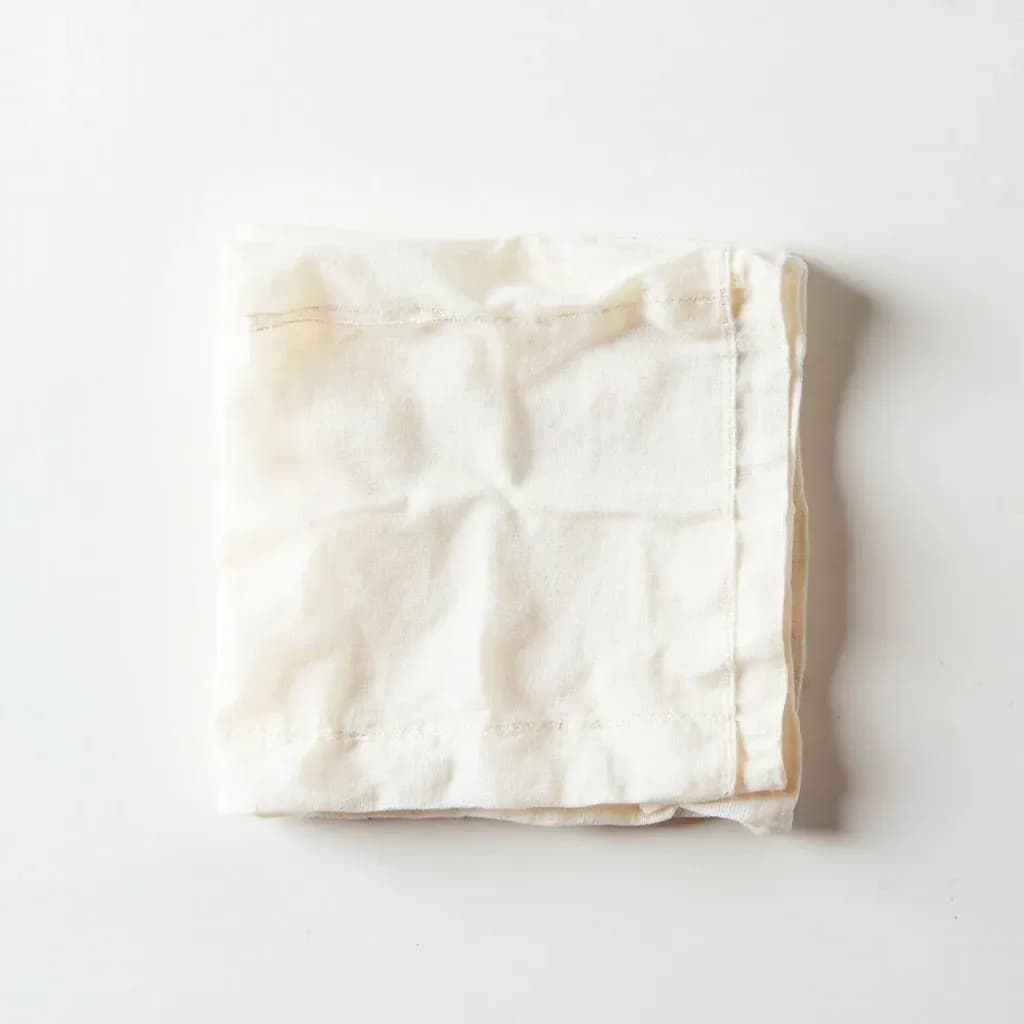
Prep Tools
Cheesecloth / Straining Cloth
Loose-woven cotton cloth for straining, draining, and bundling foods.
Cheesecloth is a loose-woven cotton cloth used to strain liquids, drain yogurt and cheese curds, squeeze coconut or nut milk, and bundle herbs into a bouquet garni. Its open weave lets liquid pass while holding back solids, and it can be doubled for finer filtering. Reusable muslin and nut-milk bags serve the same purpose for cleaner extraction.
Cheesecloth is a plain-weave cotton cloth defined by its deliberately open construction, the very feature that lets liquids pass while holding back solids. Its behavior is governed less by the word "cheesecloth" than by its grade — a numbering system based on threads per inch that runs from coarse (#10, very open) to fine (#90, the cheese-grade weave traditionally used in farmhouse cheesemaking). Most cooks own a mid-grade cloth and simply add layers to step the weave finer, doubling or tripling a #50 or #60 to approach the performance of a #90.
In the kitchen, cheesecloth is used in two distinct modes: as a strainer, lined over a chinois, colander, or bowl to catch solids while liquid passes through, and as a bundling wrap, gathered into a sachet for herbs and spices or wrapped around a press to wick moisture from curds, terrines, and roasted meat. Its biggest practical quirk is absorption — a bone-dry cloth can soak up a meaningful portion of the liquid you are trying to keep, which is why cooks dampen and wring it out before every use. With the right grade, the right number of layers, and a quick pre-wet, cheesecloth becomes one of the most versatile textiles in a working kitchen.
The cloth's history is inseparable from cheesemaking: the term itself comes from centuries of farmhouse practice, where loosely woven cloth was used to drain whey from pressed curds. That origin still shapes the modern product — unbleached cotton is preferred for cheese and stock because bleaching residues can cloud liquids and interfere with starter cultures, and the fine #90 grade remains the standard for draining soft, fresh cheeses like ricotta, paneer, and fromage frais.
Alternatives
Types & varieties
The loosest, most open weave. Best for dusting, polishing, wrapping food for roasting, bundling large aromatics, and craft work. Too coarse for fine straining.
Mid-coarse. Useful for straining stocks, holding sachet herbs, and wrapping aromatics for soup. Liquid passes fairly quickly.
Tighter general-purpose grade; the workhorse of most home kitchens. Good for stocks, nut milks, and yogurt when doubled or tripled.
The finest, cheese-grade weave. The standard for draining fresh curds (ricotta, paneer, fromage frais) and for producing ultra-clear stocks and consommés, especially when layered.
British and French equivalent: finer and more tightly woven than US cheesecloth, made specifically for soft-cheese draining and jellies. The better choice for very soft, fine-grained curds like mascarpone or quark.
Unbleached retains natural cotton color and oils; bleached is whiter and slightly more refined. Choose unbleached for cheese, fermented dairy, and delicate stocks where residues matter.
Pre-cut squares suit one-off tasks (bouquet garni, sachets, single infusions); yardage is more economical for cheesemaking, canning, and straining large batches of stock.
Layering: Getting a Finer Strainer from a Coarser Cloth
Layering is the single most useful technique for getting fine results without buying specialty cloth. Each additional layer meaningfully reduces the effective aperture of the weave, so a doubled #60 behaves like roughly a #90 for most kitchen purposes, and a tripled #50 will catch fine curds that would otherwise slip through. Pre-wetting is the partner habit that makes any strain through cheesecloth work: a dampened cloth releases liquid instead of absorbing it, and layers stay in place when wet rather than shifting as the bowl fills. Use this combination whenever you want a clear stock, a clean nut milk, or a tight cheese drain without investing in the finest grade.
- Dampen the cloth under cold running water and wring it out thoroughly before lining any strainer or bowl.
- Fold a single square into 2–4 layers, or stack two squares, to step a #50 or #60 down to roughly a #90.
- Use more layers for clear stocks and nut milks; fewer for coarse herb bundles and sachet work.
- Press the cloth gently into the strainer so it conforms and won't shift as liquid flows in.
Common uses
Tips & pitfalls
- Rinse or wash cheesecloth before first use to flush out loose lint, which can cloud stocks and give nut milks a fuzzy look.
- Dampen the cloth with cold water and wring it out before straining anything watery; a dry cloth will soak up the liquid you are trying to keep.
- Fold in 2–4 layers (or stack several squares) to step the weave down to the fineness you need — doubled #60 behaves like #90 for most jobs.
- Tie sachets with cotton butcher's twine, leaving one long tail so the bundle can be retrieved easily from a deep pot.
- Stir or lift the cloth occasionally during long strains so fine particles don't blind the weave and stall the flow.
- Wash in hot water with a mild detergent; skip fabric softener and dryer sheets, which leave residues that can off-flavor dairy and stocks.
- Sterilize by boiling 5–10 minutes before cheesemaking, and choose unbleached cloth for any culture work or fresh cheese.
- Don't substitute medical gauze without checking it is food-grade — pharmacy gauze is often sized or finished with chemicals not intended to be eaten.
- Hang-dry cheesecloth thoroughly between uses to prevent mildew, especially after dairy or cheese work.
Good to know
- Material
- 100% cotton in a plain weave; the open, loose construction is the entire point.
- Grading (US)
- Numbered by threads per inch: #10 (coarsest, very open) through #40 and #50/60 (general-purpose) up to #90 (finest, cheese-grade). Higher number = tighter weave.
- Typical sizing
- Sold by the yard at about 36 in (91 cm) wide, or as pre-cut squares from 18 to 36 in (45–91 cm).
- Bleached vs unbleached
- Unbleached is the traditional choice for cheesemaking and stock, where chemical residues are a concern; bleached is whiter and slightly softer but offers no functional advantage.
- Reusability
- Reusable for straining and bundling if washed in hot water with a mild detergent; sterilize by boiling 5–10 minutes before cheesemaking.
- Absorption
- A dry cloth absorbs a meaningful amount of liquid; dampening and wringing before use is standard practice to limit loss.
- Origin of name
- The name comes from its centuries-old role in farmhouse cheesemaking, where it drained whey from pressed curds.
- Not the same as medical gauze
- Pharmacy gauze is often sized or finished with chemicals not intended for food; check the label before any kitchen substitution.
Also called
cheesecloth · cheesecloth-strainer · muslin-cloth · straining-cloth · nut-milk-bag
Related

Peeler
Swift blade for stripping skin off fruit and vegetables

Grater
Sharp-toothed surface for shredding cheese and vegetables

Microplane
Ultra-fine rasp for citrus zest, garlic, and hard cheese

Mixing Bowl
All-purpose bowl for combining, whisking, and tossing

Whisk
Looped wires that beat air into eggs, cream, and sauces

Spatula
Flat blade for flipping, lifting, and scraping

Slotted Spoon
Pierced spoon that lifts solids and drains the liquid behind

Wooden Spoon
Gentle, heat-friendly spoon for stirring anything