Prep Tools
Colorimeter
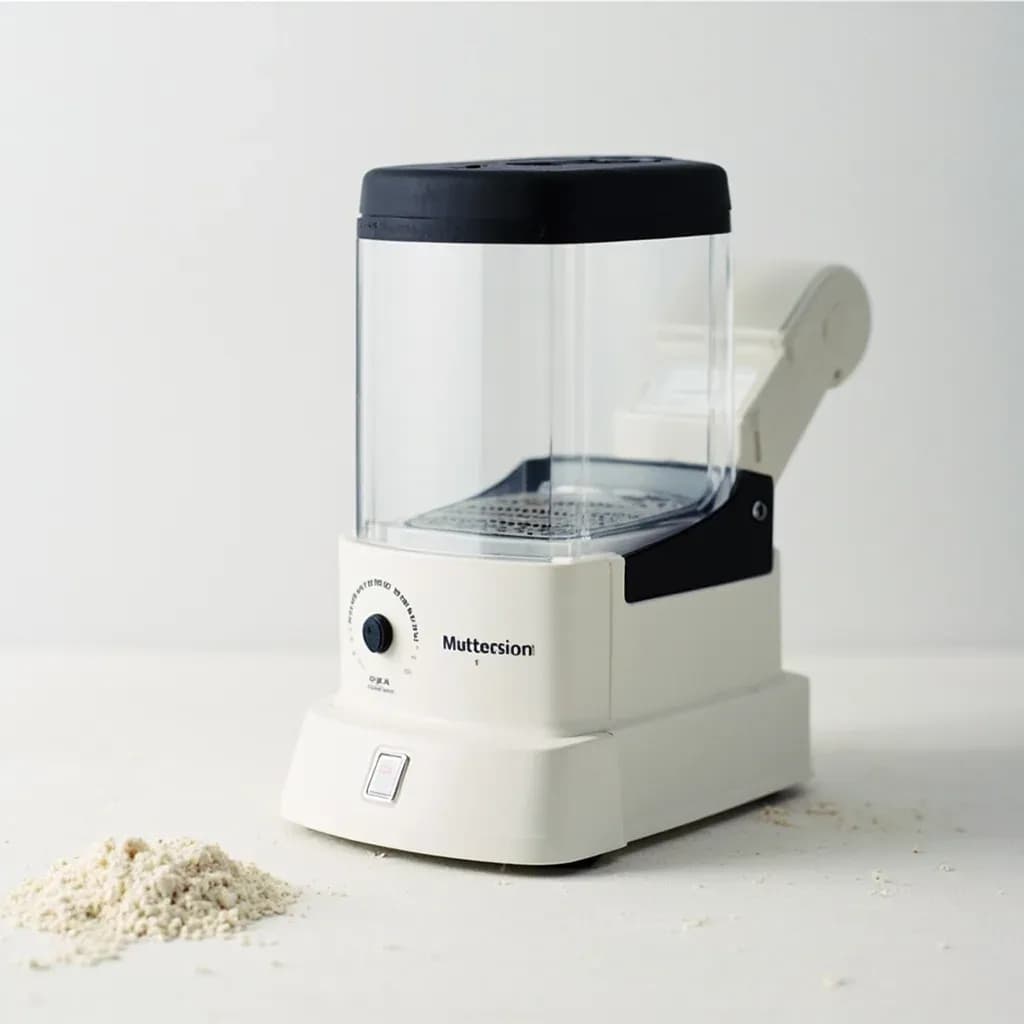
An optical instrument that measures and grades the color of flour, oils, and other products.
A colorimeter measures the precise color of a sample by reading how it reflects or absorbs light, returning standardized numeric values. In food it is used to grade flour whiteness and bran specks, check oil and syrup color, and verify batch-to-batch consistency. Removing human eye bias, it lets mills and producers hold a tight quality spec.
A colorimeter is an optical instrument that translates the color of a food — flour, oil, honey, sauce, crust — into numbers rather than impressions. The human eye is a notoriously inconsistent judge of color, particularly under changing daylight or kitchen fluorescents, and two cups of coffee, two loaves of bread, or two batches of olive oil that look identical to a buyer can differ measurably when a calibrated beam of light is bounced off them. That difference matters when a spec sheet calls for "medium roast," "extra light amber honey," or "1.5 red on the Lovibond scale," and it is the reason colorimeters have migrated from research labs onto bakery floors, mill offices, and production lines.
In food production, the dominant choice is a tristimulus colorimeter — an instrument with three filtered detectors (red, green, blue) that approximate how the human eye sees, and that reports color on a recognized scale such as CIE L*a*b*. The result is a small set of numbers, like L* = 92, b* = 9, that any lab, supplier, or buyer can reproduce. Specialized variants still serve long-standing trades: the Lovibond tintometer for oils, the Pfund comparator for honey, ICUMSA units for refined sugar, and USDA score cards for tomato paste. A close cousin, the spectrophotometer, measures the full reflectance curve across the visible spectrum; for most quality-control work the two are interchangeable in practice, but the tristimulus colorimeter is faster, cheaper, and the one a working kitchen or small production house will actually own.
Sample handling turns out to matter as much as the instrument. Packing density, cup depth, surface finish, temperature, bubbles, and even fingerprints on the sample window all shift the reading, which is why a careful operator with a $500 handheld will routinely out-perform a careless one with a $30,000 bench-top unit.
Alternatives
Types & varieties
Three-filter instrument approximating human color vision; the workhorse for routine QC of flour, oils, sauces, and powders.
Measures reflectance or transmittance across the full visible spectrum (400–700 nm) for finer color-difference work; interchangeable with a tristimulus unit for most QC purposes.
Long-established Tintometer Ltd. instrument grading fats and oils on the red/yellow Lovibond scale; still produced as both a visual comparator with stacked glass filters and an electronic unit.
Compact battery-powered units (Konica Minolta CM-series, X-Rite RM series) for spot checks on bakery floors, in mill offices, or at the receiving dock.
Larger units with integrating spheres (HunterLab LabScan and ColorFlex, Konica Minolta CM-5, X-Rite Color i-series) used in QA labs and R&D kitchens.
Mounted directly on conveyors, pipes, or chutes for continuous monitoring of flour, sugar, dough, or liquid streams during production.
Specialised comparator grading honey from water white through extra light amber to dark amber on the Pfund scale; still widely used in trade.
Choosing the right scale for the job
No single color scale suits every food, and most of the names printed on colorimeter reports are simply conventions adopted by a particular trade. The CIE L*a*b* system (a lightness axis L* and two color axes a* for red-green and b* for yellow-blue) is the modern universal language and the default on most instruments. Oils, however, are still traded on Lovibond red and yellow, honey on the Pfund scale, refined sugar on ICUMSA units, and tomato paste on USDA color scores. A practical kitchen or small producer should pick the scale their buyer or spec sheet demands, and report the raw L*a*b* numbers alongside as a portable reference.
- L*a*b* — the universal modern scale; use for new product development and cross-category comparisons.
- Lovibond red/yellow — required for edible oils under AOCS Cc 13e-92.
- Pfund — required for honey grading from water white to dark amber.
- ICUMSA — required for refined sugar; lower numbers mean whiter sugar.
Sample handling, the part that actually decides the number
The single biggest source of error in color measurement is not the instrument but the way the sample is presented to it. Two operators reading the same flour on the same colorimeter can easily disagree by several L* or b* points because one packed the cup firmly and the other tapped it loose, or one used a glass cuvette and the other plastic. Establishing a written sample-prep protocol — cup, fill, packing, temperature, time to read — is more valuable than upgrading the instrument.
- Pack powders to a consistent density in the same cup each time; use a defined tap or press routine.
- Read transparent liquids (oils, juices, clear honey) in matched glass or disposable plastic cuvettes, and always run a cuvette blank.
- For honey, warm to a standard temperature (commonly 20 °C or 40 °C) — viscosity and trapped air shift the reading.
- Tap the cuvette on the bench to dislodge micro-bubbles before reading; bubbles spike absorbance.
- Cool roasted products (coffee, bread crust, caramel) to room temperature before measuring; surface temperature shifts the apparent color.
- Clean the sample port window with a lint-free wipe and lab-grade solvent; fingerprints and flour dust throw readings off.
Colorimeter vs. spectrophotometer vs. visual comparator
The three terms get used loosely, but they describe different tools. A colorimeter reads three filtered channels, a spectrophotometer reads the full reflectance curve, and a visual comparator (Lovibond wedge, Pfund wedge, USDA tomato paste card) is a printed or glass standard the eye matches against. For most QC work the distinction between colorimeter and spectrophotometer is academic; both produce reproducible L*a*b* values, and both beat a comparator card for specification-grade work. The comparators remain useful in the field, at the dock, or for quick triage where a calibrated instrument is not to hand.
- Tristimulus colorimeter — three filtered detectors; fast, inexpensive, ideal for routine QC.
- Spectrophotometer — full 400–700 nm curve; finer color-difference work, metamerism detection, R&D use.
- Visual comparator — printed card or glass wedge; trade language, field use, not a replacement for instrument readings.
- Phone apps and cameras — not substitutes; white balance, exposure, and sensor response drift with every shot.
Common uses
Tips & pitfalls
- Always calibrate on the certified white tile and black standard at the start of a session, and re-calibrate every hour on long runs to combat LED drift.
- Use the same sample cup, fill depth, and surface finish each time — packing density of flour and powders shifts L* and b* measurably.
- Report both L* and b* (or full L*a*b*) rather than a single number; flour brightness and yellowness move independently and tell different stories.
- Track ΔE between batches rather than absolute values when judging "on spec" — ΔE under 1 is generally imperceptible to the eye, over 3 is clearly different.
- Hold liquids still and free of bubbles in the cuvette; a quick tap on the bench dislodges the micro-bubbles that spike absorbance readings.
- Cool roasted products (coffee, bread crust, caramel) to room temperature before reading; surface temperature shifts the apparent color of any hot sample.
- Keep the certified white tile sealed in the dark when not in use — yellowing of the tile is a classic source of long-term drift that quietly invalidates months of data.
- Do not rely on phone apps or cameras as substitutes; their white balance, exposure, and sensor response drift with every shot and cannot be calibrated to a standard.
Good to know
- Type
- Optical color-measurement instrument; quantifies color numerically rather than by eye
- Measurement principle
- Illuminates a sample and measures reflected or transmitted light through three filters (red, green, blue) approximating the CIE standard observer
- Common color scales
- CIE L*a*b*, CIE L*C*h°, Hunter L,a,b, Lovibond Red/Yellow, Pfund (honey), ICUMSA (sugar), USDA tomato color
- Geometry
- Typically 45°/0° for powders and pastes, or d/8° integrating sphere for glossy liquids and sauces; specular component can be included or excluded
- Calibration
- Standardized against a certified white tile and black standard at the start of every session; re-calibrate hourly on long runs to counter LED drift
- Output
- Reflectance values, tristimulus X/Y/Z, full L*a*b* or L*C*h°, and color-difference ΔE between samples
- Industry references
- AOCS Cc 13e-92 for oil color, ICC flour color methods, ICUMSA GS2 for sugar, USDA tomato paste score cards
- Approximate price range
- Entry-level handheld units from a few hundred dollars; bench-top lab instruments from several thousand to tens of thousands
Also called
Flour Color Grader · Color Meter · Flour Colorimeter
Related

Peeler
Swift blade for stripping skin off fruit and vegetables

Grater
Sharp-toothed surface for shredding cheese and vegetables

Microplane
Ultra-fine rasp for citrus zest, garlic, and hard cheese

Mixing Bowl
All-purpose bowl for combining, whisking, and tossing

Whisk
Looped wires that beat air into eggs, cream, and sauces

Spatula
Flat blade for flipping, lifting, and scraping

Slotted Spoon
Pierced spoon that lifts solids and drains the liquid behind

Wooden Spoon
Gentle, heat-friendly spoon for stirring anything