Appliances & Heat
UV Spectrophotometer (K-Values)
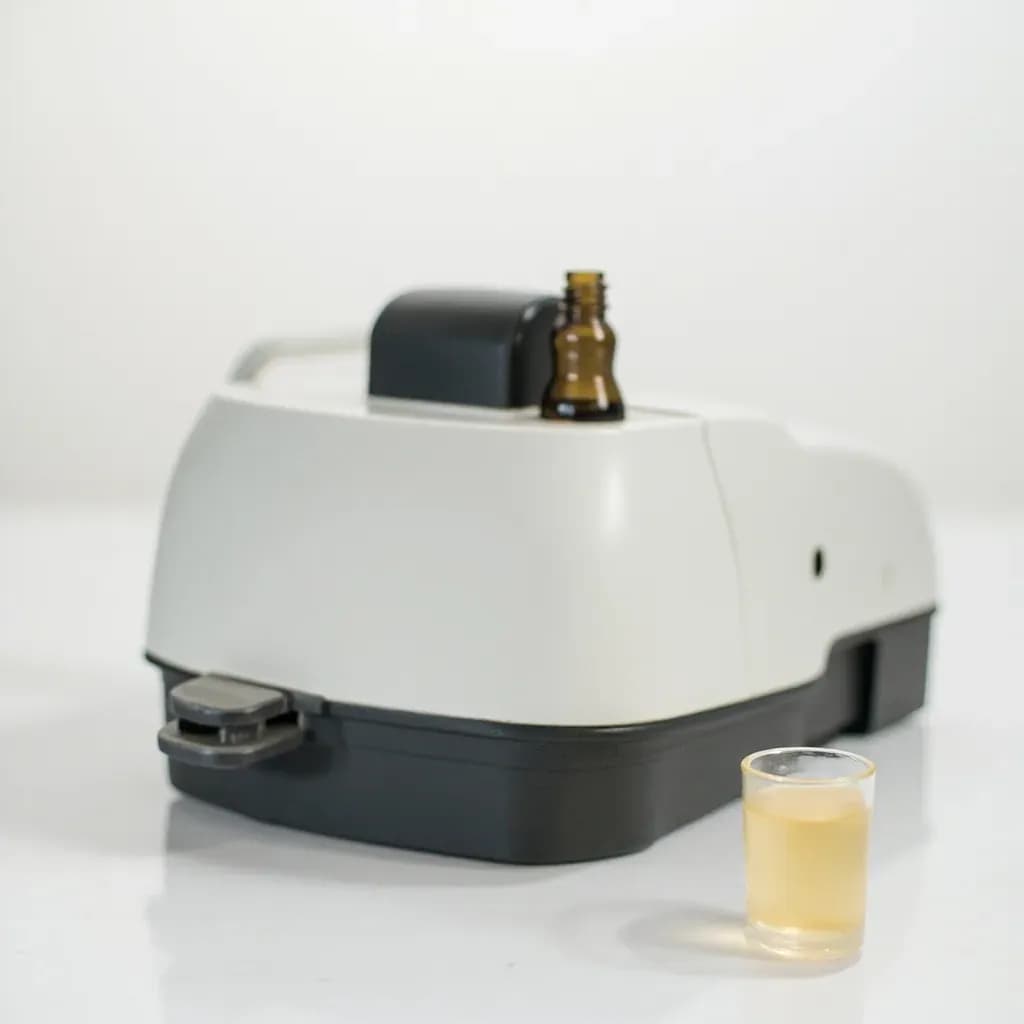
Lab device measuring how much UV light a sample absorbs, used to grade oils and check quality.
A UV spectrophotometer shines ultraviolet and visible light through a sample and measures absorbance at specific wavelengths. In food work it is used to determine K-values for olive oil, indicating oxidation and authenticity, and to gauge color or concentration of liquids. It is a quality-control and authentication instrument found in labs and high-end production kitchens.
A UV-Vis spectrophotometer is a bench instrument that shines ultraviolet light through a diluted oil sample and reports how much is absorbed at specific wavelengths. In a kitchen or production context it is used to generate K-values — extinction coefficients that track oxidative breakdown long before a human nose can smell rancidity. Because conjugated dienes and trienes absorb strongly in the deep UV, the instrument turns invisible chemistry into two clean numbers (K232 and K270) that producers, certifiers, and quality-driven kitchens use to grade an oil's category and remaining life.
The two wavelengths do very different jobs. K232 climbs first as primary oxidation products — hydroperoxides and their conjugated diene structures — accumulate, then plateaus and falls as those molecules break apart into secondary products (aldehydes, ketones, and conjugated trienes) that show up in K270. Reading the two together, and comparing them with the difference value ΔK, gives a surprisingly complete picture of an oil's history: how oxidized it is now, how oxidized it was, and whether someone may have cut a virgin oil with a refined one.
For most cooks the device is an outsourced tool — a sample goes to a lab, a report comes back — but in cooperative mills, refinery QC rooms, and a few progressive restaurant kitchens the benchtop unit sits beside the fryer, paying for itself in oil that is replaced on evidence rather than guesswork.
Alternatives
Types & varieties
Light passes through one cell at a time; operator blanks with solvent before every reading; lower cost, common in small QC labs
Splits the beam into sample and reference paths simultaneously; more stable baseline, better for the low-absorbance end of the spectrum
The workhorse for olive mills, refineries, and certified labs; needs mains power and a stable bench
Battery-operated units used in olive mills for rapid harvest decisions; less precise than benchtop but adequate for screening
Captures the full UV-Vis spectrum in one pass; useful when multiple K-values and ΔK checks are run in sequence
Reading K232, K270, and ΔK
K232 is the early-warning channel. As an oil is heated, exposed to light, or simply aged, polyunsaturated fatty acids form hydroperoxides whose conjugated diene structure absorbs at 232 nm; the K232 number climbs fast and is the first to betray a fresh oil that has been mistreated. K270 lags behind — it tracks secondary oxidation products (aldehydes, ketones, conjugated trienes) that appear as primary products break down. K270 is the better predictor of sensory rancidity and of how far an oil has travelled past its useful life.
ΔK subtracts absorbance at nearby reference wavelengths where true oxidation products do not absorb, stripping out baseline drift from scattering particles, residual turbidity, or non-oxidative chromophores. A normal ΔK stays near zero; a ΔK that is high relative to the K reading is the IOC's preferred signal that a virgin oil has been spiked with refined seed oil rather than simply aged.
- K232 ≤ 2.50 and K270 ≤ 0.22 typically read as 'fresh, well-handled extra virgin' on the IOC scale.
- K270 above ~0.25 in a working fryer is widely treated as the discard line, especially when paired with elevated free fatty acids.
- ΔK > 0.01 is treated as evidence of refining or blending, not natural oxidation.
Practical Method Notes
The official methods look simple on paper — weigh oil, dilute, read absorbance, multiply — but the small print matters. A '1% w/v' solution means 1.00 g of oil made up to 100 mL with the named solvent, measured by weight, not by pouring. Volumetric shortcuts of 1 mL oil in 100 mL solvent give wrong concentrations and wrong K-values. The solvent itself must be spectroscopic grade and matched to the method: cyclohexane for IOC olive-oil work, isooctane for AOCS polyunsaturated-fat work. Mixing methods invalidates the result.
- Filter hazy or sediment-laden oils through a 0.45 µm PTFE membrane before diluting — particulates scatter the beam and inflate absorbance.
- Avoid shaking or vortexing the diluted sample — entrained air bubbles scatter light and look like oxidation.
- Verify wavelength accuracy with a holmium oxide filter or potassium dichromate standard periodically.
Pairing K-Values with Other Oxidation Tests
No single number tells the whole story of an oil's condition. K-values are blind to free fatty acids, which rise through hydrolysis rather than oxidation, and they are insensitive to the early peroxide stage in some methods. The standard practice in any serious QC routine is to run K270 alongside free fatty acid titration, peroxide value, and (for deeper insight) anisidine value. A fryer oil showing K270 of 0.30 with normal FFA and peroxide is in a different state from the same K270 with FFA at 0.6% and peroxide at 15 meq/kg — the second is hydrolytically and oxidatively compromised and should leave the kitchen.
- Cold-pressed nut oils: track K232 monthly; the diene number is the first to move.
- Restaurant fryers: K270 + FFA is the practical 'keep/discard' pair.
- Refined seed oils: peroxide value catches the very early stage that K-values miss.
- Adulteration screening: ΔK is the discriminator, not K232 or K270 alone.
Common uses
Tips & pitfalls
- Always use quartz cuvettes — standard glass absorbs below roughly 320 nm and will give falsely low readings on K232 and K270.
- Match the solvent to the method: cyclohexane for IOC olive-oil work, isooctane for AOCS Ch 5-91 polyunsaturated-fat work; do not mix.
- Weigh the oil sample for the 1% w/v solution rather than measuring by volume; volumetric dilution skews the calculated K-value.
- Filter hazy oils through a 0.45 µm PTFE membrane before dilution, or particulates will scatter the beam and inflate the reading.
- Blank with the same lot of solvent in the same cuvette before every sample, and wipe the optical faces with a lint-free tissue — fingerprints absorb UV strongly.
- Pair K270 with free fatty acids and peroxide value when judging fryer oil; a single metric routinely misleads.
- Check the instrument with a holmium oxide or potassium dichromate standard periodically; a drifted wavelength gives wrong K-values from a perfectly prepared sample.
- If ΔK comes back higher than the K reading alone would predict, suspect refined-oil addition rather than natural oxidation — the pattern is the clue.
Good to know
- Primary function
- Measures UV absorbance of an oil-in-solvent solution to quantify primary and secondary oxidation
- Key wavelengths
- 232 nm for conjugated dienes (primary oxidation) and 270 nm for conjugated trienes (secondary oxidation)
- K-value definition
- Extinction coefficient at a given wavelength for a 1% w/v solution in a 1 cm path-length cell
- ΔK (delta K)
- Difference between absorbance at the target wavelength and the average of two reference wavelengths taken at λ±4 nm; IOC uses it to flag refined-oil adulteration
- IOC limits, extra virgin olive oil
- K232 ≤ 2.50, K270 ≤ 0.22, ΔK ≤ 0.01
- IOC limits, virgin olive oil
- K232 ≤ 2.60, K270 ≤ 0.25, ΔK ≤ 0.01
- IOC limits, lampante olive oil
- K232 > 2.60 or K270 > 0.25 or ΔK > 0.01
- Standard solvents
- Spectroscopic-grade cyclohexane (IOC method) or isooctane (AOCS Ch 5-91)
- Cuvette requirement
- Quartz cells with a 1 cm path length; glass and most plastics absorb below ~320 nm
- Reference methods
- AOCS Ch 5-91, AOCS Cd 18-91, COI/T.20/Doc. No 19 (IOC)
- Typical benchtop cost
- USD 2,000–15,000 for a UV-Vis unit capable of oil-quality work
Also called
spectrophotometer · UV-Vis spectrophotometer
Related

Stovetop
The everyday burners where most cooking actually happens

Oven
Enclosed dry heat for roasting, baking, and braising

Grill
Live-fire or gas grates for char, smoke, and high heat

Smoker
Low, slow heat and wood smoke for barbecue and brisket

Air Fryer
Countertop convection that crisps with little or no oil

Slow Cooker
Set-and-forget low heat for stews, beans, and braises

Pressure Cooker
Sealed steam pressure that cooks tough food in a fraction of the time

Rice Cooker
Foolproof, perfectly steamed rice every single time