Cookware
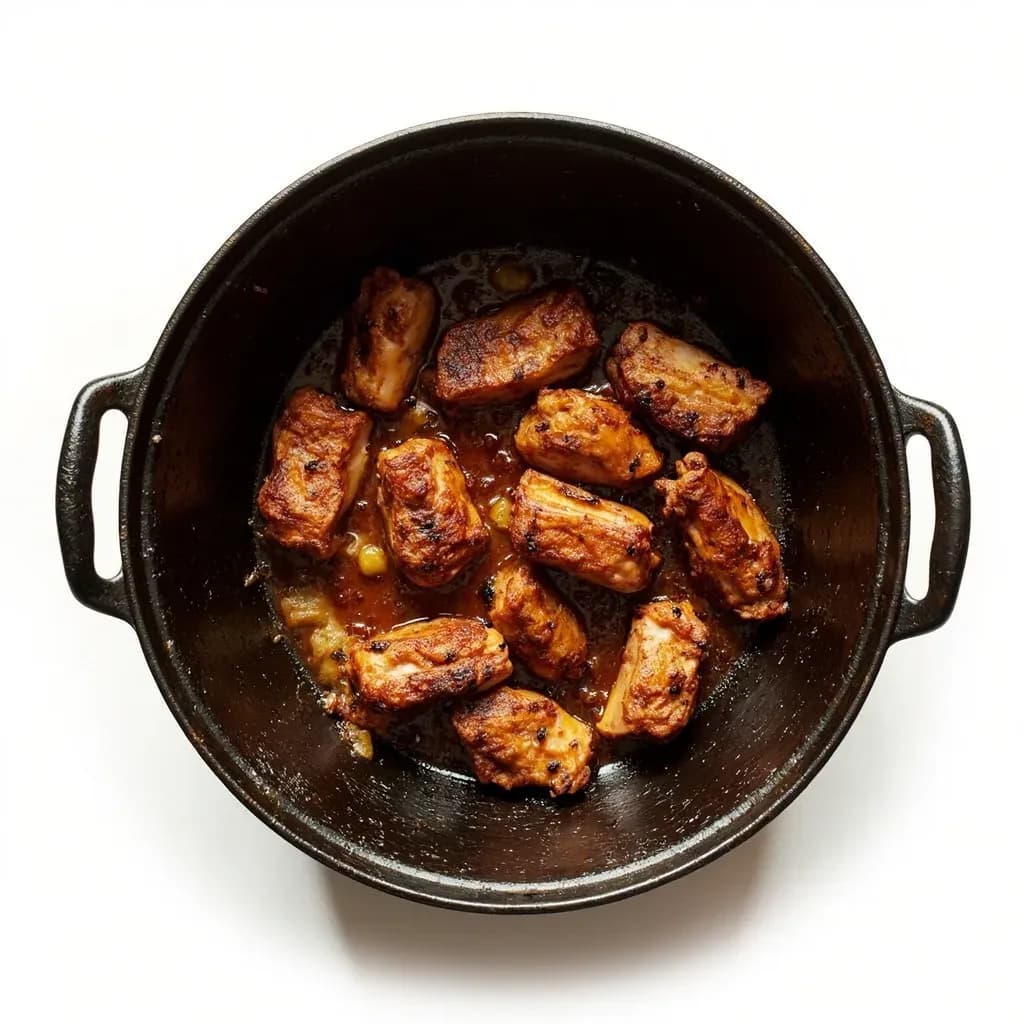
Large Cooking Cauldron
A big round-bottomed pot for cooking large quantities over an open fire, common in communal and outdoor cooking.
A large cooking cauldron is a wide, deep, often round-bottomed pot, frequently cast iron, used to cook stews, rice, and soups in big batches over wood fire or a dedicated stand. Its mass holds and spreads heat for long, even simmering and high-volume frying. It is a staple in many cultures for feasts, festivals, and outdoor communal cooking, known regionally as a kazan or potjie.
A cooking cauldron is a deep, round-bottomed pot designed to hang over a fire or rest on a tripod, with no flat base to sit on a modern grate. That rounded belly is the defining feature: it focuses heat into the center of the food, lets liquids circulate without cold spots at the corners, and concentrates thermal mass so temperatures stay steady when cold ingredients are added. In practice, a cauldron excels at long, wet cooking — stocks, stews, beans, grains, and brews — rather than the quick searing and sautéing that flatter pans handle better.
Modern cauldrons are almost always cast iron, the material that gives this style of cooking its characteristically slow, even heat release. A 12-quart cauldron weighs roughly 15–20 pounds empty; a 30-quart runs 35–45 pounds, which means the vessel itself becomes equipment you move with a bail hook, a tripod, or a hand cart rather than a pot handle. The integral bail or cast lugs exist because a full cauldron is too heavy and too hot to lift any other way.
The cauldron earns its keep at harvest suppers, scout camps, soup kitchens, and any outdoor kitchen where you are feeding a crowd over wood or charcoal. It is the historical ancestor of the Dutch oven, and when a recipe asks for a "large heavy pot over a fire," a cauldron is the closer match than a stockpot in both cooking behavior and the kind of food it produces. For most home cooks it is a specialty tool — useful, sometimes irreplaceable for outdoor cooking — but rarely the everyday pot on a flat stovetop.
Alternatives
Types & varieties
The standard today — heavy, even heat retention; must be seasoned and kept dry to prevent rust.
Central Asian cast-iron pot, often with a true round or slightly flattened bottom, used for plov (pilaf) and oil-based stews over open flame.
South African three-legged cast-iron pot; smaller and shorter, but the same family of open-fire cookware.
Modern cast-iron or rolled-steel pot with a wide flat rim, designed to sit on a steel fire ring or log-fired pit.
Historical or reenactment type — hammered or riveted bronze sheet, prized for heat conductivity but rarely used in modern kitchens.
Pre-cast-iron medieval form, made of iron bands riveted together; found in period kitchens and museum reproductions.
Often slightly squat and wide for stirring long, slow pottages; the direct ancestor of the modern Dutch oven.
Choosing a cauldron that cooks, not just decorates
The market is full of decorative iron pots marketed as cauldrons that are too thin, too shallow, or coated with paint that flakes into food. If you intend to actually cook over fire, a handful of details separate a working cauldron from a Halloween prop.
- Wall thickness of at least 4–6 mm; thin cast iron warps and cracks on the first real fire.
- A true round bottom — not a flattened disc — so the pot hangs or sits on a ring without rocking.
- Forged bail handle or cast integral lugs rated to take the weight of a full pot suspended on a hook.
- Raw or pre-seasoned cast iron, not enamel or paint; enamel chips at sustained campfire temperatures.
- Capacity matched to your crowd: a 12-qt covers about 8 main-course servings, 20-qt covers 12–15, 30-qt covers a small army.
Common uses
Tips & pitfalls
- Season a cast-iron cauldron the same way you would a Dutch oven: thin coat of neutral oil, hot oven upside-down, repeat two or three times until the surface goes matte black.
- Always heat a new cauldron gradually on the first few fires — a roaring flame on day one can thermal-shock a fresh casting and crack it along the base.
- Use a heavy iron tripod or a fireplace crane; the filled weight of a 20-qt cauldron will buckle or tip a flimsy camp stand.
- A round bottom will not sit flat on a stovetop; rest it on a wok ring, or commit to using it exclusively over a fire.
- Keep liquid moving or set a trivet or grate inside the base when cooking starchy foods — the deep belly scorches easily once the level drops.
- After washing, set the cauldron on residual coals to flash-dry it; never store it damp or it will flash-rust overnight.
- Smear the bail handle and rim with a thin film of oil before storage to slow surface rust on the parts that take the most heat cycling.
- Move a full cauldron with a tripod, chain, and hook or on a sturdy hand cart — never try to carry it by the bail alone, especially with hot liquid inside.
- Buy a fitted cast-iron lid if you plan long braises; otherwise use a tight wooden plank as historical cooks did.
- Salt-heavy or acidic stews (tomato, wine) will strip seasoning; reserve those for an unseasoned stainless pot, or re-season the cauldron afterward.
Good to know
- Etymology
- Middle English caudron, from Old Northern French caudron, from Vulgar Latin *caldarium, from Latin calidus (hot)
- Primary material
- Cast iron is the modern standard; historical cauldrons were hammered bronze or riveted wrought iron
- Typical shape
- Round-bottomed, deep body, flanged or rolled rim, integral bail or cast iron lugs for hanging
- Heat source
- Open fire, wood coals, or charcoal — hung from a hook or crane, or seated on a tripod or fire ring
- Capacity
- Roughly 8–30 quarts (7.5–28 L) for home cooks; event and brew-house cauldrons run 40–100+ gallons
- Weight, empty
- A 12-qt cast-iron cauldron runs 15–20 lb (7–9 kg); a 30-qt is closer to 35–45 lb (16–20 kg)
- Stovetop compatibility
- Round bottom prevents stable contact with a flat grate; use over fire or on a wok ring
Also called
Cauldron · Kazan · Cooking Pot
Related

Steamer
Gentle moist heat that keeps vegetables, fish, and dumplings tender

Frying Pan
Shallow sloped pan for frying, sautéing, and quick sears

Saucepan
Tall, straight-sided pot for sauces, grains, and small batches

Sauté Pan
Wide straight-sided pan with room to brown and braise

Dutch Oven
Heavy lidded pot that turns tough cuts tender over hours

Stock Pot
Tall, roomy pot for stocks, pasta, and big-batch cooking

Wok
High-sided bowl pan built for blistering-hot stir-fries

Griddle
Flat, broad surface for pancakes, smash burgers, and breakfast