Prep Tools
Cooler / Icebox
An insulated chest that keeps food and drinks cold with ice for transport and holding.
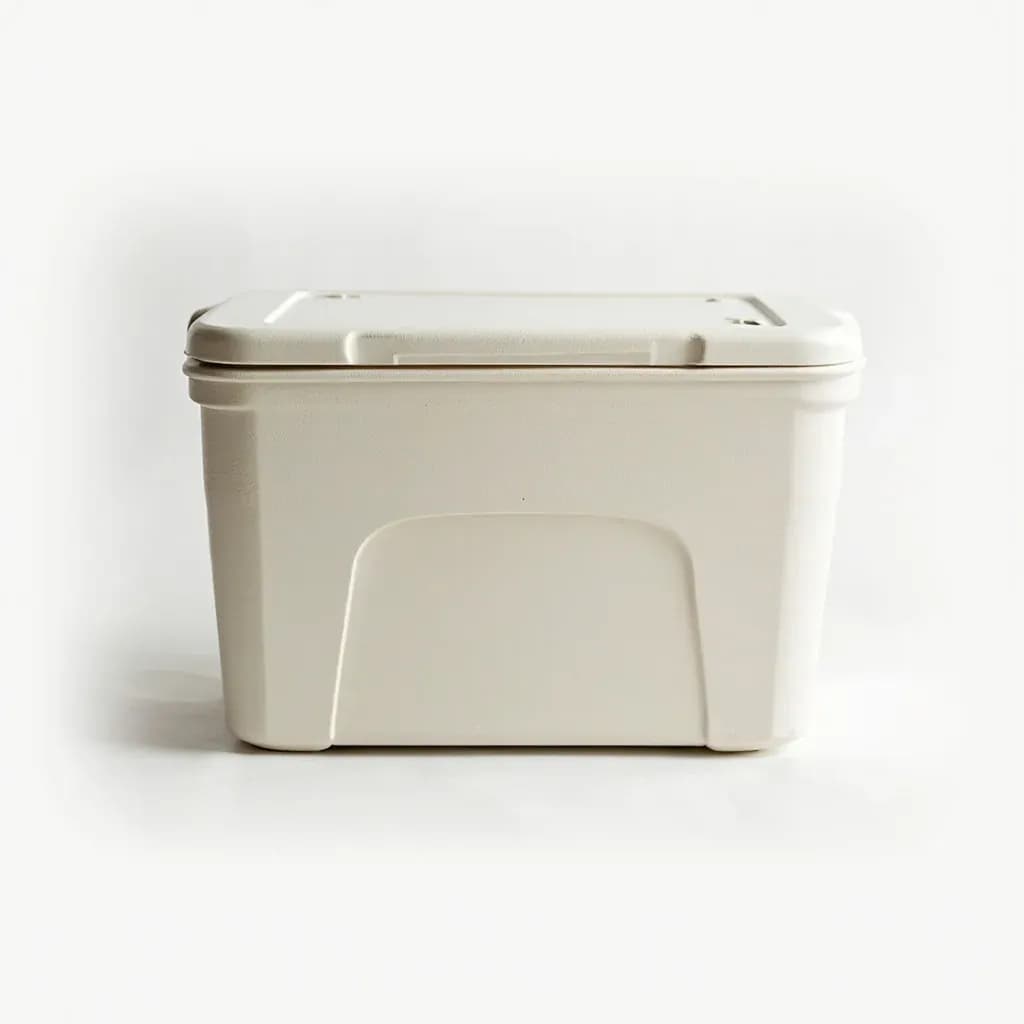
A cooler, or icebox, is a thick-walled insulated container that keeps perishables and drinks cold using ice or ice packs, without power. Cooks use it for transport, catering, and extra cold-holding when refrigerator space runs out, and a sturdy cooler can double as an improvised sous-vide bath. Pre-chilling the interior and keeping the lid closed greatly extend how long it holds temperature.
A cooler — also called an icebox in its older cabinet form — is a passive insulated container that holds food and drink at low temperature by slowing the movement of heat from the warm outside world to the cold inside. It does not make cold; it merely guards the cold you put in. That single fact governs everything about how to use one well in a kitchen: load it with already-chilled food, use more ice than you think you need, and minimize the number of times the lid comes up.
For a working cook the cooler is overflow cold storage. It is the cheap, portable second walk-in that buys you space for brining a turkey, fermenting a batch of kimchi when the kitchen runs warm, holding dressed fish on a dockside, or carrying a sheet pan of blanched greens into an ice bath when the prep sink is occupied. Choose the right shell and pack it correctly and a good cooler will hold contents below 40 °F (4 °C) for roughly two to six days, which is enough for almost any transport, brining, or cold-fermentation task a home or small professional kitchen will throw at it.
The performance gap between a flimsy styrofoam chest and a roto-molded premium cooler is enormous — anywhere from one to six days of usable ice retention — and almost all of that gap comes down to insulation type and thickness, gasket quality, and how disciplined you are about opening the lid. A cheap cooler packed well will out-perform an expensive cooler packed carelessly.
Alternatives
Types & varieties
The pre-refrigerator cold cupboard with a top ice compartment, fed by delivered block ice. Still occasionally found in country kitchens and period restorations; useful as a fermentation cabinet at roughly 40–50 °F.
The standard picnic, tailgate, and catering form: a hinged plastic chest with snap-down latches. The default for kitchen overflow.
Seamless one-piece shell with thick polyurethane foam; the high-performance category (Yeti, RTIC, Grizzly, Pelican, Engel). Worth the cost for multi-day holding, brining, and serious transport.
Foam- and often reflective-foil-insulated fabric bag, frequently with a removable rigid liner. Packable and light, but ice retention is measured in hours, not days.
Inexpensive, lightweight, often single-use. Good for short trips, shipping seafood, and as an emergency ice bath for a sheet pan of vegetables.
12 V plug-in unit that cools to roughly 30–40 °F below ambient. Useful in a car for transport, but it cannot efficiently chill a warm load and drains vehicle batteries.
Tall, narrow hard cooler with a drain plug, often with an internal baffle to keep whole fish upright. The right tool for dock-to-kitchen transport.
Built to handle the very cold temperatures of dry ice (–109 °F / –78 °C). Must be vented, never sealed airtight, because sublimating CO₂ builds pressure rapidly.
Soft zippered bag for grocery runs and short catering hops. Treat as a one- to two-hour hold, not a true cold-storage vessel.
Packing a Cooler for the Kitchen
How you pack matters more than what you paid for the cooler. The job is to minimize the air inside, keep ice in contact with the food, and protect the most temperature-sensitive items from the lid and walls.
- Pre-chill the empty cooler for 30–60 minutes with sacrificial ice or ice water; a warm plastic body will eat your first hour of retention.
- Chill the contents overnight in the refrigerator before packing. Loading warm food is the single most common cooler mistake.
- Layer ice: a bed of ice on the bottom, a middle layer of ice between rows of food, and a generous top layer. Heat enters from above, so top ice is doing the most work.
- Fill every void with ice or frozen water bottles. Air is insulation, but it is also space for heat to collect.
- Place a sheet of butcher paper or a clean kitchen towel between ice and delicate items — sashimi-grade fish, fresh herbs, raw oysters — to prevent freezer-burn texture and ice chips in the product.
- Vacuum-seal raw proteins so their juices cannot cross-contaminate other foods and so their thermal mass is reduced.
Kitchen Tasks a Cooler Handles Well
Beyond transport, a cooler is a useful piece of cooking equipment in its own right. It is essentially a second refrigerator that you can park anywhere and fill with ice.
- Cold brining: turkeys, hams, corned beef, and gravlax all want a steady 35–40 °F for one to five days, and a packed cooler holds that range more cheaply than a crowded fridge.
- Cold fermenting: sauerkraut, kimchi, hot sauces, and vinegar pickles all run better at 55–65 °F, which means a less-iced cooler (or a cabinet-style icebox) is more useful here than a freezer-grade one.
- Ice-bath work: chilling blanched vegetables, setting aspics, or rapidly cooling a large pot of stock through the danger zone (40–140 °F) is faster and gentler in a cooler-held ice bath than under a running cold tap.
- Cold-holding long-fermented doughs: rye, panettone, and bagel doughs that need a slow, cool rise will be happy in a lightly iced cooler overnight.
- Outdoor service: a drained, well-iced cooler is a perfectly serviceable cold hold for composed salads, crudo, oysters, and ceviche at a backyard or catering buffet.
Common Mistakes
Most cooler failures in the kitchen are packing failures, not equipment failures. These are the ones that come up again and again.
- Loading warm food and expecting the ice to do the work. It cannot — the ice will melt long before the food reaches a safe temperature.
- Treating the cooler like a refrigerator and adding food on top of partly melted ice. Once ice is slush, the contents are at the top of the safe range, not below it.
- Not draining meltwater. Water conducts heat about 25 times faster than air, so a pool of meltwater at the bottom is actively warming the food above it.
- Opening the cooler constantly to grab a drink or check the food. Every lid-lift is a heat spike. Use a separate drinks cooler if you can.
- Storing raw proteins in the same cooler as ready-to-eat food without vacuum-sealing or double-bagging. Coolers are notorious for cross-contamination because ice water washes juices around.
Common uses
Tips & pitfalls
- Pre-chill the cooler with sacrificial ice or ice water for 30–60 minutes before packing food.
- Use block ice when you can — it outlasts cubed ice of equal mass and doubles as a thermal ballast that resists swinging temperatures.
- Layer ice on the bottom, in the middle, and on top. The top layer is the most important because heat enters from above.
- Pack contents tightly; air gaps are the enemy. Fill voids with ice or frozen water bottles.
- Run two coolers on a trip or during an event: a 'drinks' cooler you open freely, and a 'food' cooler that stays sealed.
- Drain meltwater once ice is half-gone — standing meltwater conducts heat into the food far faster than air does.
- Salt the ice (rock salt or kosher) to drop the effective temperature and speed the initial chill of brining or fermenting loads.
- Chill contents in the refrigerator overnight before packing; never load warm food into a cooler and expect it to hold.
Good to know
- Origin
- Thomas Moore of Maryland patented a cedar-tub, rabbit-fur-insulated icebox in 1802; the portable cooler is a 20th-century descendant of that cabinet-style icebox.
- Insulation
- Premium coolers use closed-cell polyurethane foam; basic models use expanded polystyrene (EPS / styrofoam). Polyurethane insulates roughly twice as well per inch as EPS, which is the main reason for the ice-retention gap.
- Shell Construction
- Blow-molded or roto-molded polyethylene or polypropylene. Roto-molding — borrowed from boat-hull manufacturing — produces a seamless, thick-walled body that retains ice far longer.
- Capacity Range
- Roughly 6 qt (personal lunch size) to 150+ qt (party, fish, or game).
- Ice Retention
- 1–2 days for an EPS cooler, 3–6 days for a roto-molded cooler under typical test conditions (warm ambient, closed lid).
- Ice-to-Content Ratio
- Plan on about 2 lb (1 kg) of ice for every 1 lb (500 g) of contents as a starting point for raw proteins and dairy.
- Block vs. Cubed Ice
- Block ice of equal mass outlasts cubed ice because it has far less surface area exposed to warm air.
- Food-Safety Limit
- Holds perishables below 40 °F (4 °C) only while ice is sufficient. Not certified for HACCP long-term cold storage; treat any raw-protein hold beyond about 24 hours as marginal.
Also called
cooler-icebox · cooler-holding-box · food-cooler · Icebox · Esky · Cool Box
Related

Peeler
Swift blade for stripping skin off fruit and vegetables

Grater
Sharp-toothed surface for shredding cheese and vegetables

Microplane
Ultra-fine rasp for citrus zest, garlic, and hard cheese

Mixing Bowl
All-purpose bowl for combining, whisking, and tossing

Whisk
Looped wires that beat air into eggs, cream, and sauces

Spatula
Flat blade for flipping, lifting, and scraping

Slotted Spoon
Pierced spoon that lifts solids and drains the liquid behind

Wooden Spoon
Gentle, heat-friendly spoon for stirring anything