Prep Tools
Fine-Mesh Sieve
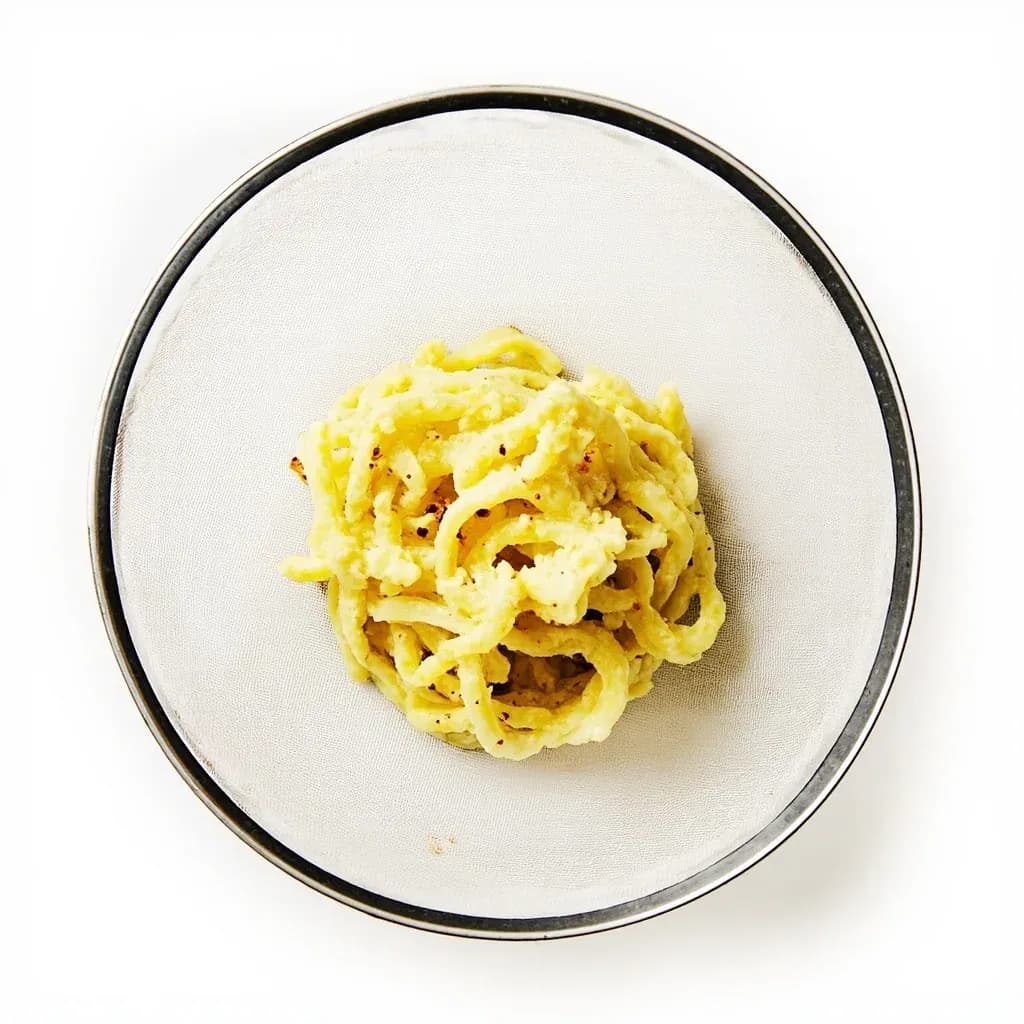
Fine wire-mesh strainer for sifting, draining, and straining lumps from liquids.
A fine-mesh sieve is a bowl-shaped strainer of tightly woven wire mesh used to sift dry ingredients, drain small grains, rinse rice or quinoa, and strain lumps from sauces and broths. The fine weave catches particles a colander would let through, giving smoother results. It is a lighter, more general-purpose tool than the deep conical chinois.
A fine-mesh sieve is defined less by its shape than by what it holds back: any solid small enough to slip through a colander's wide holes but big enough to matter in a finished dish. The defining feature is a woven wire screen — typically stainless steel — stretched over a rigid rim, with apertures small enough to catch ground pepper, herb flecks, or fine seed. It is the right tool whenever a cook wants a clear liquid, a lump-free dry ingredient, or a seedless purée, and the wrong tool whenever speed and volume of water flow are the priority.
The tool behaves differently from a colander or slotted spoon. Its openings are small, so liquids pass slowly in a diffuse shower rather than in streams, which is precisely what allows it to trap fine particles instead of letting them slip through with the water. The same fine weave is what makes it effective for sifting dry ingredients: lumps of flour, cocoa, or confectioners' sugar are held back while the fine powder falls through in an airy cloud. That same slowness is why a fine-mesh sieve is almost always paired with a deep bowl to catch drips, a heatproof vessel when the liquid is hot, and a utensil — ladle, spatula, or wooden pestle — to move the contents through rather than fingers, which clog the mesh and risk burns.
Three specialist forms are worth knowing by name: the round bowl sieve for general sifting and straining, the conical chinois for puréeing soups and sauces with a wooden pestle, and the flat drum tamis for ultra-fine sifting and pressing soft fruit. A coarse colander is not a substitute; the test is whether water passes through in a fine shower that holds back fine herbs and ground pepper, and whether the mesh visibly catches what a slotted spoon would let pass.
Alternatives
Types & varieties
The everyday form: a shallow stainless mesh over a wire ring, with or without a handle. Used for sifting, single-portion straining, and dusting.
A very fine, deep, cone-shaped strainer used in professional kitchens to purée soups and sauces by working the contents through with a wooden pestle.
A coarse-conical predecessor of the chinois with a perforated metal cone on a stand; largely replaced by the chinois but the term persists.
A flat or hoop-style screen of fine mesh stretched on a frame, used with a scraper or brush for ultra-fine sifting of flour and cocoa, and for pressing soft purées.
Reinforced sieves with finer mesh (often labeled 200-mesh or 'micro-mesh') for clarifying stocks, straining custards, and sifting powdered sugar without residue.
Coated or all-nylon mesh for non-metal contact with acidic or reactive foods; lower heat tolerance than all-metal versions.
Very small, shallow sieves (3–4 inches) for dusting powdered sugar, lifting a poached egg, or straining a single portion.
Choosing the right mesh count
Mesh count — the number of openings per linear inch — is the single most useful number to know when buying a fine-mesh sieve. A 40-mesh sieve has openings of about 0.4 mm and is the right all-purpose choice for rinsing grains, draining orzo, and lifting poached eggs. An 80-mesh sieve (around 0.18 mm) is the workhorse for straining pan sauces, custards, and purées. Above 100 mesh, the sieve begins to behave like a sifter: powdered sugar, cocoa, and almond flour come through lump-free, but liquids drain very slowly. A home cook who wants to cover nearly every task needs two sieves — a sturdy 60- or 80-mesh bowl for wet work, and a finer 100-mesh tamis or bowl for dry sifting and custard straining.
Chinois vs. tamis: when to use which
The chinois and the tamis are often confused because both are finer than a standard bowl sieve, but they are designed for opposite tasks. The chinois is a deep cone meant to hold liquid and soft solids; the cook works a wooden pestle in a circular motion, pressing the contents against the mesh from inside the cone. It is the right tool for a tomato coulis, a pumpkin soup, or a fruit sauce that should be velvety and seedless. The tamis is a flat or shallow drum that the cook works from above — placing soft food directly on the mesh and pressing it through with a scraper, wooden pestle, or the back of a ladle. It is the right tool for pressing a soft cheese through, sifting a large batch of flour and cocoa together, or pushing raspberries for a seedless coulis. Buying both is unnecessary for most home cooks; a chinois covers the wet tasks, and a small 100-mesh bowl sieve covers the dry ones.
Care and longevity
The most common reason a fine-mesh sieve fails is rust at the rim where the mesh meets the frame, caused by trapped moisture. Hand washing in warm soapy water, then drying immediately — preferably on a towel or in a warm oven — prevents this. Avoid steel wool and harsh abrasives that roughen the surface and invite corrosion. Dishwasher cycles are usually safe, but the prolonged contact with detergent and the humid drying environment shorten the life of all but the best-quality models. If the mesh sags, a wire pulls free, or the rim dents, the sieve should be replaced: a bent frame no longer holds the mesh under tension, and small particles will slip through the loosened weave.
Common uses
Tips & pitfalls
- Tap the side of the rim, not the bottom, to move contents through; tapping the bottom can force lumps through the mesh and dent the frame.
- Set the sieve over a bowl deeper than you think you need — fine mesh passes liquid slowly, and splashing is the norm.
- For very fine clarification, line the sieve with a layer of cheesecloth or a coffee filter instead of relying on the mesh alone.
- Never push soft solids through with your fingers; use the back of a ladle, a flexible spatula, or a wooden pestle designed for the chinois.
- Match mesh count to the job: 40–60 mesh for general straining, 80+ for sauces, 100+ for sifting powdered sugar and cocoa.
- When working with hot liquids, rest the sieve on a heatproof bowl or the rim of the pot itself; never plunge a cold-handled sieve into boiling liquid.
- Dry the sieve thoroughly after washing — trapped moisture at the rim is the leading cause of rust on otherwise stainless models.
- Replace a sieve whose mesh sags or whose rim has bent; a frame out of tension will let coarse bits through no matter how fine the weave.
Good to know
- Also called
- Fine-mesh strainer; a fine conical version is a chinois (with its pestle, a sauce chinois), and a drum-style fine sieve is a tamis.
- Primary material
- Stainless steel wire mesh on a stainless or tinned steel rim; nylon-mesh versions exist for non-metal contact with acidic foods.
- Typical mesh count
- 40–80 mesh for general home use (about 0.18–0.4 mm openings); 100–200 mesh for pastry, confectioners' sugar, and stock clarification.
- Standard home sizes
- 6–8 inches (15–20 cm) diameter is most common; 3–4 inch versions for tea, cocoa dusting, and single eggs; 10–12 inch for large-batch stock.
- Shape
- Shallow round bowl (most common), deep cone (chinois), or flat drum (tamis).
- Depth
- About 2–3 inches (5–7.5 cm) for the bowl type; conical versions run 6–8 inches deep to hold puréed soup.
- Dishwasher safe
- Most stainless-steel fine-mesh sieves are dishwasher safe, though hand washing and immediate drying prevent rust at the rim.
- Replaces
- Coarse colanders and slotted spoons for any task where small solid particles must be retained or removed.
Also called
fine-mesh-sieve · mesh-strainer · soup-strainer · sieve · strainer
Related

Peeler
Swift blade for stripping skin off fruit and vegetables

Grater
Sharp-toothed surface for shredding cheese and vegetables

Microplane
Ultra-fine rasp for citrus zest, garlic, and hard cheese

Mixing Bowl
All-purpose bowl for combining, whisking, and tossing

Whisk
Looped wires that beat air into eggs, cream, and sauces

Spatula
Flat blade for flipping, lifting, and scraping

Slotted Spoon
Pierced spoon that lifts solids and drains the liquid behind

Wooden Spoon
Gentle, heat-friendly spoon for stirring anything