Prep Tools
French Whisk
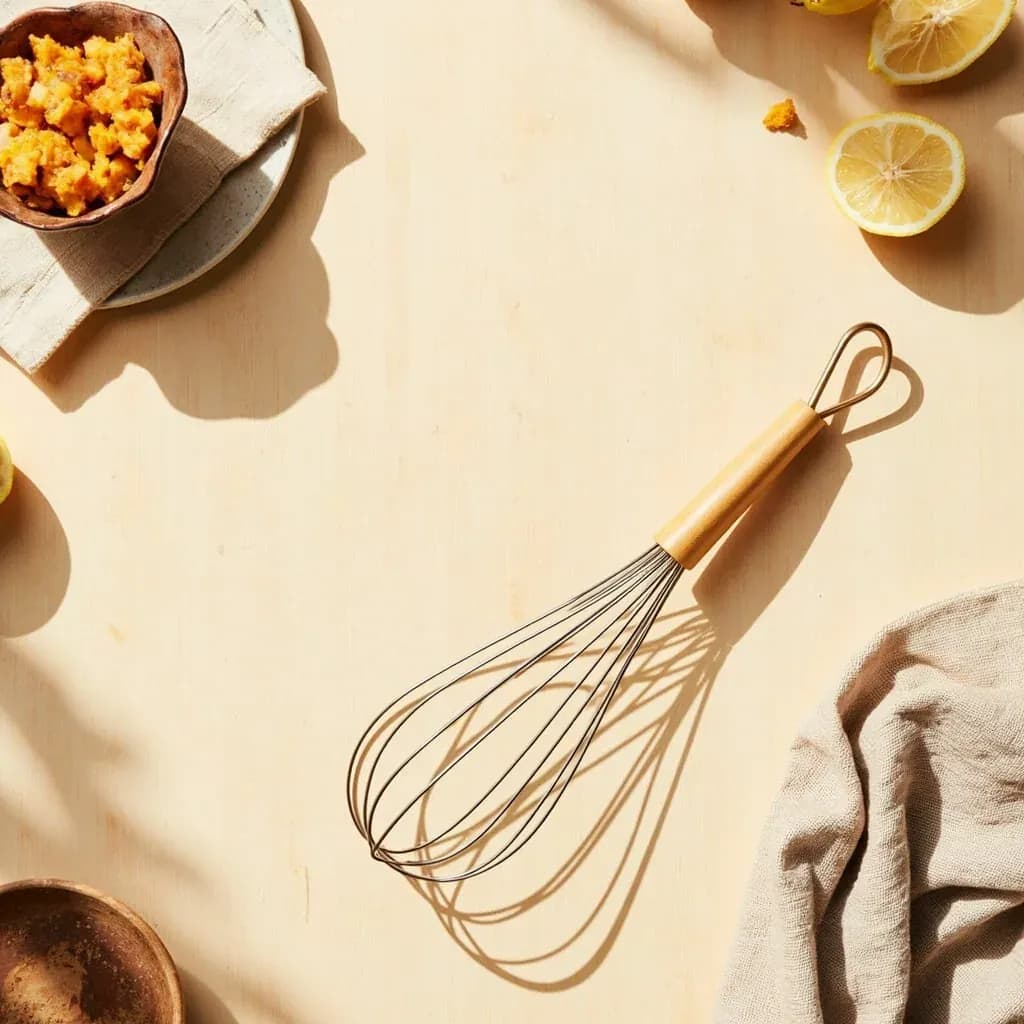
Narrow, tapered whisk with stiff wires built for reaching into pots and emulsifying sauces, vinaigrettes and roux; less air-incorporating than a rounded balloon whisk, less flat than a sauce whisk.
A French whisk is a hand whisk built around a narrow, elongated cage of stiff wires — a slim teardrop or elongated cone rather than the bulb of a balloon whisk or the paddle-like profile of a flat whisk. It evolved in European professional kitchens because cooks needed a tool that could reach the bottom of tall stockpots, deep saucepans, and narrow pots, where a balloon whisk simply would not fit and a flat whisk would not have the volume to move liquid. Today it is the everyday workhorse in restaurant kitchens, where it is often labelled simply a 'cooking whisk' or 'sauce whisk.'
Because the cage is narrow, mechanical force concentrates at the tip, giving the cook good leverage against the bottom and walls of the pan without the splashing that a balloon whisk produces. Air incorporation is moderate — enough to blend a vinaigrette or lift a pan sauce, not enough to whip cream or fully aerate a voluminous sabayon. Wires are usually stainless steel and the handle long enough (typically 12–14 inches in professional versions) that the hand stays clear of steam and rim heat.
For the home cook this is the most useful whisk to own first, because it handles the widest range of jobs: pan sauces, gravies, mother sauces, roux, custards, vinaigrettes, and emulsions. The French whisk sits in the middle of the whisk design spectrum — more reach and leverage than a balloon whisk, and more aeration and stirring action than a flat (roux) whisk, with far better access in any vessel deeper than a sauté pan.
Alternatives
Types & varieties
Narrow teardrop cage of stainless wires on a long handle — the standard French-whisk form and the everyday restaurant workhorse.
Shorter version, around 8–10 inches, for vinaigrettes, small bowls, and single-serving tasks.
Wires coated in food-safe silicone; gentler on non-stick and enameled cookware but not suited to high direct heat.
Rounded, bulbous wire cage; incorporates more air and is the right tool for whipping cream and eggs.
Flattened wire cage with a flat bottom edge; built for deglazing, smoothing roux, and working in shallow pans.
A single coiled spring rather than separate wires; useful for thin liquids in narrow containers.
Heavier looped-wire head built for stirring thick batters and bread doughs; too stiff for sauce work.
Where the French whisk fits
Whisk design is essentially a tradeoff between three things: reach, aeration, and contact with the pan bottom. A balloon whisk wins on aeration — its bulbous cage traps and folds air, which is why it whips cream and egg whites. A flat whisk wins on contact — its paddle-like profile sweeps the bottom of a shallow pan, which is why it is the right tool for a blond roux or for deglazing a wide skillet. The French whisk is the compromise: a cage narrow enough to drop into a stockpot but full enough to actually move liquid, with enough spring to lift a sauce without deflating it. Most cooks who own only one whisk are best served by a 12-inch French.
Sizing and selection
Length matters more than wire count for this style of whisk. Match the tool to the deepest vessel you actually cook in.
- 8–10 inches: vinaigrettes, small bowls, single-pan tasks; too short for stockpots.
- 12 inches: the all-purpose size for saucepans, sauciers, and most home stovetops.
- 14–16 inches: professional sizes meant for tall stockpots and bain-marie work; the extra length keeps the hand out of steam.
- Stainless-steel wires and stainless handle: most durable, fully dishwasher-safe, and tolerant of contact with cast iron and steel.
- Wooden handle: warmer in the hand but cannot go in the dishwasher and should not sit in water.
- Silicone-coated wires: choose for non-stick and enameled cast iron; avoid over high direct heat, where the coating can discolor or degrade above roughly 220 °C / 425 °F.
Care and storage
The vulnerable point on any French whisk is the joint where the wires enter the ferrule — that is where corrosion starts on budget models and where wires eventually loosen on abused ones. A little attention after each wash goes a long way.
- Hand-wash wooden-handled and nickel-plated whisks; a stainless whisk with a stainless handle can go in the dishwasher.
- Dry the ferrule joint after washing, especially on nickel-plated versions, to prevent corrosion creeping up the wires.
- Store hanging by the handle loop or laid flat; do not toss it into a drawer where heavier utensils splay the wires open.
- If wires bend, reshape them gently around a wine bottle or similar form — do not pull them back with pliers, which loosens the ferrule.
Common uses
Tips & pitfalls
- Move the whisk in small, continuous circles rather than a vigorous up-and-down pumping motion, which introduces unwanted air and splashes hot liquid.
- Tilt the pan and sweep the wire cage into the corners, where sauces thicken fastest and are most likely to scorch.
- Because the cage is narrow, mechanical force concentrates at the tip — press it firmly against the pan bottom only when you are deliberately working a roux, not when emulsifying a delicate sauce.
- Match the length of the whisk to the depth of your most-used pot: the wires should reach the bottom while your hand stays clear of the rim and steam.
- After washing, dry the joint where the wires enter the ferrule to prevent corrosion, especially on nickel-plated models.
- Avoid silicone-coated whisks over high direct heat; the coating can discolor or degrade above roughly 220 °C / 425 °F.
- If a sauce breaks — a hollandaise or beurre monté that has split — start a fresh yolk or a fresh tablespoon of warm liquid in a clean bowl and slowly whisk the broken sauce in, drop by drop, to re-emulsify.
- Do not use a French whisk to beat heavy or thick batters for long periods; the thin wires can bend or pop loose from the ferrule. Switch to a wooden spoon or a dough whisk for those jobs.
Good to know
- Type
- Hand whisk (manual mixing tool)
- Also called
- Cooking whisk, sauce whisk, straight whisk, narrow whisk
- Shape
- Narrow, elongated teardrop or conical wire cage; slimmer than a balloon whisk and not flattened like a roux whisk
- Wire material
- Usually stainless steel; sometimes nickel-plated or silicone-coated
- Handle material
- Stainless steel, beech or walnut wood, or heat-resistant composite
- Typical overall length
- 10–16 in (25–40 cm); professional versions commonly 12–14 in
- Wire count
- Usually 6–10 wires formed into a closed loop and anchored by a ferrule
- Air incorporation
- Low to moderate — less than a balloon whisk, more than a flat whisk
- Dishwasher safe
- Most stainless-steel versions are; wooden-handled and nickel-plated models should be hand-washed
- Best for
- Sauces, gravies, roux, emulsions, vinaigrettes, custards, and deglazing in deeper vessels
Also called
sauce whisk · narrow whisk · tapered whisk
