Prep Tools
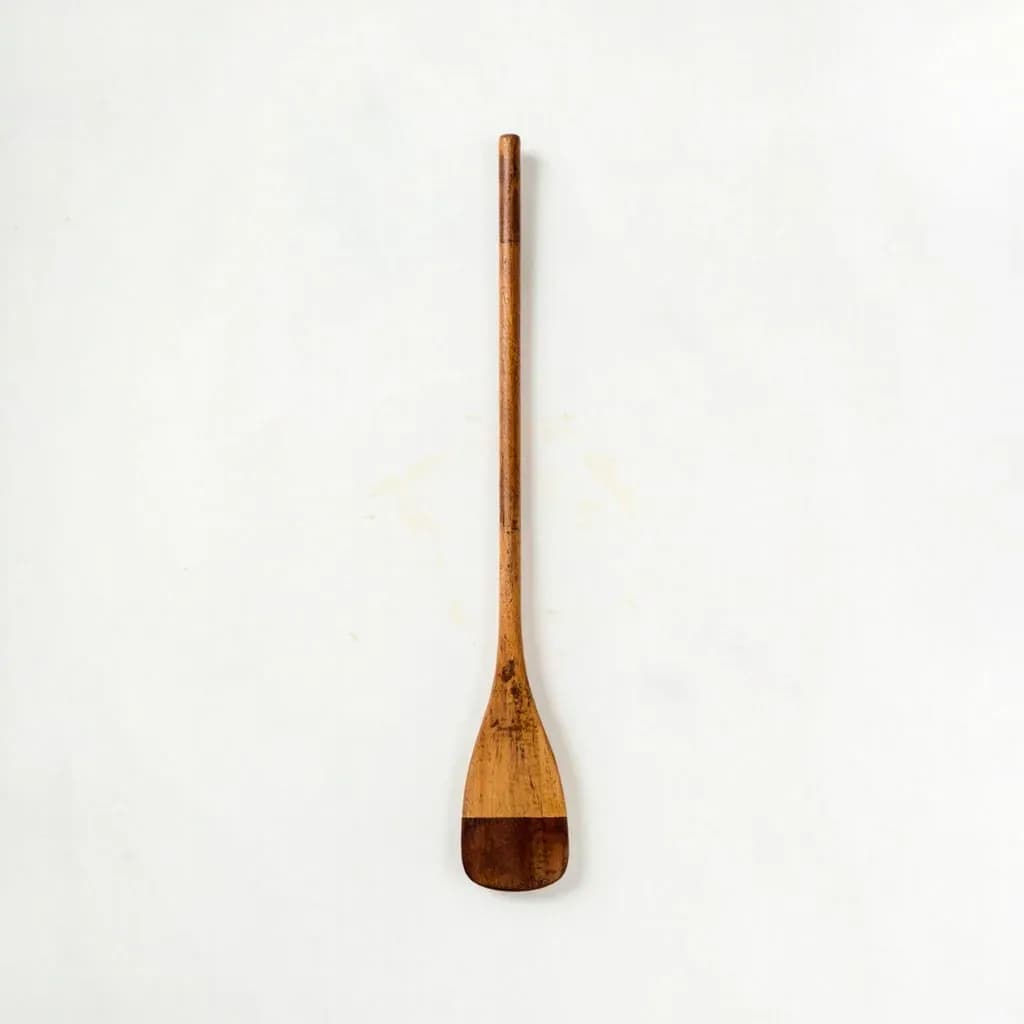
Fufu Stirring Paddle
A long sturdy wooden paddle for stirring thick starchy doughs like fufu and pap.
A fufu stirring paddle is a long, strong wooden paddle or stick used to vigorously stir and beat thick starchy staples such as fufu, foufou, tô, and stiff porridge as they cook. The dense, sticky mass requires real force to keep smooth and lump-free, so the paddle is built long and rigid for leverage over a hot pot. Variants exist across West, Central, and Southern Africa under many local names.
The fufu stirring paddle is a long-handled, flat-bladed wooden tool built for the demanding work of stirring West and Central African starches as they cook into dense, elastic doughs. A traditional fufu mass — made from cassava, yam, plantain, or cocoyam — becomes heavy, sticky, and fiercely hot as it thickens, and an ordinary spoon quickly buckles, splinters, or simply cannot push through. The paddle's heft and broad blade give the cook the leverage to fold, press, and gather the dough in a way that develops its signature smooth, stretchy texture.
Most paddles run 45–60 cm long, with a slim round handle and a flat, squared or slightly rounded blade 7–12 cm across. That length is not stylistic: it keeps the cook's hand well clear of the splattering starch and rising steam. Hardwood is the traditional material because it tolerates prolonged contact with hot dough without softening, and a single piece of wood — no glued joints — is essential because the leverage applied to a stiff dough can split a laminated handle wide open.
From fufu and banku on the Ghanaian coast to ugali in East Africa and sadza further south, the paddle is the tool that turns a pot of bubbling starch into the finished mound on the serving plate.
Alternatives
Types & varieties
The classic form: solid hardwood, long round handle, flat paddle end. The most common paddle in Ghanaian, Nigerian, and Cameroonian kitchens.
A wider, sometimes slightly curved variant used specifically for banku, which is stirred with a vigorous folding and swirling motion.
A compact wooden stirrer used inside a large wooden mortar when pounding fufu with a heavy pestle; the paddle gathers and turns the mash between strikes.
Hand-carved from a single billet of wood; common in village markets, with the blade often shaped and re-shaped by years of use.
Contemporary utensils marketed for fufu; silicone paddles suit non-stick pots but lack the heft, rigidity, and leverage of wood for traditional use.
The Stirring Technique
A fufu paddle is not used like a whisk. The motion that produces a smooth, lump-free dough is a slow, deliberate fold-and-press: drive the blade down through the center of the mass, sweep it along the bottom of the pot, and fold the dough back over itself as you draw the paddle up the far side. Repeating this in a single direction — not back and forth — aligns the starch fibers and develops elasticity without tearing the dough. For banku, the sweep is longer and more circular; for ugali and sadza, the fold is sharper and the paddle is used almost like a lever to compress the stiffening maize meal. Lower the heat before each stirring pass; the paddle scrapes the pot bottom and an open flame scorches the dough within seconds.
- Fold-and-press, never whisk: the goal is to compress and align the starch, not aerate it.
- Work in a single direction; reversing direction tears the dough and leaves it streaky.
- Lower the flame before each pass — the paddle's edge against the pot bottom plus high heat will burn the dough fast.
- Keep the blade angled against the bottom so you lift and fold rather than chop into the mass.
Common uses
Tips & pitfalls
- Use a folding-and-pressing motion rather than a whisk-like stir; this develops fufu's smooth, stretchy texture without lumps.
- Keep wooden paddles seasoned: rub with food-safe mineral oil or light vegetable oil after drying to prevent cracking and absorption of starch.
- Never soak the paddle in water overnight; rinse, hot-scrape off starch, and stand it upright to air-dry so the handle joint does not split.
- Reserve the paddle for thick starches only — acidic or strongly colored foods will stain and flavor the wood.
- Stand back from the pot: fufu and banku spatter hard as they thicken, and the long handle exists because steam and small bits of dough travel.
- Wobble or flex in the paddle is a sign to replace it; the leverage used on stiff dough can snap a weakened blade and send it into the pot.
- Choose one-piece hardwood construction; glued joints will fail in hot water and under the load of a full pot of dough.
Good to know
- Tool type
- Long-handled stirring paddle (kitchen tool)
- Primary material
- Hardwood, traditionally locally sourced dense woods
- Typical length
- Approximately 45–60 cm (18–24 in) overall; handle makes up most of the length
- Paddle end shape
- Flat, broad, slightly rounded or squared blade, often 7–12 cm across
- Origin
- West and Central African kitchens; used wherever fufu-family starches are cooked
- Why so long
- The handle keeps the cook's hand well away from the very hot, thick, splattering starch mass
- Dishes it stirs
- Fufu, banku, kenkey, eko, amala, ugali, sadza, nshima, pap, ogi, akamu
- Alternative names
- Fufu stick, banku paddle, fufu turner, cassava stirrer, wooden porridge paddle
Also called
Funje Stirring Stick · Wooden Pâte Paddle · Stirring Paddle · Cou-Cou Stick · Umwuko
Related

Peeler
Swift blade for stripping skin off fruit and vegetables

Grater
Sharp-toothed surface for shredding cheese and vegetables

Microplane
Ultra-fine rasp for citrus zest, garlic, and hard cheese

Mixing Bowl
All-purpose bowl for combining, whisking, and tossing

Whisk
Looped wires that beat air into eggs, cream, and sauces

Spatula
Flat blade for flipping, lifting, and scraping

Slotted Spoon
Pierced spoon that lifts solids and drains the liquid behind

Wooden Spoon
Gentle, heat-friendly spoon for stirring anything