Prep Tools
Grinding Stone
A stone slab and roller or pestle for crushing spices, grains, and pastes by hand.
A grinding stone is a heavy stone surface, used with a roller or hand stone, to crush and grind spices, grains, nuts, and wet masala into pastes. Found across many cultures as the sil-batta, metate, or batán, it relies on pressure and abrasion rather than blades, giving a coarse, aromatic texture prized in traditional cooking. The rough stone surface releases oils and flavors that a blade grinder often misses.
A grinding stone is a two-part tool: a flat or shallow-sloped bed stone worked by a smaller hand-held muller, roller, or pestle. The bed stone's surface is roughened by pecking, carving, or natural grain so that ingredients grip and fracture between the two surfaces rather than skating across a polished face. In essence it is a controlled shear: pressure plus grit, repeated in a circular or back-and-forth motion, breaks cellular walls and crushes seed coats without the heat or centrifugal violence of an electric blade mill.
What distinguishes a grinding stone from a mortar and pestle is the broad working surface and the use of body weight rather than wrist action. That makes it the right tool for jobs a pestle handles poorly: large batches of wet batter, fresh whole-grain flour, and nixtamalized corn ground into masa. Because stone heats only slightly during grinding, volatile oils in spices and aromatics survive intact, and the resulting pastes taste brighter and more vivid than machine-ground equivalents. The cost is speed and convenience — these are heavy, stationary, slow tools that reward a cook who treats them as a long-term, seasoned piece of equipment.
In a modern kitchen the term usually refers to one of three practical forms: a Mesoamerican metate with a mano, an Indian sil-batta set, or a small granite slab-and-pin sold for crushing aromatics at the stovetop. The rotary chakki and ancient rotary quern are the mechanized extension of the same idea and produce similar results in terms of flavor and texture.
Alternatives
Types & varieties
Mesoamerican rectangular or three-legged slab of basalt or andesite with a hand-held cylindrical or loaf-shaped grinding stone. The defining tool for grinding nixtamalized corn into masa for tortillas and tamales; also used for cacao, chiles, achiote, and moles.
South Asian pair of circular millstones — a stationary bed stone and a runner stone turned by a wooden handle, later by crank or motor. The traditional mill for whole-wheat atta, besan, and rice flour.
Indian flat or slightly concave circular stone worked with a short cylindrical stone roller for wet grinding: idli and dosa batters, chutneys, and spice pastes. The hand-driven ancestor of the tabletop wet grinder.
Malay and Indonesian cylindrical stone pestle used with a stone mortar or shallow slab to pound rempah, sambal, and spice pastes, often in tandem with a lighter wooden penumbuk.
Japanese hewn-granite mortar worked with a heavy wooden mallet (kine); used for pounding mochi, crushing sesame into goma, and grinding kinako. A related flat stone (ishisara) handles crushing and grating.
European, North African, and Levantine grain-grinding stones from the Neolithic through the Iron Age. The saddle quern is a curved lower stone worked by a hand-held upper stone; the rotary quern stacks two circular stones with a central hopper and a wooden handle.
West African heavy stone slab and smaller hand-stone (Yoruba odo, Igbo nkwa) used to grind egusi and melon seed, dried pepper, fermented cassava, and locust bean for soups and stews.
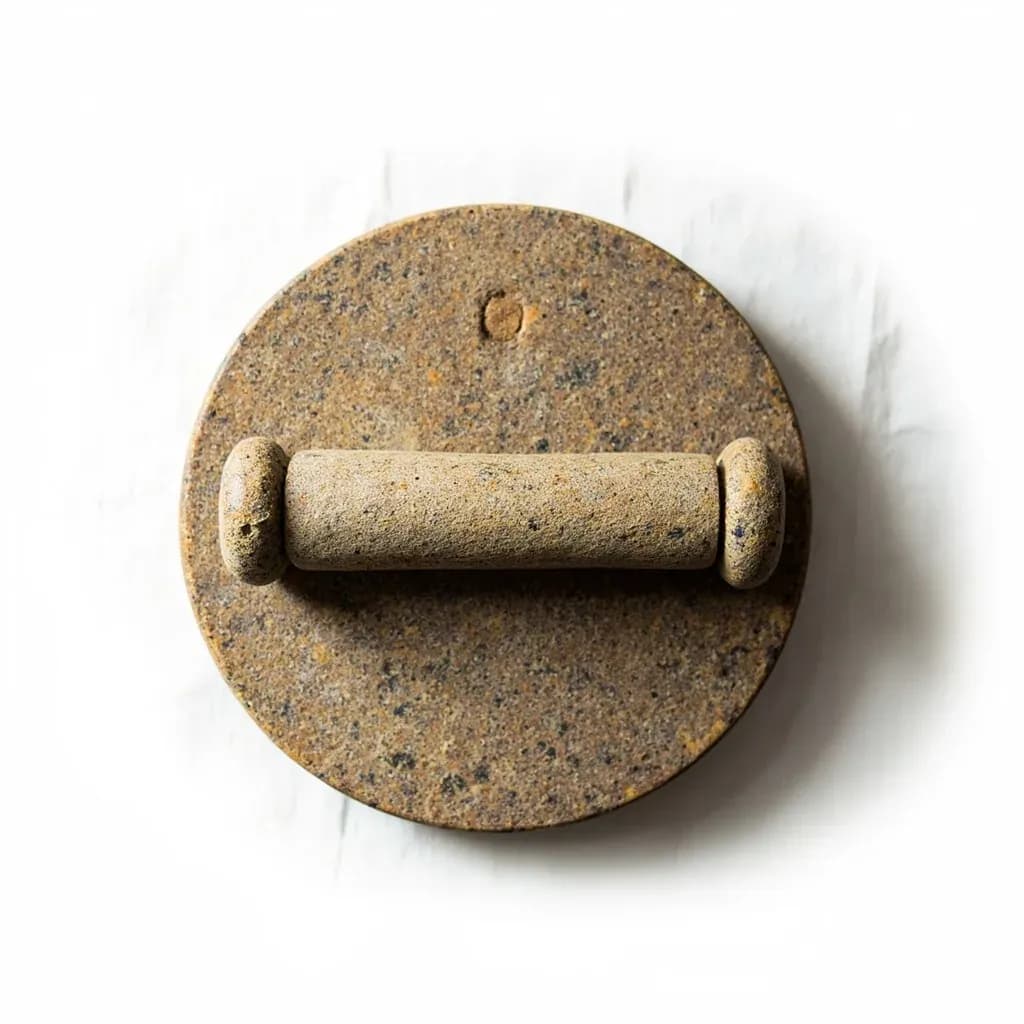
Modern retail form: a small granite slab (typically 8–12 in.) with a short granite rolling pin, sold for crushing garlic, ginger, cardamom, and small batches of spice at the stovetop.
How the stone actually breaks food
A grinding stone works by shear, not impact. The roughened bed stone holds the ingredient in place while the muller slides across it, applying downward pressure that cracks seed coats, bursts oil-bearing cells, and shears fibrous tissue. Because the motion is slow and the stone stays cool, fragile aromatic compounds — the terpenes in cumin, the pyrazines in toasted coriander, the volatile sulfides in fresh garlic — are released without being cooked off the way they can be in a high-speed blade grinder or an overheated mortar. The trade-off is uniformity: a stone produces a coarser, more variable grind than a burr mill, which is exactly what you want for spice blends and batters but a drawback when you need cake-flour fineness.
- Shear-based crushing preserves volatile oils better than blade mills.
- The textured surface grips ingredients; a polished stone smears them.
- Wet grinding on a damp sil keeps batters cool and aerated for idli and dosa.
- A chakki's rotating runner stone is the mechanized extension of the same principle.
Seasoning and long-term care
A new stone arrives with loose grit from the quarry or carving process, and the pores need to be primed before it meets food. The standard ritual — grinding dry rice, or coarse salt with a splash of water, until the slurry runs clean — both flushes debris and burnishes the working face to a uniform texture. After that, the stone's care is mostly about what you avoid: no soap, no oil on the stone itself, no soaking, and no storing where moisture can sit against the underside. A stone seasoned for one purpose (a metate used only for masa, a sil-batta used only for dosa batter) will outperform a general-purpose one, because the pores pack with starch or oil that complements the next grind.
Common uses
Tips & pitfalls
- Season a new stone by grinding a handful of dry rice (or coarse salt with a splash of water) until the slurry runs clean and white and the surface feels smooth and non-gritty under the palm — this removes loose grit and primes the pores.
- When wet-grinding, keep the sil or metate lightly damp; the batta or mano glides instead of catching, and the batter stays cool and aerated rather than tearing or heating up.
- Apply even, full-surface circular pressure with the weight of the muller; pressing only on one edge will dish the stone unevenly and give lumpy results.
- Use separate stones for pungent ingredients (garlic, onion, dried shrimp, fish) and for dry spices, grains, or sweet pastes — porous stone holds strong odors for years.
- Never use dish soap or harsh detergents; the porous matrix absorbs them and taints the next grind. Clean with dry rice, salt, or a few stone chips, wipe with a damp cloth, and air-dry fully.
- Avoid starting a brand-new stone on very hard whole spices (whole cloves, large peppercorns, star anise) — they scratch and dent the working face. Break them down in a small mill or mortar first.
- Do not use a stone sold as decorative or sourced from an unknown quarry. Limestone and some sandstones can leave a chalky, bitter note; stick to food-grade basalt, granite, or andesite.
- Oil wooden handles and mallets occasionally with food-grade mineral oil, but never oil the stone itself — trapped oil goes rancid in the pores and off-flavors pastes.
- Store the stone flat in a dry spot with airflow underneath; moisture trapped against the bottom can crack it, especially in unheated kitchens in winter.
- If the surface polishes smooth from years of use, re-roughen it with a hammerstone or coarse file — a glazed stone no longer grips ingredients and just smears them.
Good to know
- Origin
- Among the oldest food-prep tools known; saddle querns date to the Neolithic (c. 7000 BCE) in the Fertile Crescent, with independent traditions in Mesoamerica, South Asia, and sub-Saharan Africa.
- Material
- Most commonly basalt, granite, andesite, and sandstone; modern kitchen versions are usually granite. Marble and soapstone are softer and less durable for heavy grinding.
- Components
- A flat or shallow-sloped bed stone and a smaller hand-held muller, roller, or pestle; in chakki form, a rotating runner stone turned over the bed stone.
- Typical weight
- Household slabs run 5–25 lb (2–11 kg); commercial chakki stones can exceed 100 lb (45 kg). Small granite slab-and-pin sets sold for home use are typically 4–10 lb.
- Working surface
- Roughened by pecking, carving, or natural grain so ingredients grip and fracture rather than skating; chakki stones are dressed with a chisel to expose fresh grit.
- Heat
- Stone heats only slightly during grinding, so volatile oils in spices and aromatics are preserved better than in high-speed electric blade mills.
- Capacity
- Small home metate or sil-batta handles roughly 1–2 cups of paste or spice at a time; a hand-cranked household chakki can mill several kilograms of grain per hour.
- Cleaning
- Never washed with soap — the porous matrix absorbs it. Cleaned by grinding dry coarse rice, salt, or stone chips, then wiped with a damp cloth and air-dried.
- Lifespan
- A well-kept basalt or granite grinding stone is effectively a lifetime tool; the working face is renewed by re-pecking or re-dressing when it becomes too smooth.
Also called
Sil-Batta · Metate · Batán · Piedra de Moler · Ammikkallu · Stone Grinder · Shil-Nora
Related

Peeler
Swift blade for stripping skin off fruit and vegetables

Grater
Sharp-toothed surface for shredding cheese and vegetables

Microplane
Ultra-fine rasp for citrus zest, garlic, and hard cheese

Mixing Bowl
All-purpose bowl for combining, whisking, and tossing

Whisk
Looped wires that beat air into eggs, cream, and sauces

Spatula
Flat blade for flipping, lifting, and scraping

Slotted Spoon
Pierced spoon that lifts solids and drains the liquid behind

Wooden Spoon
Gentle, heat-friendly spoon for stirring anything