Prep Tools
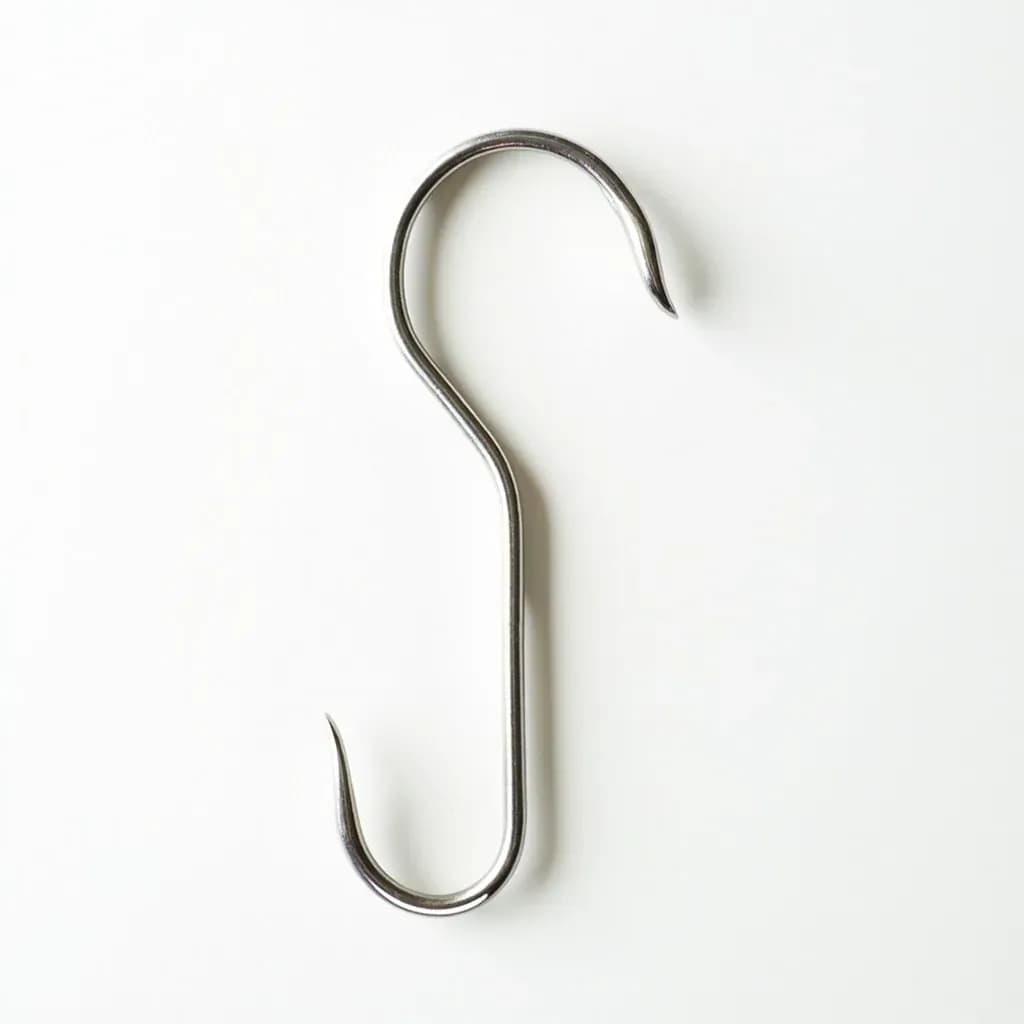
Roast Meat Hook
Metal hook for hanging, lifting, and turning large roasts and cured meats.
A roast meat hook is a sturdy curved metal hook used to hang meat for curing, smoking, or drying, and to lift and turn heavy roasts. Cooks hook into a joint or cavity to maneuver hot meat off a spit, out of an oven, or onto a board without piercing it many times. The single point keeps juices in better than a fork while giving a strong grip.
The roast meat hook is one of the oldest tools still in continuous kitchen use, a direct descendant of the iron hooks that hung sides of beef in medieval shambles and pigs on gambrels in nineteenth-century farm slaughterhouses. At its simplest it is a curved piece of metal ending in a point: drive the point into bone, tendon, or twine, and gravity does the rest. What separates a serviceable hook from a bad one is geometry — the depth and radius of the curve, the taper of the point, and how the shank transfers load back to whatever is bearing the weight.
A serious cook keeps more than one, because the tool has two distinct jobs that look similar but demand different hardware. A short, sharp, heavy-gauge butcher's hook is built for leverage on a wet, heavy primal cut that may be swung off a table or rail; it is about strength, grip, and a food-safe finish. A long, slim, stainless curing hook is built to live inside a ham or coppa for months in a humid aging room; it is about inertness, corrosion resistance, and a curve gentle enough not to split a shank bone. Conflating the two — using a galvanized slaughterhouse hook to hang a prosciutto, or a delicate curing hook to lift a 30-pound brisket — is one of the most common mistakes cooks make with the tool.
Used correctly, a hook leaves almost no puncture damage to the finished product, which is why it is preferred over a carving fork for lifting a roast intact from a pan, and why charcutiers thread them through sinew rather than meat. It also frees both hands, letting you suspend a bird in a deep fryer or a confit pot and raise it cleanly when the cook is done.
Alternatives
Types & varieties
Simple double-curved hook; the everyday prep tool for hanging small cured goods, tool bags, or suspending a roast from a rod.
One straight shank ending in a sharp, deeply curved point; the standard for lifting sides of beef or pork off the table or rail.
A V- or T-shaped metal bar that spreads the hind legs of a carcass; meat hooks are driven into the Achilles tendons above the hocks first, then the gambrel is hung from both hooks to bear the weight.
Long, slim, stainless hook with a gentle curve, designed to thread through the shank bone or sinew of a ham and hang it in a curing or dry-aging room for months at a time.
Heavy forged hook, traditionally with a flattened or barbed shoulder, sized to anchor in the Achilles tendons of a hanging pig so the gambrel can be hung from it.
Two short hooks joined by a crossbar; used to suspend long, thin items like whole cured loins, pancetta rolls, or strings of sausages from a drying rail.
Sturdy stainless S- or single-hook used in vertical water smokers and offset smokers to hang briskets, ribs, or whole chickens from the grate.
Small handled hook with a spring-loaded latch used to draw lardoons of fat through a roast; related in shape but a different tool.
The two families of meat hook
Most of the confusion around this tool comes from mixing up the two jobs it does. Knowing which family a hook belongs to dictates what it is made of, how thick it is, and how it should be used.
- Handling hooks are short, thick, and sharp. They are sized to be driven into a primal cut, a roast, or a tendon with one hand, hold the weight of a single piece, and come right back out. They live on the prep table or rail. Stainless is preferred for food-safety reasons, but heavy carbon steel is acceptable if dried after every wash.
- Curing and hanging hooks are long, slim, and gently curved. They are meant to pass through a shank bone, a loop of twine, or a piece of sinew and stay there for weeks or months. They live in the curing room or smoker, so they must be fully stainless, with no plating that can pit or off-flavor the product.
- Bridging the two is a mistake: a curing hook is too weak to lift a 25 lb brisket cleanly, and a heavy butcher's hook is too blunt and too short to thread through a prosciutto without damaging it.
Hook, fork, or twine?
A carving fork pierces straight through a roast and tears muscle fibers on the way out, leaving a ragged hole that bleeds juice onto the board. A hook, driven into bone, tendon, or a pre-tied loop of butcher's twine, bears the weight without slicing the meat. For any large piece you intend to present whole — a standing rib roast, a porchetta, a bone-in ham — a hook is the cleaner choice. Twine alone is fine in the oven, but the moment you need to lift a 15 lb roast out of a pan, you want a hook engaged with the bones, not a loop of string pinched between your fingers.
- For a standing rib roast, drive the hook between the rib bones from the back, not through the eye meat.
- For a whole ham, thread the hook through the exposed shank bone or the Achilles tendon above the hock.
- For a trussed bird going into a fryer or confit, pass the hook through the trussing twine between the drumsticks, not through the breast.
Common uses
Tips & pitfalls
- Anchor a roast hook in bone, a thick tendon, or butcher's twine — never in soft muscle, where it can tear free under the meat's weight and drop the roast.
- For cured meats, choose stainless only; carbon steel and galvanized coatings can rust in humid aging rooms and off-flavor the product.
- Sanitize hooks between raw-meat tasks the way you would a cutting board: hot soapy scrub, then a brief dip in a sanitizing solution.
- When hanging a whole carcass, drive each hook into the Achilles tendon above the hock, then hang the gambrel from both hooks so the load is balanced and the carcass hangs square.
- Keep the point oriented away from your body and your working hand; a slipped carcass can swing the hook hard enough to cause real injury.
- Heat travels up metal fast — grip the shank with a dry towel or heavy glove when lifting a hot roast out of a pan.
- Hang a heavy roasting hook from a sturdy ceiling hook or butcher's rail, not from a thin pot-rack, which is rated for cookware, not 50 lb of beef.
- File a slight flat onto the very tip of a dedicated curing hook so it seats in the shank bone without chipping or splitting it.
Good to know
- Material
- Food-grade stainless steel is the standard in modern kitchens; forged carbon steel and galvanized iron appear in traditional butchery and slaughterhouse gear.
- Typical length
- Household and prep hooks run 4–8 in (10–20 cm); professional butcher's hooks 8–14 in (20–35 cm); heavy carcass and gambrel hooks can exceed 18 in (45 cm).
- Working load
- Light prep hooks are rated for roughly 10–25 lb (4.5–11 kg); heavy butcher's and gambrel hooks commonly 100–300 lb (45–135 kg), with industrial models higher.
- Cross-section
- Round stock penetrates tissue more easily and is easier to sanitize; flat bar resists bending under heavy hanging loads and is favored for gambrels and carcass hooks.
- Origin
- Butchery hooks date back at least to medieval European slaughterhouses; the gambrel and matched hooks became standard in eighteenth- and nineteenth-century hog butchery in Britain and North America.
- Cleaning
- Stainless hooks tolerate hot soapy water and a commercial dishwasher or dilute bleach bath; carbon steel must be dried immediately to prevent flash rust.
- Storage
- Hang from a pegboard, rail, or dedicated hook strip — never loose in a drawer, where the point can injure a hand or be blunted against other tools.
- Compatibility
- Pairs with a gambrel for whole carcasses, butcher's twine loops for roasts, and curing rails or lofts for charcuterie.
Also called
roasting-fork · Butcher's Hook · Bacon Hook
Related

Peeler
Swift blade for stripping skin off fruit and vegetables

Grater
Sharp-toothed surface for shredding cheese and vegetables

Microplane
Ultra-fine rasp for citrus zest, garlic, and hard cheese

Mixing Bowl
All-purpose bowl for combining, whisking, and tossing

Whisk
Looped wires that beat air into eggs, cream, and sauces

Spatula
Flat blade for flipping, lifting, and scraping

Slotted Spoon
Pierced spoon that lifts solids and drains the liquid behind

Wooden Spoon
Gentle, heat-friendly spoon for stirring anything