Prep Tools
Pintxo Cocktail Stick
A small skewer that pins toppings to bread in Basque pintxos and counts the tab.
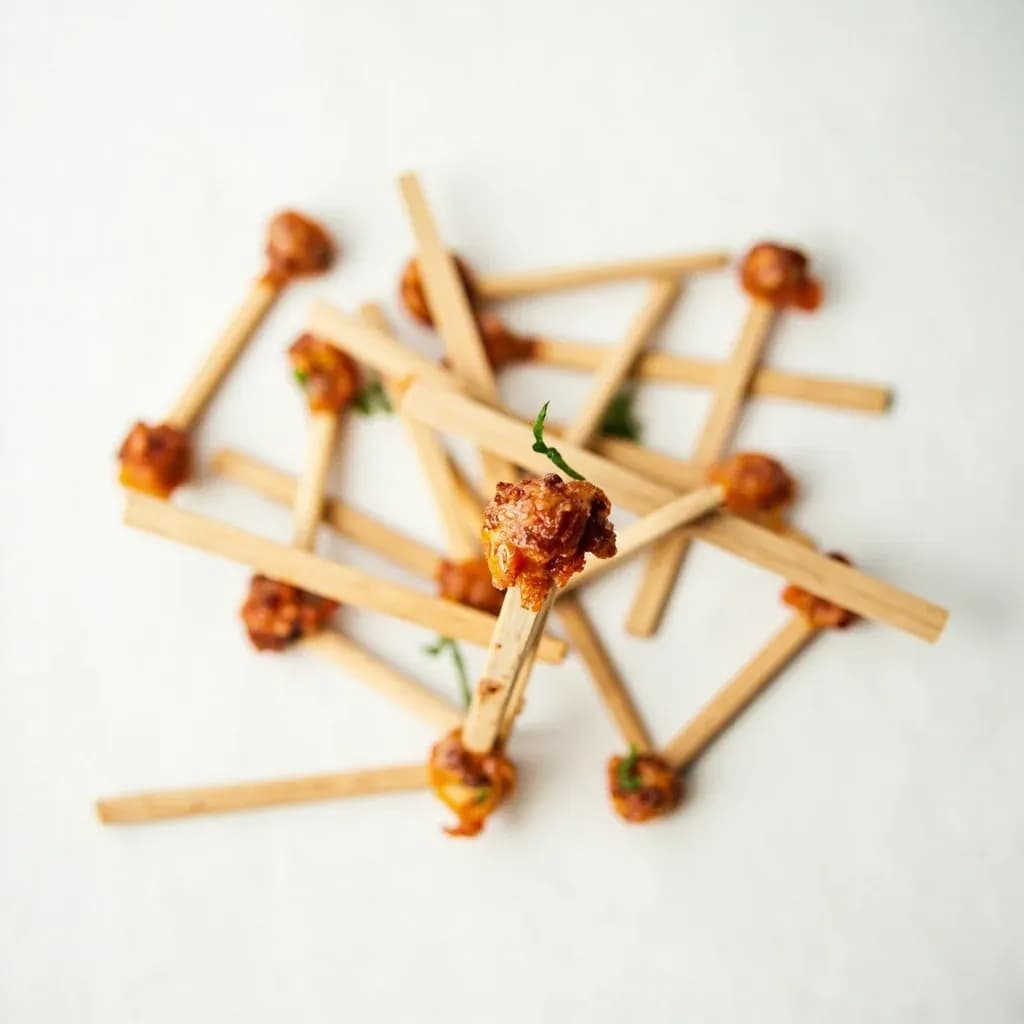
A pintxo stick is a short toothpick or cocktail skewer used in Basque bars to pin a topping to a slice of bread, forming a pintxo. Beyond holding the bite together, the sticks traditionally tally the bill, with the bartender counting them at the end. They come in plain wood or decorative versions.
A pintxo stick is a short, slender skewer — typically 7–10 cm of birch, bamboo, plastic, or stainless steel — that anchors a topping to a small bread base in the Basque pintxo tradition. The word 'pintxo' is itself the Basque term for 'spike,' and the pick is the defining element of the dish: every bite is delivered pre-assembled, with the stick doing the structural work so a cook can compose a single mouthful that holds together from the bar to the table. The most traditional models carry a frilled paper or cellophane top in the banderilla style, named for the barbed darts of Spanish bullfighting, giving the pick a visual identity beyond its purely mechanical job.
In San Sebastián and Bilbao, the stick has a second role that has shaped its very proportions. Pintxos are usually ordered by pointing rather than reading a menu, and the running tab is settled at the end of a round by counting the empty sticks on each plate. The pick is therefore calibrated to be long enough to anchor bread with a generous topping, slim enough to be eaten around or pulled free without effort, and often decorated at one end so the count is visible at a glance on a crowded countertop.
In the kitchen the stick behaves like a very small, food-safe nail. Wooden and bamboo versions are slightly absorbent and will split if forced through tough skins, while stainless steel and rigid plastic skewers can punch cleanly through olives, cured ham, and crusty bread. A soaked wooden pick is more forgiving with raw fish and acidic toppings; a metal pick keeps its tip after dozens of uses but can dent soft garnishes if pushed too hard.
Alternatives
Types & varieties
The basic birch or bamboo pick; the most common pintxo stick, no decoration, cheap and disposable
Wooden stick with a serrated paper or cellophane frill at one end; the classic banderilla shape also used for Spanish tapas and olives
Plastic or wood with a small coloured cellophane flag; common at buffets and for marking drink glasses
Plastic pick with a closed loop at the top; favours olives, cherries, and stacked produce cubes
Longer pick, often 10–12 cm, designed to skewer an olive plus garnishes; sometimes called a 'martini pick'
Plastic picks moulded into shapes (swords, umbrellas, fish) for party service; functional but not traditional in Basque bars
Dishwasher-safe; used in fine-dining pintxo service and tasting menus where waste is a concern
The Counting System
Pintxo bars in the Basque Country rarely use paper tickets. A customer walks to the counter, points at what looks good, and the cook hands over a small plate with the assembled bite impaled on a stick. At the end of the session, the barman counts the empty sticks on each plate — that is the bill. The convention has two practical consequences for the cook: every stick must be easy to see and identify, and it must remain attached to the pintxo until it is eaten, since a stick that falls out and is swept away with crumbs will be charged again on the next round. The decorative frilled top, the coloured cellophane flag, and the banderilla shape all exist partly to make the count visible across a crowded bar.
Common uses
Tips & pitfalls
- Soak wooden sticks in cold water for 10–15 minutes before spearing raw fish or acidic toppings like tomato and vinegar; this slows splintering and prevents breakage mid-bite.
- Match stick length to the pintxo: too short and the stick disappears into the topping, too long and it dominates the bite and makes the plate look untidy.
- In San Sebastián bars, leave the sticks clearly on the plate at the end of the round so the barman can count them; stacking sticks on a neighbour's plate can shift the tab onto them.
- Use frilled or coloured picks when serving several flavours on one platter so guests can identify their choice at a glance.
- Avoid cheap polystyrene picks that carry a plastic odour; they can taint delicate toppings like smoked salmon, foie gras, or fresh cheese.
- Push the stick through the softest element first (bread, folded pepper, tortilla) so harder items (olives, anchovies, cured ham) stay intact rather than being crushed at the entry point.
- Keep a small container ready for used sticks at the table during home service; sticks left loose on a tablecloth can scratch or stain it.
- For hot pintxos, briefly toast wooden sticks in the oven so they char lightly and don't look out of place against grilled toppings — the heat also dries the wood so it does not soften under the food.
Good to know
- Origin
- Basque Country (País Vasco), northern Spain, especially San Sebastián/Donostia and Bilbao; 'pintxo' is Basque for 'spike'
- Typical length
- Roughly 7–10 cm (3–4 in) for pintxos; olive and cocktail picks run 8–12 cm
- Common materials
- Wood (birch, bamboo), food-safe plastic with cellophane or frilled tops, and stainless steel for reusable versions
- Standard diameters
- Around 1.5–2.5 mm for wood; 1–1.5 mm for decorative plastic frilled picks
- Counting function
- In traditional bars, the number of sticks left on the plate at the end of a round is the customer's running tab
- Reusability
- Wooden and bamboo versions are single-use; stainless steel and hard plastic picks are reusable
- Food safety note
- Disposable wooden sticks are food-grade but not sterile; reusable metal picks should be washed at 60 °C+ between uses
Also called
cocktail stick · pincho stick · toothpick skewer
Related

Peeler
Swift blade for stripping skin off fruit and vegetables

Grater
Sharp-toothed surface for shredding cheese and vegetables

Microplane
Ultra-fine rasp for citrus zest, garlic, and hard cheese

Mixing Bowl
All-purpose bowl for combining, whisking, and tossing

Whisk
Looped wires that beat air into eggs, cream, and sauces

Spatula
Flat blade for flipping, lifting, and scraping

Slotted Spoon
Pierced spoon that lifts solids and drains the liquid behind

Wooden Spoon
Gentle, heat-friendly spoon for stirring anything