Prep Tools
Ravioli Cutter
A fluted wheel or stamp that cuts and crimps filled pasta into sealed ravioli.
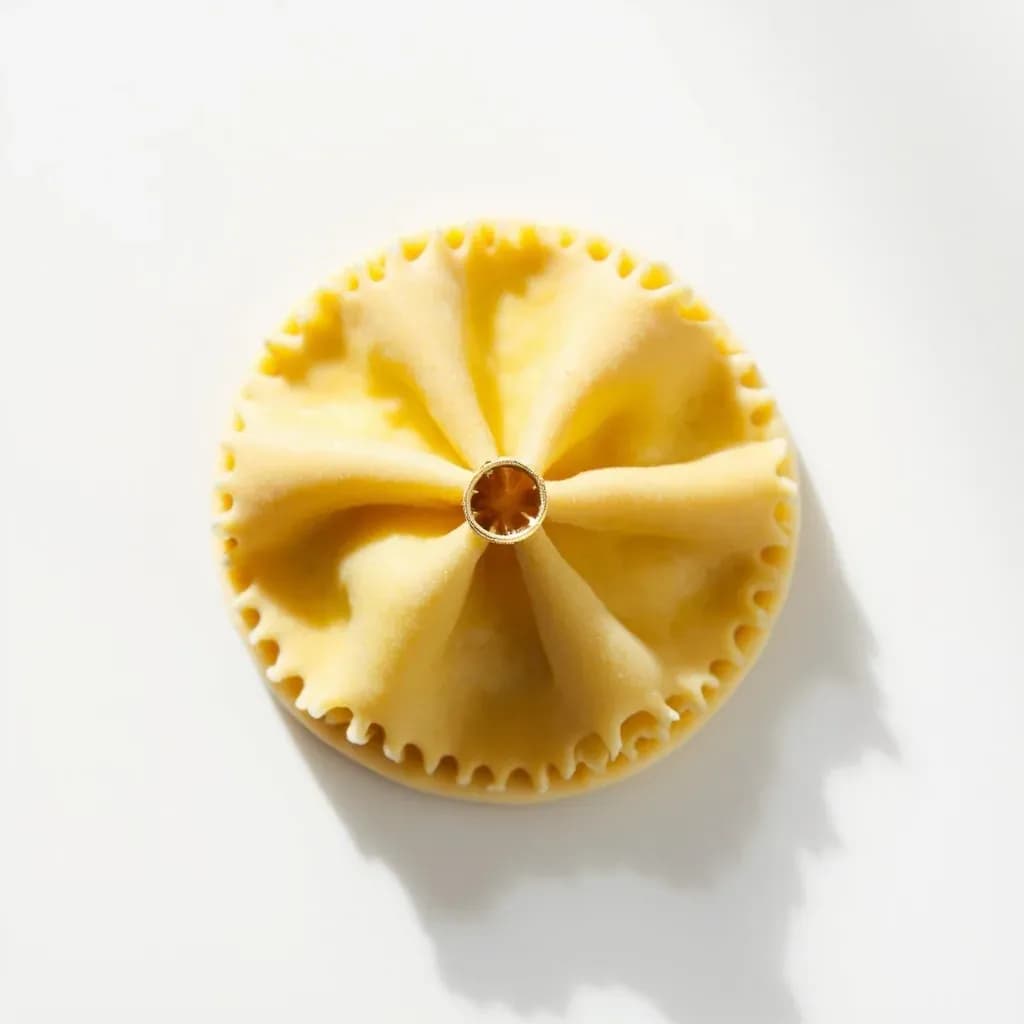
A ravioli cutter is a tool that cuts filled pasta into shapes while crimping the edges to seal in the filling. It comes as a fluted rolling wheel (rotella tagliapasta), a square or round stamp, or a press-style mold. Cooks use it after laying filling on a sheet of pasta and covering it with a second sheet.
A ravioli cutter is a precision seaming tool disguised as a pastry wheel. The defining feature is its fluted, wavy edge: when rolled or pressed across two stacked sheets of fresh egg pasta, that wavy profile both slices through the dough and compresses the two layers into a raised, undulating seam. That seam is the whole point — the increased surface area of dough pressed against dough is what holds the filling inside once the pasta hits boiling water. A plain knife or straight pastry wheel will cut the pasta cleanly but leaves a flat edge with little to grip, and that edge tends to spring open as the ravioli cooks.
Two broad families exist. The fluted wheel (a single pastry-wheel style cutter, sometimes paired as a double or mounted in a multi-roller frame) is rolled along rows of filling and gives the fastest output for batch work. The wooden or metal stamp — typically a square or round block of turned beech about 5–6 cm across — is pressed down one piece at a time and is the traditional Italian form. Both produce a sealed, finished ravioli; the choice comes down to volume, hand steadiness, and personal preference. A separate, related category is the ravioli mold or tray, where dough is draped over indented pockets, filled, covered with a second sheet, and rolled sealed in one motion — a different workflow that produces very uniform pieces.
The cutter pairs naturally with a hand-crank or motorised pasta machine for rolling sheets to a consistent 1–1.5 mm, a bench scraper for lifting cut pieces without tearing, and a semolina-dusted tray for holding. Most problems blamed on the cutter actually trace back to filling: too much filling, or filling placed too close to the sheet's edge, will force the seal open in the pot regardless of how cleanly the cut was made.
Alternatives
Types & varieties
Pastry-wheel style tool with a wavy edge; rolled manually along stacked pasta sheets one row at a time. The most versatile choice for small batches.
Two parallel fluted wheels on one handle that cut and crimp both edges of a single strip in one pass; faster than a single wheel but requires a steadier hand.
A frame holding several parallel fluted wheels; cuts and seals multiple rows in a single pass for high-volume production.
A wooden or metal block, usually turned beech, with a fluted square outline; pressed straight down to cut and seal one piece at a time. The traditional Italian form.
Circular fluted stamp, often used for round filled pastas such as mezzelune, casoncelli, or agnolini-style shapes.
A metal or wooden tray with indented pockets; dough is laid over, pockets are filled, a second sheet is laid on top, and a rolling pin seals and separates the pieces in one motion.
A hand-press tool that delivers even downward pressure, useful for consistent sealing without tearing the dough.
Why the Flutes Matter
The fluted edge is not decorative — it is the sealing mechanism. When the wavy profile presses the two pasta sheets together, it creates a series of small, overlapping ridges where dough meets dough. That ridged seam has substantially more contact surface than a straight cut, so the two sheets bond more firmly as they dry, and the seam has mechanical grip in addition to the starch-and-protein bond. A straight wheel or knife produces a flat, knife-edge seam with very little contact area; it cuts cleanly but does not seal. The same geometry is why pie crust edges are crimped with a fork or pinched between fingers — shape, not glue, holds the food together.
In practice this means: if ravioli are splitting open in the pot, the crimp geometry is usually not the problem. The likely culprits are too much filling, filling placed too close to the edge, or air trapped around the filling that expands during cooking and forces the seam apart from the inside.
Wheel or Stamp: Which to Choose
For a cook making a few dozen pieces at a time, a single fluted wheel is the most versatile choice. It moves quickly, is easy to clean, and lets you space rows of filling however you like. The trade-off is that the seal is only as straight and even as your hand — any wobble shows up directly in the crimp.
A wooden square stamp is the traditional Italian form and is forgiving for beginners because the tool itself defines the shape: you centre it over a mound of filling and press. Beech is the classic wood because it absorbs a little surface moisture and grips the dough slightly, helping the seam hold. Wooden stamps do, however, need to stay dry between uses and should never go in the dishwasher, where they can swell, crack, or trap moisture that turns the flutes sour.
For batch work — making ravioli for a crowd or for the freezer — a double wheel or a multi-roller frame (several parallel fluted wheels on one handle) saves significant time by cutting and crimping multiple rows in a single pass. These are almost always metal and require a steady, even hand; they are not forgiving of uneven dough thickness, so consistent sheet rolling matters more than with a stamp.
Common uses
Tips & pitfalls
- Roll pasta sheets to a uniform 1–1.5 mm thickness; uneven sheets cause the cutter to break through thin spots and produce ragged seals.
- Dust the cutter lightly with flour or semolina before each pass so dough doesn't cling to the flutes and clog the cutting edge.
- Brush a thin line of water or beaten egg along the bottom sheet's edge before laying the top sheet; the fluted wheel then compresses a moist seam that bonds firmly as the pasta dries.
- Use steady, one-directional pressure with a wheel cutter; rocking back and forth tears the flutes and leaves a ragged, leaky seal.
- With a stamp, press straight down and lift cleanly; twisting drags dough into the flutes and distorts the edge of the finished piece.
- Leave a 1–1.5 cm border of dough around each filling mound so the seal sits on dough, not filling — this is the single biggest factor in preventing blowouts in boiling water.
- Press out trapped air pockets around the filling before sealing; air expands during cooking and splits the pasta from the inside.
- Rest cut ravioli on a floured or semolina-dusted tray for 10–15 minutes before cooking so the seam sets and the surface dries slightly, which both helps them hold their shape and prevents sticking.
Good to know
- Also called
- Pasta wheel, fluted pastry wheel, ravioli stamp, ravioli press
- Primary function
- Cutting filled pasta sheets into individual pieces while crimping edges to seal the filling inside
- Key design feature
- Fluted (wavy) edge that both cuts and creates a raised seal by compressing two dough layers together
- Typical wheel diameter
- 5–7.5 cm (2–3 in)
- Typical stamp size
- 5–6.5 cm (2–2.5 in), square or round
- Common materials
- Stainless steel blade with beech or maple handle; stamps often turned beech wood; some all-metal versions
- Companion tool
- Hand-crank or motorised pasta machine for rolling sheets to uniform thickness
- Care
- Hand wash and dry immediately after use; wooden stamps should not be soaked or put through a dishwasher
Also called
Rotella Tagliapasta · pasta wheel cutter · ravioli stamp
Related

Peeler
Swift blade for stripping skin off fruit and vegetables

Grater
Sharp-toothed surface for shredding cheese and vegetables

Microplane
Ultra-fine rasp for citrus zest, garlic, and hard cheese

Mixing Bowl
All-purpose bowl for combining, whisking, and tossing

Whisk
Looped wires that beat air into eggs, cream, and sauces

Spatula
Flat blade for flipping, lifting, and scraping

Slotted Spoon
Pierced spoon that lifts solids and drains the liquid behind

Wooden Spoon
Gentle, heat-friendly spoon for stirring anything