Prep Tools
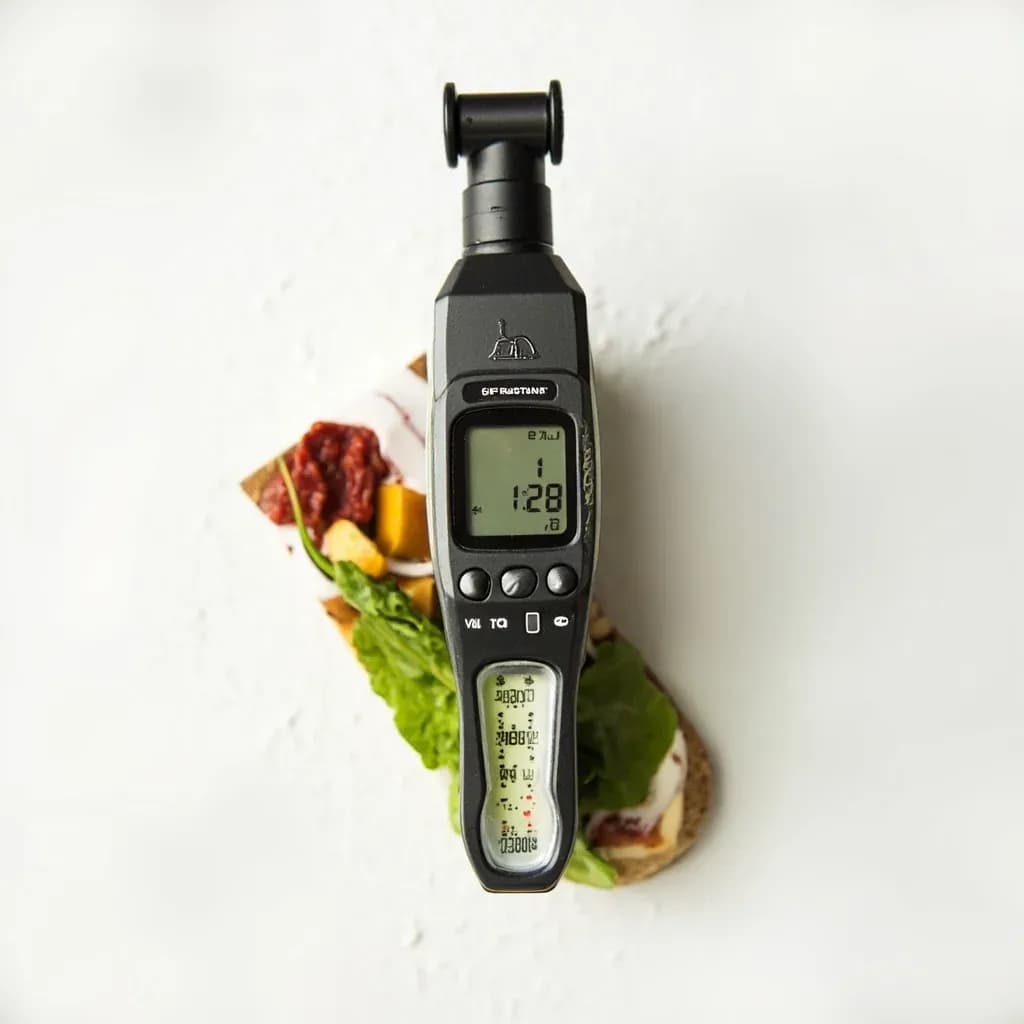
Refractometer
An optical instrument that measures sugar or salt concentration in a liquid by light refraction.
A refractometer is a precision optical tool that measures how much light bends through a drop of liquid to read its dissolved sugar (Brix), salt, or alcohol content. Cooks, brewers, jam-makers, and pickle and fruit producers use it to gauge ripeness, syrup density, and brine strength accurately. A few drops on the prism and a glance through the eyepiece give an instant numeric reading.
A refractometer is a precision optical instrument that quantifies the concentration of dissolved solids — most often sugar — in a liquid, by measuring how much light bends as it passes through a thin sample laid on a glass prism. In the kitchen it is the fastest and most accurate way to verify that a syrup, must, brine, or preserve has reached its target concentration, replacing the guesswork of thermometers, spoon tests, and float gauges. Because it reads only a few drops in seconds, it is equally useful for monitoring a fermenting batch, a delicate Italian meringue, or a plate of gravlax curing in the cooler.
What the meter reports is not pure sugar, but the total soluble solids (TSS) of the liquid — usually expressed in Brix (°Bx), where 1°Bx equals roughly 1 gram of sucrose per 100 grams of solution. Sugars dominate, but acids, pectin, proteins, salts, and alcohol all shift the number, which is why refractometer readings must be interpreted with the matrix in mind. A reading on grape must is almost pure sugar; a reading on lemon juice will run high because of citric acid; a reading on actively fermenting wine will be artificially low because ethanol refracts light differently from sucrose. Knowing what you are measuring is half of using the tool well.
Calibration, temperature, and clean technique matter as much as the instrument itself. Most culinary refractometers are calibrated to 0°Bx with distilled water at 20°C / 68°F, and a swing of five degrees from that point introduces an error of roughly 0.1–0.5°Bx. Automatic Temperature Compensation (ATC) handles most of this on digital units; on analog (optical) units, simply waiting thirty seconds for the sample to equilibrate to instrument temperature restores accuracy. Treated well — calibrated before each session, cleaned with a soft tissue and water, stored dry — even an inexpensive analog refractometer will give years of service and reproduce laboratory readings within a fraction of a degree.
Alternatives
Types & varieties
Handheld eyepiece unit; cheapest, no batteries; relies on ambient daylight for a clear shadow-line.
Electronic sensor with LCD readout; built-in ATC, higher precision (≈±0.1°Bx), works in any light.
Specialized 58–92°Bx scale calibrated for high-sugar matrices; reports moisture % rather than raw °Bx.
NaCl-dedicated scale (typically 0–28% salt or 0–100‰); standard in charcuterie for checking brine strength.
Usually 0–32°Bx, paired with software to convert to Plato, specific gravity, or potential ABV.
Bench-top, higher precision, requires more sample; rare outside labs.
Reading the Brix Number Correctly
The Brix scale assumes the dissolved solids are pure sucrose. In the kitchen, almost nothing is pure sucrose, so the number you see is an estimate weighted by whatever else is in solution. Treat the refractometer as a precise relative tool — repeatability is excellent — but apply judgment to the absolute value. The notes below cover the cases that catch cooks out most often.
- Fermenting liquids (wine, cider, beer): once ethanol appears, refractive index falls and the refractometer under-reads dramatically. Switch to a hydrometer, or apply a published alcohol-correction formula (e.g., Sean Terrill's, or the tools built into brewing software).
- Acidic liquids (vinegar, citrus, verjus): expect a small positive bias from the acids themselves; the higher the acid concentration, the larger the swing.
- Hot preserves and syrups: °Bx rises as a sample cools, so published jam-set targets of 65–68°Bx assume a hot reading. Test at ~80–90°C for an honest result.
- Salt brines: a Brix refractometer is calibrated for sucrose, not sodium chloride, so the reading on a brine will not reflect true salt concentration. Use a dedicated salinity refractometer, or convert with a published table.
- Very dark liquids (molasses, aged balsamic): dilute 1:1 with distilled water and double the reading — valid only when sugar dominates the dissolved solids.
Common uses
Tips & pitfalls
- Calibrate with distilled or RO water at the start of every session, and again after any temperature swing of more than ~5°C.
- Use a plastic pipette to place the sample on the prism — metal spoons and spatulas will scratch the soft optical glass.
- Let the sample sit on the prism for about 30 seconds so it reaches the instrument's temperature before reading; this matters most on analog units without ATC.
- On optical units, read the shadow-line at the sharp blue/white boundary, not the diffuse middle of the gradient.
- Between samples, clean with a soft lens tissue dampened with distilled water, then let the prism dry so you don't dilute the next reading.
- Store the instrument dry with the daylight plate closed and a small silica pack inside the case — trapped moisture will fog the prism and ruin accuracy.
Good to know
- Operating principle
- Measures the refractive index of a liquid by observing how light bends when passing through a sample on a prism.
- Primary scale
- Brix (°Bx) — grams of sucrose per 100 g of solution; 1°Bx ≈ 1% sugar by weight.
- Calibration point
- 0°Bx using distilled or reverse-osmosis water at ~20°C / 68°F.
- Typical culinary range
- 0–32°Bx general purpose; 0–10°Bx for low-sugar liquids; 28–62°Bx for jams and concentrates; 58–92°Bx dedicated honey refractometers.
- Automatic Temperature Compensation (ATC)
- Corrects readings across roughly 10–30°C / 50–86°F; standard on most digital culinary units.
- Sample volume
- 2–3 drops (about 0.05–0.1 mL) per reading.
- Reading time
- Optical: a few seconds once temperature equilibrates (~30 s); digital: 1–3 seconds.
- Light source for optical units
- Aim toward natural daylight (overcast sky or window) — never direct sun, tungsten, or fluorescent light, which skews the shadow-line.
Also called
Brix Refractometer · Sugar Refractometer
Related

Peeler
Swift blade for stripping skin off fruit and vegetables

Grater
Sharp-toothed surface for shredding cheese and vegetables

Microplane
Ultra-fine rasp for citrus zest, garlic, and hard cheese

Mixing Bowl
All-purpose bowl for combining, whisking, and tossing

Whisk
Looped wires that beat air into eggs, cream, and sauces

Spatula
Flat blade for flipping, lifting, and scraping

Slotted Spoon
Pierced spoon that lifts solids and drains the liquid behind

Wooden Spoon
Gentle, heat-friendly spoon for stirring anything